Review: Tomb Raider: The Last Revelation
|
Tomb Raider: The Last Revelation Developer: Core Design |
 I’m somewhat embarrassed to admit that, prior to playing The Last Revelation, I had never played a Tomb Raider game. Although I consider myself a connoisseur of action-adventure games, I intentionally avoided the Tomb Raider series simply because I assumed that the Core team had put their collective effort into developing Lara Croft’s chest as opposed to developing a quality game experience, and I didn’t feel like supporting that type of entertainment. When I was given the opportunity to review The Last Revelation, there were two reasons that I agreed to do so. The first reason was that since I hadn’t played any of the other games, it would be very easy for me to judge the game on its own merits, as opposed to comparing it with the previous games in the series; the second reason was that I wanted to test my assumption and find out if the state of computer gaming was as bad as I thought.
I installed the game, and expected the worst … and the worst never came. In fact, I have very few negative comments about The Last Revelation. I found the game to be quite entertaining, with challenging puzzles and excellent graphics. Here’s the breakdown.
What’s Going on Here?
The game opens with you playing the young Lara Croft, just starting her education with the famous archeologist Werner Von Croy. While attempting to obtain a valuable artifact, Von Croy is trapped inside an ancient temple, and Lara barely escapes. From this moment forward, Von Croy and Lara are enemies … skipping forward to present-day Egypt, we help Lara reach the Amulet of Horus, which inadvertently releases the evil power of the Egyptian god Set. In order to stop Set, Lara must reawaken the god Horus with various artifacts scattered in different Egyptian locales, all the while avoiding Von Croy.
The entire story is told through the in-game movies; this plot is sufficient to tie the different levels and locales together, but it seemed a little bit shallow to me. It’s my impression, though, that gamers don’t play the Tomb Raider series for the plot–there’s a deeper exploration motive behind the attraction.
Overall Plot Grade: B
 How Did it Look?
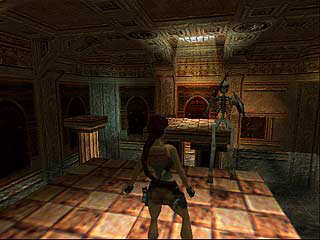
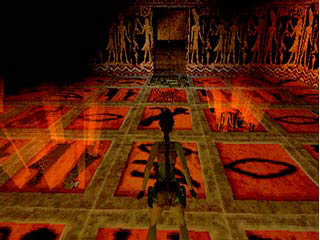
Let me begin by saying that I still disapprove of Lara’s build. Perhaps I’m a prude, but I think that the entire series would not have suffered at all if a more physically realistic female model had been used, and I would have preferred it. If this aspect of the game is ignored (and once I started playing, I found this very easy to do), The Last Revelation gets very high marks in the graphics department.
I was most impressed with the attention to detail in the game. For example, while firing your pistols, the shells from the bullets fly out of the guns, clattering to the ground … but if Lara’s standing near water, the shells actually splash into the water and sink. The integration of this effect is so seamless that I didn’t even notice it the first time; I found myself aimlessly firing my weapons just to see the effect. Lara’s ponytail is another effect that you have to see to believe–it moves when she does, just like a real ponytail would. If Lara’s standing in a breeze, her hair reflects the wind’s direction. (I tried to wrap it around her neck by turning in a circle in a stiff wind, but was unsuccessful–that would have been a very challenging programming effort, indeed) My only complaint with the ponytail effect is similar to the complaint I have with the blowing coattail effect in Nocturne–it was as if the blown object suddenly took on the physical properties of tissue paper, as opposed to something with more mass. An additional detail that took me by surprise was the moisture that drips off of Lara after she jumps out of water. The developer didn’t just turn on “drip” for fifteen seconds after she reaches dry land–the dripping rate actually decreases the longer Lara is out of the water. Bravo!
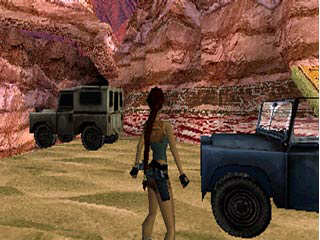 The character animation is also very well done. All of the actions that Lara performs during the game look exactly as if a real person were performing them … with the exception of running. What is so complex about running that makes animating it so difficult? When I run, my upper body moves up and down as my legs bend and extend (and yes, for those of you who read my review of Fear Effect, I still look silly while doing it). I don’t know how to run and keep my head from bobbing up and down, but apparently all of the characters in The Last Revelation have discovered this secret. I probably wouldn’t have noticed it if the rest of the motion wasn’t so picture-perfect.
The environments that are explored by Lara during the game are elegantly rendered, and in some cases, nearly historically accurate. My only issue with the architecture is that it appeared too new to be thousands of years old; I suppose that I should chalk the appearance up to the presence of the Egyptian spirits in the tombs and suspend my disbelief, but 2000-year-old tombs should be dusty, crumbly, faded places. Depth of field does not come into play very often, as most of the game is played within enclosed spaces, but when outside, I had no problems seeing far enough into the distance to make out new, unexplored structures.
The one part of the graphics experience that I found lacking was the in-game movies. When the game switches to these movies, as opposed to those movies that are regenerated using the graphics engine, the image quality was a few notches below “great” in my book. I think the compression factor used when these movies were generated was too large and should have been decreased. There aren’t very many of these movies, though, so it doesn’t take much away from the experience.
Overall Graphics Grade: A-
How Did it Sound?
Certain parts of the sound in The Last Revelation made a direct hit with me. For example, when Lara solves a puzzle and enters a new area, a brief symphonic epiphany accompanies her entrance. This feature had multiple effects on me; on the one hand, I felt like I actually accomplished something, and on the other hand, it added a certain cinematic flavor to the game. The music pushed my puzzle-solving attitude from attentive to enthusiastic, and really added something to the game. This same technique was used, with a snippet of foreboding tones, to alert you when enemies were approaching. Excellent!
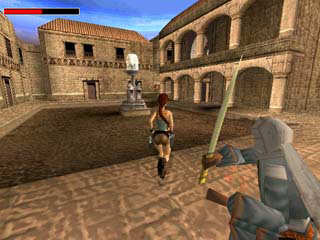 Overall, this is a quiet game, with very low background music. I’m not sure if I can even call it music–perhaps moody atmospherics is a better term for it. Most of the sound effects in the game are well above the ambient background tones, with a few notable exceptions. I discovered early in the game that certain objects, when set into motion by a lever or switch, made very little noise. Gigantic wheels, boulders, and other weighty objects simply did not make noise at what I thought was the appropriate volume, and it cost me in a number of occasions. I didn’t get the auditory clue that something had happened, so I painstakingly reexplored the area, only to find that the obstacle had already moved!
Probably the least satisfying part of the auditory experience was the voice acting. In fact, I think this is a global issue with gaming. I’ve started, and not finished, a number of pure adventure games recently, only to stop because the voices were done so inadequately that I couldn’t stand to listen to one more minute. The voice acting in The Last Revelation isn’t horrible, but there’s a definite lack of feeling in the actors’ voices. If the plot had been more involved, or there had been significantly more verbal sequences in the game, this might have had a larger impact on my opinion.
Overall Sound Grade: A-
Was it Fun?
As I stated above, this was my first experience with a Tomb Raider game. My initial reaction to the game’s controls was fairly negative; having recently played System Shock 2, I was extremely surprised to find that the mouse served absolutely no purpose! Lara is exclusively controlled via keyboard, which took some getting used to. My initial frustration with the keys eventually disappeared with practice, but it was apparent throughout the game that a hand-held controller of some kind would have been a better choice (I assume that the console versions of this game are not quite as difficult to deal with). My main problem was not dealing with the keys themselves, but with the combinations of keys necessary to perform different acrobatic maneuvers. I found it nearly impossible to perform a diving roll while “dashing,” and I did not master the standard roll until midway through the game. The most irritating aspect of the controls, however, was an error in the documentation–I found myself unable to get out of a jeep after one of the faster-paced action sequences. The key that was documented in the manual (the “End” key) simply did not work. It was only through a particularly helpful website that I discovered the correct combination of keys necessary (“Jump” plus “Left”) to leave the jeep behind, and I never would have guessed it myself. (I played the “Millennium” edition of The Last Revelation, so I am not sure if the standard release of the game also has this documentation error.)
Knowing the controls did not necessarily imply that I could do what I wanted to in the game. The standard actions, like jumping, crawling onto ledges, and activating objects, were executed perfectly. Swimming, however, was another matter. I consistently became stuck, and had to restore a saved game, while swimming through narrow areas. Additionally, swinging from one rope to another makes an appearance on my list of “most irritating game sequences of all time.” Although these actions do not occur very frequently during the game, it is still a crime to put a gamer through this level of annoyance.
The puzzles in The Last Revelation almost completely make up for the difficult control system. There are some truly exceptional puzzles in this game, including playing an ancient board game (Senet) and using an enemy to help you proceed. Many of the puzzles are of the standard “find the item and put it here” variety that exist in every third-person action-adventure game, but there are so many additional puzzle types that these are a welcome change. Another nifty type of puzzle present in The Last Revelation is the “don’t forget that your character can do that” type, requiring that your character swing along the edge of a flatbed car on a train instead of climbing the insurmountable load it carries. Some of the sequences in this game are truly difficult–without a walkthrough, I would have never been able to continue, simply because my mind was closed as to the possible solutions. “Think outside the box” became my mantra as I progressed, and in the process, I learned a few basic facts about the Tomb Raider universe that seasoned fans are probably fully aware of. (It didn’t take me too long to figure out that what you see in a mirror might be different that what you see in reality–big clue.) Having played adventure/puzzle games for twenty years, I found some of the puzzles in this game to be extremely refreshing and creative, while others were borderline impossible. The pleasure of solving these, though, reminded me why I like this kind of game in the first place.
Overall Gameplay Grade: B+
All told, I had a great time playing The Last Revelation, with the exceptions I listed above. In fact, I enjoyed it so much that I’ve purchased the first two games in the series (for the Playstation, though–hopefully I’ll be able to deal with the controls a bit more intuitively that way). There’s a minor amount of violence in this game–nothing much worse than what’s on Saturday morning cartoons these days, so it’s appropriate for most kids over age ten. (Many thanks to Mark Lawlor for helping me out of some tough situations, and to Stella for walkthrough hosting above the call of duty.)
Final Grade: A-
PC System Requirements: Pentium II 266 MHz Processor or equivalent without hardware 3D acceleration
Pentium II 233 MHz Processor or equivalent with hardware 3D acceleration
Windows 95/98 compatible computer system with
16MB of RAM (32MB recommended)
DirectX 6.1 or higher (included)
4X CD-ROM
4 MB Video Card
100% DirectX 6.1 or higher compliant sound card
Keyboard and mouse