Review: Timeline
|
Timeline Review Developer: Timeline Computer Entertainment By Randy Sluganski 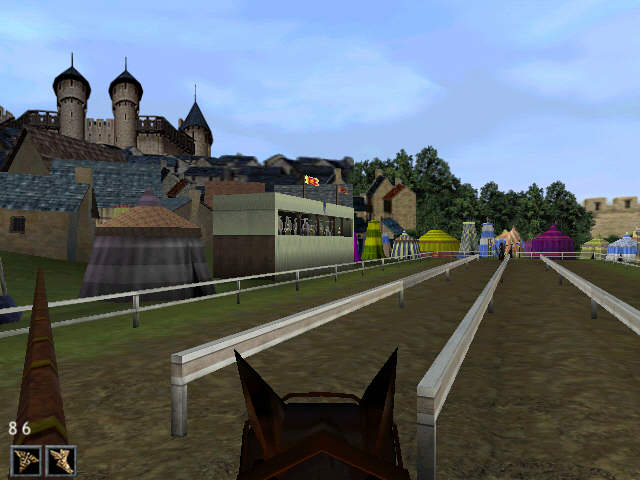 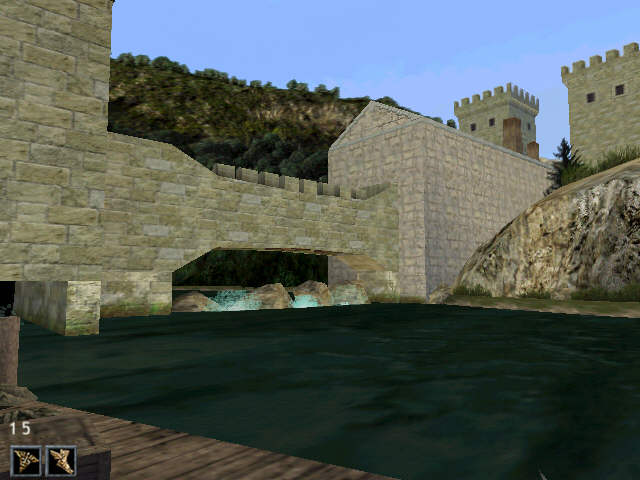  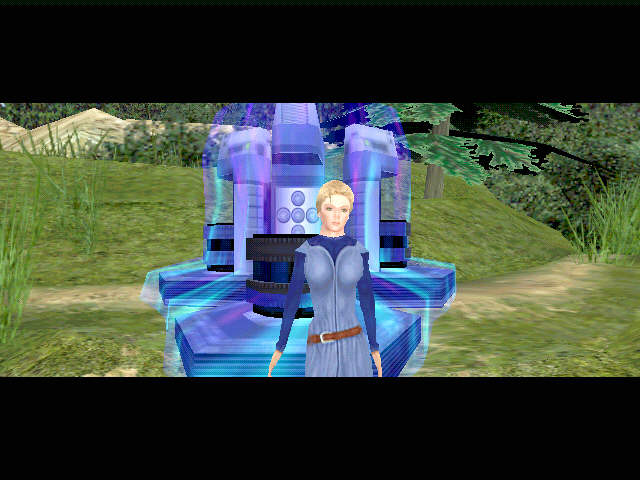 |
It is a proven fact that action gamers are suckers for eye candy at the expense of plot and theme. Medical research has shown that this myopia is the direct result of a lack of brain cells in the frontal lobe caused by one too many games of Quake and Doom. Adventure gamers, on the other hand, are not so easily appeased, and God pity the poor fool who tries to pull the wool over our eyes and substitute graphics for depth. But what does one do when the “poor fool” is one of the best-selling authors of our generation–Michael Crichton, the creator of Jurassic Park, Congo, The Andromeda Strain, and ER?
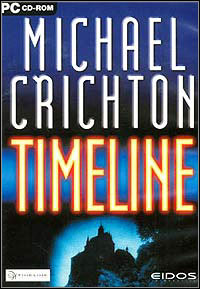
Crichton’s Timeline was one of the best-selling novels of the past year. Imaginative, yet soap opera-ish, it was a story that begged to be made into an adventure game. A team of archeologists, working on a large excavation in the Dordogne region of France, discover they can time-travel back to fourteenth century feudal France. And travel they must, for the dig’s leader, Professor Johnston, has mysteriously disappeared, leaving behind a videotape disclosing his whereabouts. Now you must rescue your professor amid a perilous world of knights, jousts, castles, and dungeons. Shades of A Connecticut Yankee in King Arthur’s Court, this is the stuff of classic literature and, with any luck, adventure gaming.
Now, if you have an hour or two to kill on a lazy afternoon, then Timeline will fill that void. Your eyes will be dazzled by the graphics, your senses stunned by the realism, and your pocketbook violated. Not only is this the shortest game I have ever played, but it is also the most dumbed-down. It is one thing to purposely structure the game to attract new gamers, but quite another to actually provide solutions. As if you have not already guessed that your next step should be to visit the inn, especially after a townsperson and your partner have both told you this, you are then reminded in no uncertain terms what to do next when your screen flashes the following message, “You should now visit the inn!” Uh … thanks. This is truly adventure gaming for the Beavis and Butt-head generation of gamers.
If you have read Timeline, then be informed that the game follows the plot of the book exactly–only with fewer characters. If you have not read the book, don’t despair, for it is included in the box with the game. In fact, if you can find Timeline in a clearance bin for about $10, then you will have found a real steal, especially since the paperback retails for $7.99 plus tax.
After undergoing the shortest training period in gaming history, you are then transported to fourteenth century France. You first step, after one of the members of your party is slain, is to slide down a slope to the castle area. There are historical reasons for the location of the castle and the slope, but we will discuss those later when we explore the tutorial. Since the game is played from a first-person viewpoint, all you see in front of you as you slide down the hill is the mud. And the boulders you have to avoid. And the apples you can pick up for an energy boost in case you have crashed into a boulder. You can even make yourself slide faster or slower! What an innovation. Wait a minute, didn’t I do this same thing three years ago, only with better sound effects and more excitement, in Crash Bandicoot?
It is all downhill from here. The puzzles are not puzzling, the action sequences–which include a joust, a bow-shooting competition, and a horseback ride–are of a difficulty level befitting arthritic senior citizens, and any urge to explore is hindered by a restriction on your character’s movements. Death will come often, as certain jumping puzzles are impossible to navigate, but in this game death is a welcome choice.
About halfway through the game–or in gaming terms, thirty minutes later–I decided to experience the interactive tour of the Timeline world, narrated by Michael Crichton. The tour was without a doubt the best part of the game, as Crichton explained the layout of the castle and provided detail that brought the game to life. At times, he even discussed why certain aspects veered from historical reality in order to compensate for artistic imagery. I then returned to the game only to find that all of my saves had been overwritten by my guided tour. It was at this point that I decided I was glad that the weapons in Timeline were all nonviolent–the arrows and swords you wield only stun or shock your enemies into submission–because for some strange reason I had a sudden urge to prod the Timeline creative team in their buttocks.
There is a time, though, when realism in a game can be taken too far. Such an instance would be when the inhabitants of the town of all speak in their native French tongue and the only way to understand them is when your partner translates their conversations. Obviously, the Timeline creative team considered it too much of a stretch to believe that the average gamer could still imagine that the game was set in the Middle Ages of France if the citizens spoke English. Luckily, I had just returned from a visit to Cryo-Networks in France when I played Timeline and thus was able to fluently translate. Now call me crazy if you will, but I overheard two knights in a corner whispering, and I swear they pointed at me and then giggled in French, “Yes, zat is ze dumb bastard who paid $40 for zis game.” As stated previously, sometimes realism can be taken to extremes.
Final Grade: D
If you enjoyed Timeline:
Play: Knight’s Chase
Watch: A Connecticut Yankee in King Arthur’s Court
Read: Timeline
System Requirements:Pentium II 266 MHz
3D video card with 8 MB memory
64 MB RAM
Windows 95/98
4X CD-ROM
600 MB for installation
DirectX 7 or higher
Brief Interview with Michael Crichton
Was Timeline written with the express goal of creating a software company and game from the finished product or was it just an afterthought?
The game company was started in 1997, almost a year before I began writing the book. The company was created to make all sorts of games, and the first year was spent on the rendering engine and the authoring system. Then when I wrote the novel Timeline, which appeared two years later, we decided to make a game of that. It seemed like a good idea.
How do you plan to handle future episodes in the Timeline series; will they be available in book form first and then as a computer game, or do you foresee some as book-only or game-only projects?
I won’t write more Timeline books. I expect there will be more games.
Does Timeline Computer Entertainment have the options to only future Timeline projects, or does the company have the rights to transfer some of your past novels (Coma, Jurassic Park, etc.) into game form?
We may do game versions of some old projects, but for the moment I am looking forward to new things. Several of the old projects, such as Jurassic Park, have already had games made from them.
How much input did you have into the Timeline game as compared to previous games produced from your writings, i.e., Congo, Trespasser?
I had nothing to do with any previous game such as Congo or Trespasser; most of them I have never seen. I was very involved with Timeline. I spent most of the past year working on it.
What eras of history would you like to cover in future Timeline projects?
It’s my longstanding policy never to talk about future projects. I have a pretty clear idea of where to go next, though.