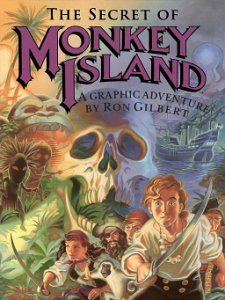
Review: The Secret of Monkey Island
|
The Secret of Monkey Island Developer: LucasArts |
Here I sit, still waiting for my copy of Grim Fandango to arrive. Meanwhile, I had ordered the LucasArts Classic Adventures, too, and got them already, so I thought I would pop them in and see what was what. Out of the five games included on the diskettes (yes, it’s true–diskettes!), I had only played Loom before and so had a pretty good selection. I chose to start with The Secret of Monkey Island because I had enjoyed Monkey Island III (The Curse of Monkey Island) so thoroughly. (It seems as if I am always playing more recent games in series first and then going back to the older ones.)
You are Guybrush Threepwood, pirate wannabe. As the game opens, you find yourself at the lookout point of Mêlée IslandTM. You talk to the lookout to find out where to go to learn how to be a pirate. He directs you to the SCUMM bar, where you get three missions to complete from three disreputable, grog-drinking, “important looking pirates.” You also learn that the pirates are unable to ply their trade because the ghost pirate LeChuck has been patrolling the nearby waters, hoping to make off with the toothsome Governor Elaine Marley. In the course of completing your pirate training, you meet and fall in love with Governor Marley, and as you have just finished your last quest, LeChuck kidnaps her and makes off to Monkey Island. You vow to rescue her, assemble a crew, and set off for Monkey Island. There, you must befriend a castaway, a monkey, and some cannibals to further your mission; when you have obtained what you need, you descend into the bowels of hell to destroy LeChuck and reunite with your sweet Elaine. LucasArts has never skimped on plot, even if it is not deeply philosophical stuff, and this game had a lot of laughs–I give the plot an A.
The interface is one of those where you get a list of verbs at the bottom of the screen next to the list of your inventory. When you move your cursor over an object that you can interact with, an appropriate verb is highlighted, so at least you don’t have to try all of the verbs on everything. Sometimes the highlighted verb is not the most appropriate, but you still don’t have to try them all; it’s pretty intuitive as to which one to choose. The game plays like every other LucasArts game I’ve ever played; you mainly learn things from conversing with characters, pick up inventory items, and use the inventory items either with other items or at other locations to accomplish given tasks. What I like second-best about LucasArts games is that you can’t get stuck; if you neglected to do something and then move past it, you can always go back again, and the program won’t let you progress to the next phase if you haven’t completed the earlier phase. (What I like the best is that you can’t die.) Gameplay gets a B+ instead of an A only because I prefer the more modern style of games without the verbs.
This is a cartoon game that was released in 1990. (In fact, the credits on the game referred to one of the developers finally getting a 286–that brings back memories to us geezerly types.) The graphics by today’s standards have some mighty big pixels, but I could tell what everything was, unlike in some other older games with big pixels. In extended conversations, LucasArts employed the very-little-or-no-movement kind of closeups of the characters, but there were only about five instances of that. The backgrounds were very well-drawn in inimitable LucasArts style, and integration of the character movement on top of them was seamless. If this was still 1990, I would give the graphics an A, and I don’t think it’s fair to penalize them for the vast advances in personal computers since then, so I will let my A stand.
There is no voice acting; you have to actually read the words. The music has a Caribbean feel; lots of instruments that sound like kettle drums with a reggae flavor. I really like it, but there is not enough of it, due to the limitations of floppies, I guess. There were also not very many sound effects, and what there were sounded like they had not completely made the transition from being designed for those tinny built-in PC speakers. (I’m kind of surprised at the quality of the music, in fact; I don’t remember sound cards and speakers being available in 1990–they must have been, though, or else why would LucasArts bother with music?) I give this category a B; while the music is great, the sound effects bring down the grade.
I got a lot of pleasure out of playing this game, but it was quick. I have played quite a few LucasArts games and have a good feel for how they work, so I probably spent about six hours total on this game with no hints. Actually, that’s pretty good, considering that all five of the Classic Adventures only took up seven floppies. I enjoyed it a lot, especially the humor. I also believe it holds up quite well in these Pentium II, 24X CD, 16-million-color-monitor days. Overall, I rate the game a B+ and would recommend it to anyone who enjoys LucasArts games, or for that matter, anyone who has never played a LucasArts game. I know some folks take their gaming pretty seriously and play only serious games–they probably don’t like LucasArts games much–but I say gaming is supposed to be fun, and this is a fun game.
P.S. As I was writing this, the UPS truck drove up, bearing my Grim Fandango, so I’ve gotta go now.
Final Grade: B+