Review: The Legend of Zelda: Majora’s Mask
|
The Legend of Zelda: Majora’s Mask Developer/Publisher: Nintendo By Mike Schwab 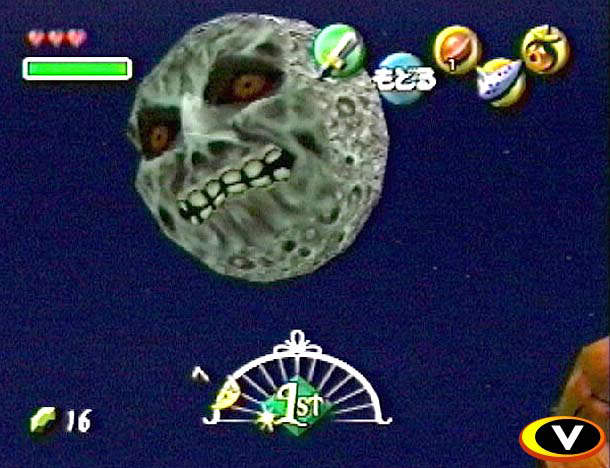 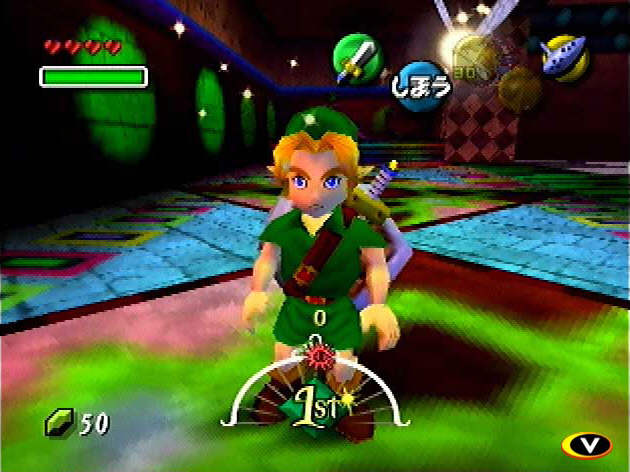 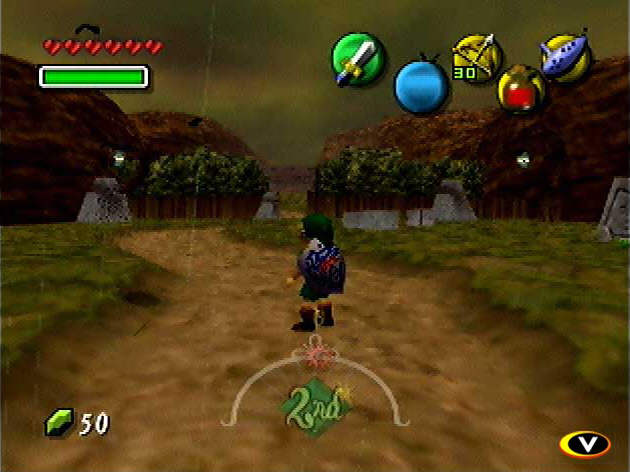 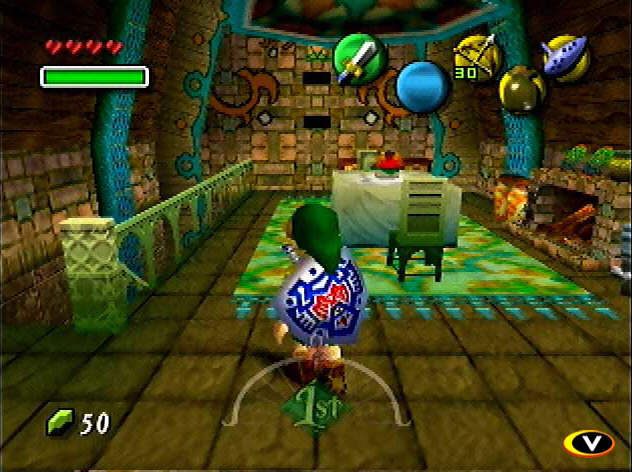 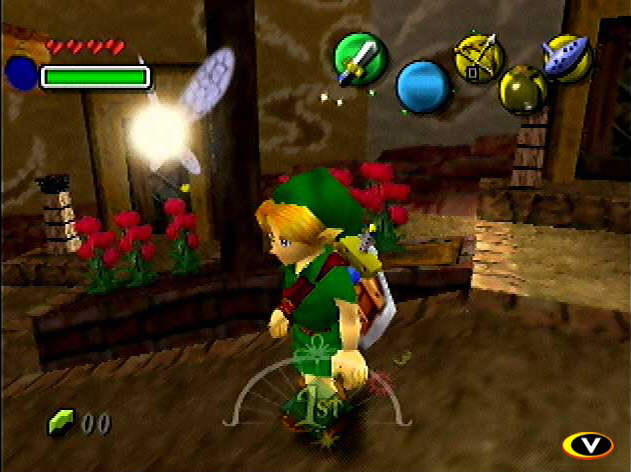 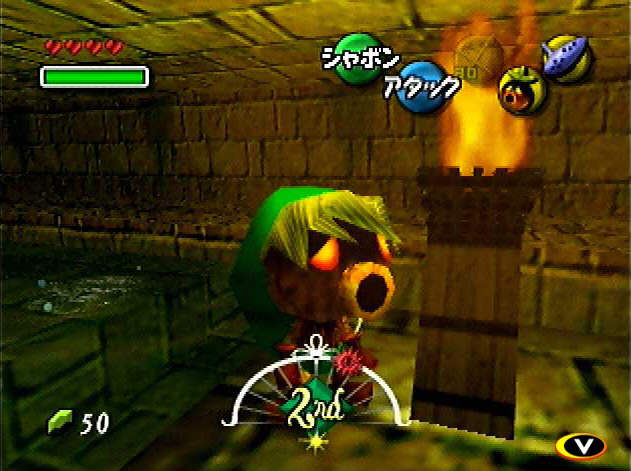 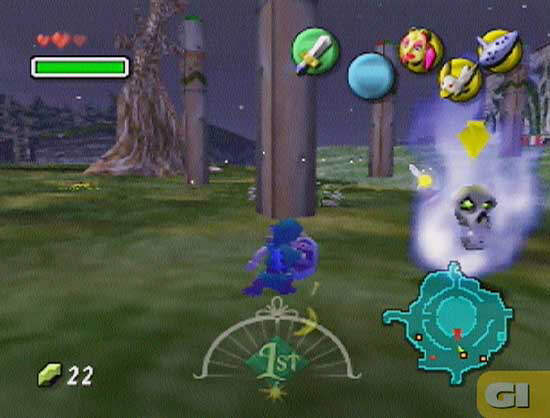 |
If you’ve ever seen the movie Groundhog Day or any of the Back to the Future films, you’ll feel right at home in Nintendo’s latest offering in the Zelda series, The Legend of Zelda: Majora’s Mask. The game takes place over a 72-hour period, which you will relive again and again and again until you’ve saved the proverbial day. However, unlike Bill Murray’s unfortunate character in Groundhog Day, you’ll yearn for the chance to return to this enchanting world, where political intrigue and remarkable characters and places surround you.
In short, the story proceeds this way. An evil “skull kid” drags our hero, Link, unwillingly into another world by stealing his horse and his ocarina. In this other world (named Termina), it seems the moon is falling. Yes, it’s literally falling down out of the sky towards nearby Clock Town, and in three days’ time–boom, Clock Town is history. This is all happening because Link’s nemesis has stolen an artifact called Majora’s Mask, and its sinister power has transformed him into quite an evil being. Your job is to get the mask back before the three days is up, thus ending the curse and saving the town.
You’ll find the village of Clock Town quite amazing in and of itself. The complexity of plots, conspiracies, and events occurring between all of its inhabitants is a bit overwhelming. Luckily, you are provided with a notebook to help keep track of it all. Each citizen of Clock Town does his/her own thing, and you’ll see the people walk back and forth between stores and houses. Depending on what time you are coming through, you always have a chance of meeting someone new and possibly obtaining some new information.
Time is one of three major features of the game, and it is real-time, albeit extremely truncated. An average day in the game will last about 18 minutes or so, and to help you keep track there is a clock located on the bottom of your screen at all times. I am usually scared off by the advent of time limits–time limits in general restrict your freedom and deter exploration. But the time limit is Majora’s Mask is much different; it adds an entertaining new twist to the gameplay. Early on in the game, Link manages to get his handy Ocarina back, and with it he can play certain tunes that affect the world around him. Within his repertoire is a valuable song that allows you at any time to save your progress and start back at hour zero. It might sound contradictory, but you use it quite a bit. It would be tough to finish this game in 10 three-day cycles; in only one, it’s impossible.
Time plays a larger factor than just providing an ending to the game. You’ll find out quickly that most of the events and people around you are time-sensitive as well. Some examples of this might include meeting someone at exactly 5:00 pm, waiting for the mailman to deliver the mail at precisely 8:00 am, or visiting a certain shop that is only open between 9:00 pm and 11:00 pm. In addition, there are certain areas of the game that you cannot access until day two or three, which reduces your available time to finish some tasks. Time will affect nearly everything you do in Majora’s Mask, and Nintendo has done it in such a clever way that you can’t help but smile while solving the puzzles around you.
Previously, I mentioned Link’s ocarina, and in case you weren’t aware, this is a flute-type instrument. Princess Zelda gave him this very special ocarina in the first N64 game, and it proves to be equally valuable in the sequel. The ocarina produces the next major feature of the game–songs. All told, you will learn around a dozen songs during the game, each with its own unique purpose. Some will help you affect the flow of time, as mentioned before, and others will help you influence the major characters of the game. Two things are certain, however–you will need these happy tunes to finish the game, and you will inevitably be humming these same tunes during work the next day (I’m still not sure if this is good or bad!).
Masks, not surprisingly, are the last integral part of Majora’s Mask. Throughout the game, there are 24 in all, but you’ll only need a select few to actually finish the story. Usually they are gifted to you for specific accomplishments, and you’ll find that with the acquisition of most new masks, new “doors” within the game will open. A few select masks will temporarily change Link into a different creature, which also allows for progress in new areas. The mask idea was first introduced in The Legend of Zelda: The Ocarina of Time, but it plays a much more prominent role here.
The graphics in this game are quite striking. Beautiful coloring and effects are everywhere, and with the large size of some areas, it’s hard to believe the game runs as smoothly as it does. Some areas in the distance can become fuzzy, but this is a minor fault that doesn’t affect gameplay much at all. The world is fully 3D, and with the addition of real-time and changing day and night cycles, the immersion factor is at an all-time high. The worlds that Link travels through are complex and intricate, with varying degrees of difficulty. The first world you visit seems to only whet your appetite, as it is fairly linear, but as the game progresses the terrain becomes more challenging and levels more elaborate. Before it’s all over, you’ll see thick swamps, snow-covered mountains, sandy beaches, underground dungeons, and more.
Gameplay in Majora’s Mask is rich and detailed, as is the case with most of Nintendo’s major titles. You will almost never be completely stuck, as there seemingly are always other places to go or new things to try out. I finished this game in a somewhat standard period of around 30 or 40 hours, and even though I completed the endgame, I left many objectives unfinished within the town and the four major areas surrounding it. To be honest, I was surprised so much could be left undone while still being allowed to “finish” the game. But in the end, that’s the beauty–just like Fight Club, you decide your level of involvement. I’m sure the game could easily be stretched out into 60+ hours if you decided to complete everything.
I have a difficult time finding any faults with Majora’s Mask–it’s challenging, fun, and well-designed. The one beef I can come up with is the “kiddie” factor. I fully admit that, being 32 years old, I often felt silly playing this game because of the some of the cutesy characters and overly happy music. This is a minor thing at best, and being a big Nintendo fan, I’m quite used to it by this point. I’m also used to that strange look my wife gives me when coming into the TV room.
For you adventure purists, I feel obligated to tell you that there are several situations that require action, namely the cliched big “bosses” in each major area of the game. To this I say: get a grip, you can do it. But seriously, to ditch Majora’s Mask for this reason would be a shame, mainly because the majority of the game is spent thinking through scenarios and exploring the vast areas of Termina. This is the ultimate adventure for someone like me. I only wish other companies were making games as well as Nintendo made Majora’s Mask.
Final Grade: A
If you liked The Legend of Zelda: Majora’s Mask:
Watch: Groundhog Day, Back to the Future, The Mask, Meteor
Read: The Time Machine
Play: Any of Nintendo’s Zelda series