Review: The Legend of Lotus Spring
|
The Legend of Lotus Spring Developer: Women Wise
|



Space Ghost: Ray and Darcy, can you give the audience a little background regarding this new major release?
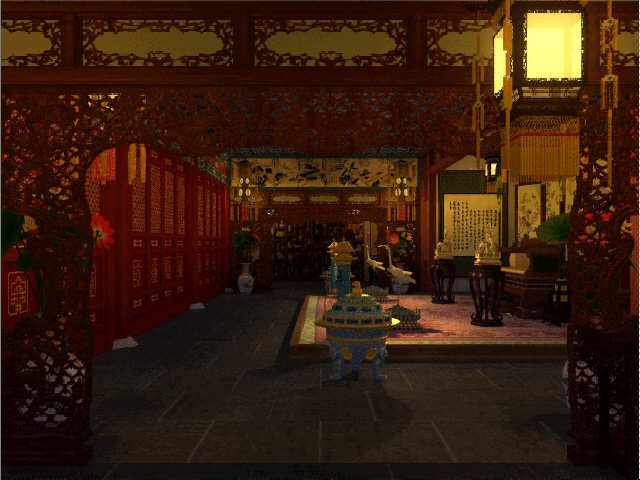
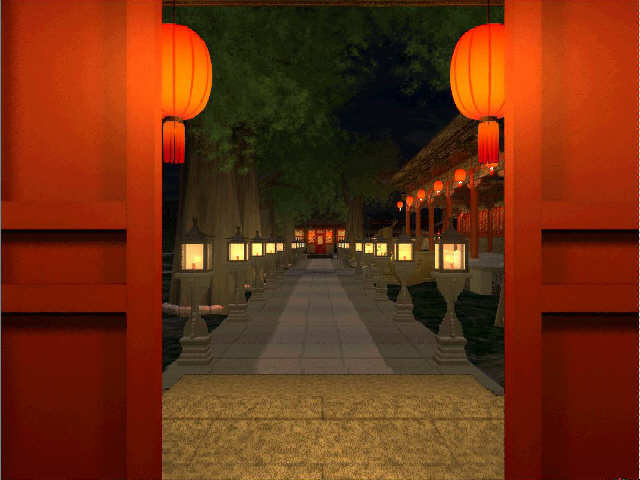
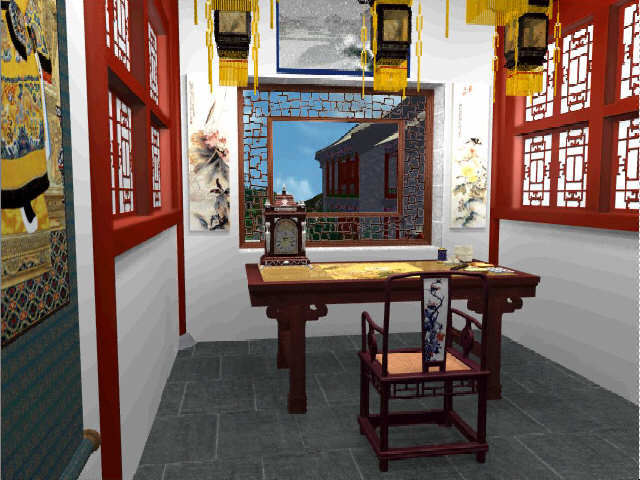
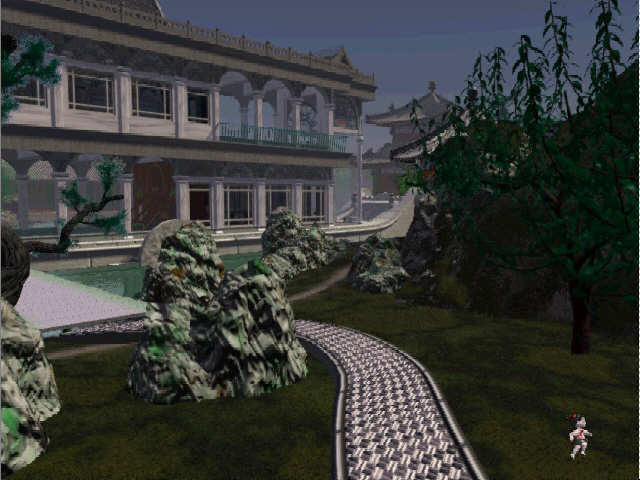
Darcy: The Legend of Lotus Spring, the latest in a series of adventure gaming titles published by DreamCatcher Interactive, tells the hundred-year-old story of a romance in pre-20th century China, and was created by the developer, Women Wise, in coordination with historians to accurately and in detail fashion a duplicate of the world these people lived within, using original construction plans and historical documents including diaries, paintings, and photographs, and it succeeds at bringing this slice of history back to life for the player.
Ray: As the first title from Women Wise and published by DreamCatcher Interactive, this game is being billed as “the first digital media entertainment package directed specifically at women.” I’m a guy, but, shockingly, I played it. So sue me, I like DreamCatcher, you think I could skip one of their new titles?
I’m glad to read the above description of the title, actually. “Digital media entertainment”–that’s indeed what The Legend of Lotus Spring is. As opposed to a “game.”
Darcy: Be prepared to immerse yourself in a portion of the history of China, as well as its music and overall feel. The pleasure of being able to even just walk around in an environment painstakingly recreated from historical documents is truly astounding and worth the price of admission. The story itself is based on historical fact and still maintains a great measure of adventure game ambiance despite the significance of truth the story carries with it.
Space Ghost: So this is an entirely new direction in the adventure gaming genre?
Darcy: Qin is the only gaming title that even remotely comes to mind with any similarity at all, and this is only a cultural similarity. This game is truly original. There are no spaceships to navigate. Nothing jumps out at you. There is no equipment that I have to drag my husband over to the screen to explain to me what it is or what it looks like and how it works or how he thinks it works. I’m not stupid, I don’t understand these things because I don’t want to understand them or I would. This is what men are for.
Space Ghost: So, Ray, you’re disappointed with the lack of full game elements?
Ray: Don’t panic Space Ghost; this isn’t really a complaint. Let me explain. Lotus Spring is a title that the players could have wildly different reactions to, depending on their expectations. If they are looking for a game chock full of puzzles, dialog, and general adventure game problem-solving, they will be sorely disappointed with this game.
However, if they are willing to meet Lotus Spring on its own terms, it can be very rewarding. We’ve often described many of our adventure games as “interactive fiction.” Well, I suggest that this product is a new animal entirely. I would describe it as “interactive poetry.”
Space Ghost: Sounds intriguing. How about you two sharing with us a little more of the background of the story itself?
Ray: Superficially, the story of the game involves your character, the young Chinese Emperor Xian Feng, and his forbidden love with a Han woman who he renamed Lotus Spring. Xian Feng is returning to the garden paradise where he and his doomed wife shared their love, in an attempt to discover what has happened to her.
Darcy: It’s a story of the true-life romance that occurred in the autumn of 1858. The gameplay takes place in a loving and painstakingly recreated Yuan Ming Yuan, or Garden of Perfect Brightness, a garden that, in actual fact, was destroyed by fire a scant two years after this story during the second Opium Wars and that, after being set on fire, burned for three days and three nights, truly a loss for history.
Space Ghost: So what kind of puzzles and/or interactive elements does Lotus Spring contain?
Ray: The “game” simply consists of wandering around the beautiful garden and interacting with mementos from Lotus Spring’s life. The “puzzles” are so light as to almost not be there. But in this game, that’s not really the point. This game is about exploration and discovery, not puzzle/problem solving.
Darcy: You can explore all you like, but the game follows a very linear story, and unless you follow that path in the correct sequence through the garden, you’ll have some difficulty progressing forward through the game. I myself like the open access of being able to fully explore the environment rather than being in a place where there are only two rooms open and I’m stuck, so this was definitely a plus. You are given clues as to the direction to take and gently guided through the garden by a series of paths that, I’m assuming, mirror the original garden.
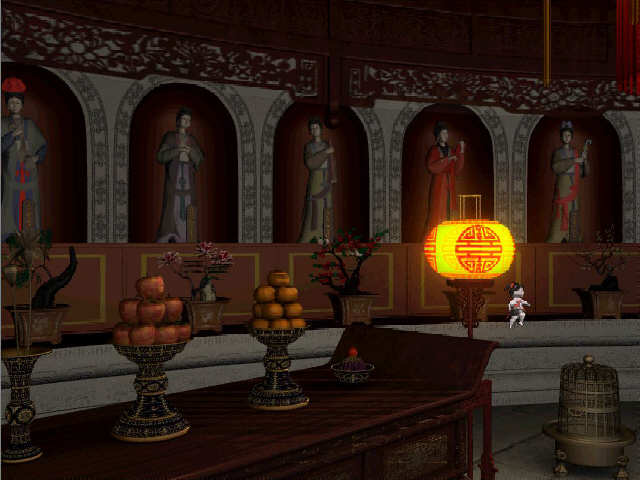
Ray: Everything about Lotus Spring is poetry. The graphics are beautiful, often heartbreakingly so. Especially lovely are the animations you trigger during your explorations. Some of these are so remarkable that they bear repeated viewings.
Darcy: There are slight inventory-based puzzles that reward you with details about the story or an animation. There are only six inventory items to collect, and these are shown in grey outline prior to collection at the beginning of the game when the inventory area is accessed.
Ray: Along the way you learn much about the life of these two young lovers, as well as much about the culture and history of their world. As you move through the game, you gradually fill up a diary with memories.
Darcy: There is a lot to look at and examine. Activities result in rewards of animations and added pages in the book. To the seasoned gamer this would be a bit disappointing, but to those that enjoy visual games with the accent on the immersive environment, to wander around in this would be right up their alley. This style of gaming is reminiscent of the games done by Japanese designer Haruhiko Shono, who made L-Zone, Gadget, and Alice, which were all pretty much click-through fests, although in Alice you were to find and collect a full deck of cards, a bit more task than the others. And this is more similar to Lotus Spring as there is a story here to be found out and told, and tasks to be done to accomplish this.
The way in which accomplished tasks are interwoven within exploration is quite clever and unusual. You’re never hit over the head with what needs to be done next, and this subtlety I found quite refreshing. The veteran gamer may not realize in just the normal course of exploration that he/she’s accomplishing game goals right off the bat, due to the seamlessness between story design and task. Tasks to accomplish are written as a subtext to the story and graphics, and this flows right along with the style of design and subject matter. If one is not careful, this is a point that could be missed on the experienced gamer, ever looking to be hit over the head by a sliding puzzle blocking the next doorway.
Space Ghost: What did you think of the graphics?
Darcy: Actually, Space Ghost, I was pleasantly surprised to find the graphics gently feminine without being condescending. The prerendered scenes are visually stunning. Navigation is quite intuitive. The animation is spectacular eye candy–we are definitely moving to the next level in graphics for adventure games, and this is a particularly good feat for Women Wise, which has managed, despite the arduous number of months and years it customarily takes to develop a game with any amount of depth and breadth, to have a fresh polished look that obviously took a good while to accomplish without the graphics looking dated.
Ray: Another element of the game I liked is the cursor: it’s a little Chinese doll! It frequently comes to life when interacting with an object.
Darcy: Definitely the most clever cursor I’ve seen since The 7th Guest and quite an unusual switch from run-of-the-mill adventure games. There was also a particularly thorough and satisfying endgame sequence.
Space Ghost: How’s the music? I’m assuming we’re not looking at a heavy metal score here …
Ray: The music is absolutely gorgeous and adds greatly to the dreamy atmosphere.
Darcy: I thought the music, while being extremely well-produced and atmospheric, played in short, repetitive loops and in some game areas became redundant. However, the exactness with which this was obviously written and/or chosen helped to create an overall soothing mood in each area of the game, necessary to bring about the sensation of actually stepping into a faithfully-recreated-from-historical-fact garden.
Space Ghost: Any drawbacks you two kids noted in playing?
Ray: Playing The Legend of Lotus Spring is like falling into a heady, moody, beautiful, romantic dream.
I have to rouse myself from the dream, however, to make one significant complaint about this title. This one is a sore point with me. Ray’s Game Rule #3843: All games must have an ending.
Now, don’t get me wrong, I don’t need all my endings to be tied up neatly. I don’t mind elliptical narrative at all. When I mean ending, I mean this–at some point, when you’ve done everything you can in the game, the game needs to tell you that you’ve completed it. Final animation, roll credits. Something.
Unfortunately, like Comer, Lotus Spring just … stops. No ending, no credits … you’re stuck in that damn beautiful garden forever. This would be an easy problem to fix, and I wish DreamCatcher would have insisted on it.
Darcy: On the Mac end of things, animations were sometimes choppy, videos would cut out despite my Mac meeting the game’s recommended system requirements. I encountered one script error, but to its credit the game didn’t dump out or quit despite these. There is also, I am happy to report, only one disk swap, in a two-disk game, although you must start with the first disk each time you play.
Ray: Also, there seems to be a QuickTime issue with the game. I had trouble with audio dropping out during animations. At press time we were informed by DreamCatcher that this problem can be easily solved by making a minor adjustment in your Quick Time menu.
Space Ghost: Final thoughts?
Darcy: Women Wise has produced a title that captures the heart as well as stimulates the mind, with breathtaking, elegant style and rich storytelling. There is quite a bit of rich historical detail to be gleaned, which makes this a good title for teenage girls, but it also satisfies anyone that is interested in a game with greater depth in its story, rather than just moving from one scene/puzzle to the next. Accolades go to Women Wise for smartly developing this for both PC and Mac.
Ray: If you leave your expectations behind and approach The Legend of Lotus Spring as a new kind of interactive experience, it can be quite rewarding.
Darcy: Additionally, purchasers will be able to download a novella of the story by Carolyn Williams from the I Read Romance website for free.
Space Ghost: Okay, so all that said, what kind of a final score does Women Wise’s freshman title garner?
Darcy: I give it a final grade of A- for the stunning design and story detail, with a half a point taken off because my personal taste in puzzles is a bit harder than dished out here.
Ray: Final grade is B.
Note: You can download a PDF file of the Lotus Spring novella from Women Wise’s web site.
System Requirements:
Mac:
OS 7.5 or higher
90 MHz Power PC, 150 MHz recommended
16 MB RAM, 20 MB recommended
10 MB hard drive space
4X CD-ROM drive, 8X recommended
640×480 display, thousands of colorsPC:
Windows 95/98/NT
100 MHz Pentium, 166 MHz or faster recommended
16 MB RAM, 32 MB or more recommended
10 MB hard drive space
4X CD-ROM drive, 8X recommended
640×480 display, High Color
Windows-compatible sound cardSystem Configuration:
May require minor adjustments to the configuration of your operating system and/or updates to some hardware component drivers.