Review: Star Trek: Hidden Evil
|
Star Trek: Hidden Evil Developer: Presto Studios 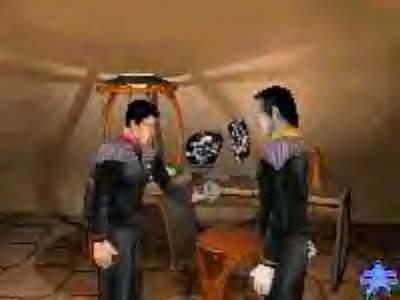 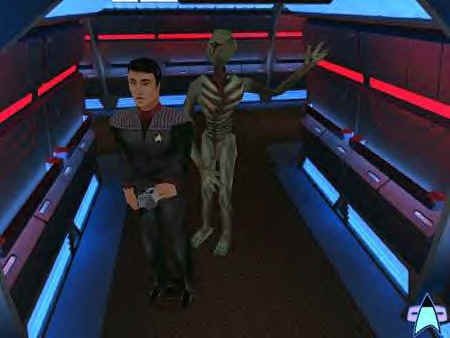 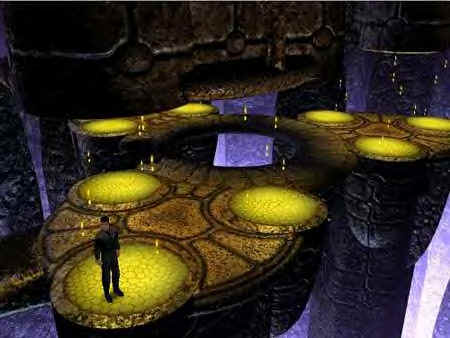 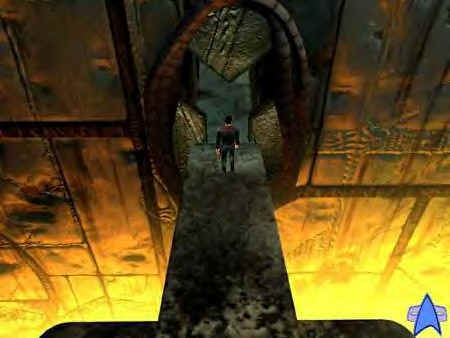 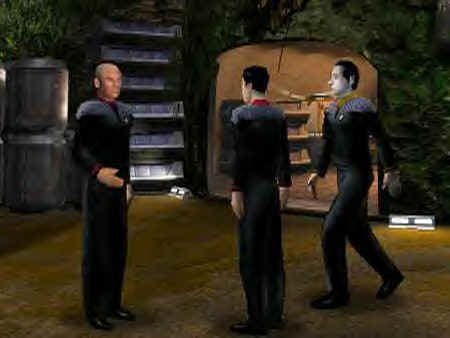 |
The recent trend toward brevity in adventure games is encouraging, yet at the same time disheartening. Encouraging because even though smaller budgets and tighter production schedules are producing games that can be completed by experienced players in under a week, if not a day, novice or first-time adventure game players will be drawn by the budget price and easy solvability of these games. Whereas a first-time player might be put off by the complexity and length of a Gabriel Knight 3, the same gamer might unknowingly appreciate the gentle easing into the genre by a game comprised of simpler puzzles. Disheartening because games like Star Trek: Hidden Evil have so much untapped potential that while a newbie can ease into this game and leave it feeling satisfied, experienced adventurers will be discouraged by this brief, but enchanting, voyage into an uncharted galaxy known as Star Trek Lite and will find themselves humming not the familiar snatches of the Star Trek theme song, but instead refrains of Peggy Lee’s Is That All There Is.
Presto Studios, renowned for its excellent Journeyman Project series of graphic adventures, was tagged by Activision to create a product for the casual gamer based on the Star Trek mythos. It had to be mission-based, it had to be easy, and it had to be on store shelves by Christmas. On this basis, they have succeeded on all fronts. If one keeps in mind that Hidden Evil is aimed at a market that would normally be intimidated by a Trek game based on its implied complexity and prolonged play time, then Hidden Evil more than delivers what it has promised: a solid, immersive adventure game for a budget price. If you are a hardcore adventurer, unless you are a Star Trek fan or a collector, then Hidden Evil will only serve to whet your appetite until something more substantial is released.
Hidden Evil picks up nine months after the events that occurred in the 1998 film, Star Trek: Insurrection. (I find this an interesting choice, for if you are attempting to attract the casual gamer, might they not also be put off by a game based on a movie they may not have seen or mistakenly believe that the game is only a recreation of the film?) Your alter ego for this mission is Ensign Sovok, a rookie cadet assigned to the Federation outpost protecting the planet Ba’ku. Sovok soon joins Picard and Data on a seemingly routine mission to investigate some artifacts from an unknown culture that have been unearthed during a dig to construct a new colony. The remainder of the Enterprise crew is conveniently written out of the story by remaining aboard ship while it undergoes routine maintenance. This fact-finding mission quickly develops into (and if you didn’t already suspect this, then you’ve never seen an episode of Star Trek) a full-blown crisis, and you’ll soon find yourself dodging phaser blasts and applying your Vulcan Nerve Pinch to the baddies. The plot is well-paced and self-contained and does a good job of imparting the “feel” of the series. Though not epic in scope, as we have come to expect from the Star Trek franchise, this is one instance where the intimacy of the plot allows us to concentrate on the characters and not their gadgetry. Story grade: B-.
The action and puzzle aspects of Hidden Evil have been simplified. Maybe too much. Auto-aiming allows for the combat impaired (such as me) to easily lock onto any target. In concession to the adventure gamers, damage to your character done by the enemies has been minimized while your phaser strength is set at high. The larger problem in the action sequences is mastering the keyboard-only game controls. On the flip side, the puzzles are constructed so as to not frustrate the novice or action player. This is not to say that they are overly simplified, but they have been kept within the context of the story (would that more adventure games would follow this “novel” idea). Astute use of your tricorder and the ability to find and disable a shield generator or activate a transporter tends to evoke a higher degree of involvement in the Trek universe than is usual in most games. A familiarity with the characters and their gadgetry is helpful, but the game has been constructed so that the nonfan can glean the necessary information without the usual intimidating techno-babble. Another nice touch is that you cannot walk or fall off the edge of a cliff (-cough-Indiana Jones and the Infernal Machine-cough-). Overall, the gameplay and puzzle solutions are extremely linear, as the emphasis is on creating a relaxed and fun atmosphere. Still, a lessening of the “dumbing-down” factor (will the European version of Hidden Evil be harder?) would have earned the puzzles a higher grade than a C-.
Hidden Evil uses 3D polygonal characters against 2D pre-rendered backgrounds. Though the polygon count is occasionally low, the overall effect is outstanding, and the real-time movement animation provides a splendid contrast to the beautiful backgrounds. Everything is viewed from a third-person, fixed perspective. The camera angles are preset, but there is not the constant repositioning that was prevalent in Nocturne. Picard and Data are easily recognizable, and the addition of their mouths moving with the dialogue (though not always in sync) is a nice addition that immensely increases the immersion factor. The cut scenes are done through the judicious use of the in-game engine, and footage from the movie has also been appropriated. Nothing spectacular, but a solid, colorful effort that perfectly conveys the required otherwordly atmosphere and earns a grade of B-.
The voice acting for Hidden Evil is superb, as it should be considering that Patrick Stewart and Brent Spiner have reprised their roles from the series. The familiarity of their voices adds a lot to the character recognition. The talk interface for the game is simple; there are no branching dialogues, so you never run across any of those strangely inflected responses that you receive by asking a question out of order. Sound effects and music are both stellar. Soundtracks in games have had a banner year with Outcast and Omikron, and though Hidden Evil does not approach those lofty heights, its score does add immensely to the overall gaming experience. The music and sound effects are splendid and highly evocative of the long-running series. If you were to only hear the audio portion of this game coming from a room, it would be easy to mistake it for an actual episode of the series. Grade: A-.
One naturally wonders how much better this game could have been had Presto Studios been allotted more time and budget. Considering that it is aimed at the casual gamer, it is a solid product worth recommending. The hardcore audience won’t find much to dislike, but neither will they find a product that they can sink their teeth into. Consider this one small step for Presto Studios and one giant leap for the Star Trek adventure franchise.
Final grade: B-.
Download the Hidden Evil demo here.
System Requirements: Pentium 200
32 MB RAM
4x CD-ROM
Windows 95/98