Review: Space Quest VI: The Spinal Frontier
|
Space Quest VI: The Spinal Frontier Developer/Publisher: Sierra On-Line By Adam Rodman 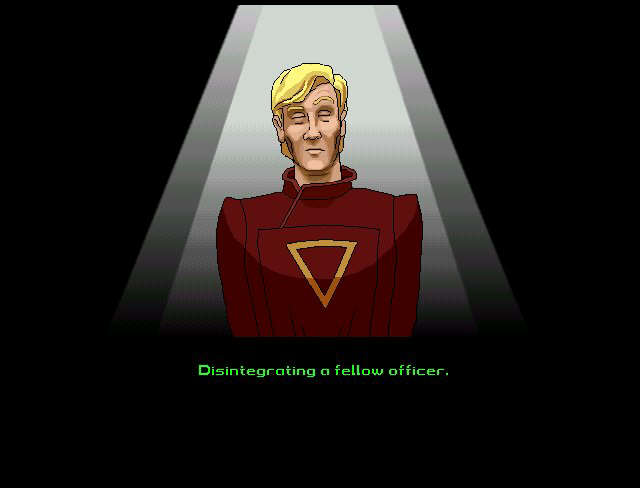 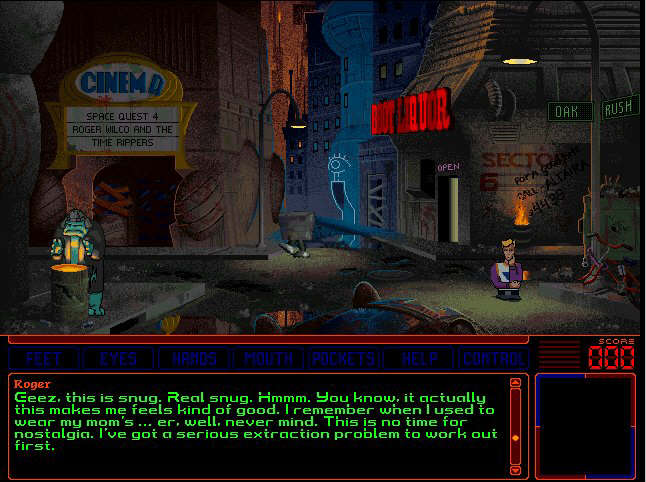 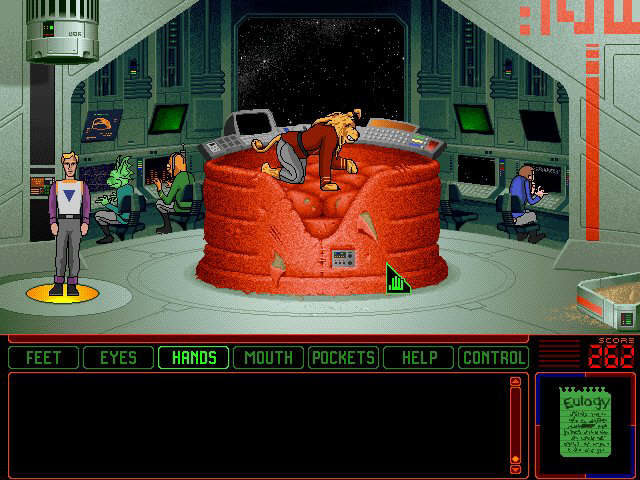 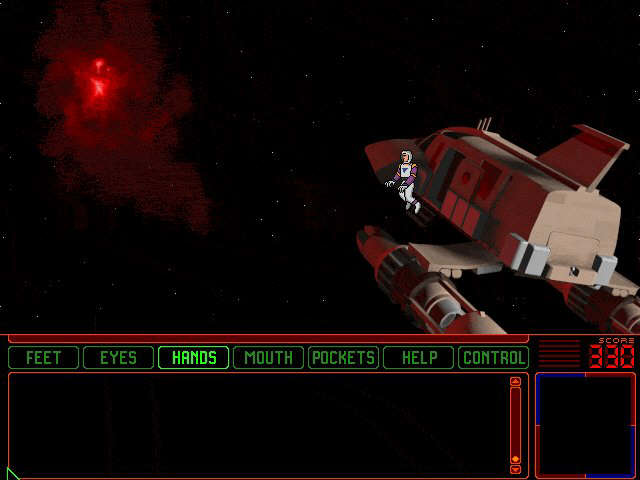 |
“I’m not going down there! A man has to draw the line somewhere,
and I’m drawing it at the er … colon.”
–Roger Wilco, while exploring Stellar Santiago’s body
The subtitle of Space Quest VI, “The Spinal Frontier,” is obviously a parody on Star Trek V: The Final Frontier. Besides the name similarities, these two pieces of science fiction have one major thing in common–Star Trek V was undoubtedly the lamest, most pathetic, most forlorn, and any-other-synonym-for-pitiful-and-bad-you-can-think-of of the Star Trek movies, and Space Quest VI seems to carry that torch as well for the Space Quest series. While not a totally horrible game, knowing that The Spinal Frontier is the last of the Space Quest series is sure to leave any fan disappointed.
Space Quest VI’s problems begin with its story. While the plot focuses on a conspiracy against hero/janitor Roger Wilco to steal his body, this is hardly apparent throughout the game, especially in the beginning. Roger was a captain in Space Quest V; now he’s demoted back to janitor. The game starts as Janitor Second Class Wilco departs for shore leave on the backwater planet Polysorbate 60. What’s his goal? Absolutely nothing. No plot to speak of. You’ll spend hours wandering around a city with no apparent goal, solving puzzle after monotonous puzzle. Some of them are easy, some are more difficult, and almost all of them are inventory-based. Unfortunately, some of the best brain-ticklers in the game are found here, so “enjoy” it while you can. I won’t give away the story, but Roger travels to some interesting locales throughout the game, including the large end section in a human body. One of the problems with Space Quest VI is the degree of “freedom” it gives the player later on in the game. Because the average puzzle involves clicking on every single object in the screen, hoping you can pick it up, the only solution to getting stuck in the game is to travel to every planet you’ve been to and click on every object in every scene. Now that’s freedom! In all fairness, Space Quest VI does handle death better than the previous games. When Roger dies (which will happen a lot, trust me), you have the option to replay the game from the point of death. The story in Space Quest VI gets a C, and the puzzles get a C-.
The previous Space Quest games have all had excellent graphics for their time. Space Quest VI, with its SVGA graphics, breaks that tradition. While the backgrounds are always exotic and look quite good, the characters look like they were drawn by a high school art student. I guess the designers were going for a cartoony feel. They succeeded at that, but the underdetailed and poorly animated sprites they used hardly are appropriate for the subject matter. Sierra’s other adventure game that was released at this time, Kings Quest 7, suffers from the same problem. While the backgrounds and spaceships look nice, the sprites just kill the feel of the game. I give the graphics a C.
Pretty much the only field where Space Quest VI doesn’t disappoint is the sound. Like the fourth and fifth games in the series, Space Quest VI has beautiful music that fits the tone of the current locale perfectly. The voice acting is also above par. Gary Owens returns as the narrator, though his chiding comments can get annoying after a while (the average human can only stand “Excellent guess, Kreskin, excellent, but wrong” so many times before being driven into a murderous rage). I give the sound an A-.
Space Quest VI is probably the worst of the Space Quest series. Be that as it may, diehard fans of Sierra adventures may like it. For the rest of you, keep your fingers crossed that Sierra will make a Space Quest VII and learn from their mistakes in VI.
Final Grade: C
System Requirements:
PC:
DOS 6.0+
486, 25 MHz
8 MB RAM
5 MB free HD space
CD-ROM drive
Supported sound cardMac:
68040, PowerPC Mac
12 MB (8 MB available)
System 7.1 or higher
16 MB RAM required for Power Mac native mode