Review: Revenant
|
Revenant Developer: Cinematix By Adam Rodman 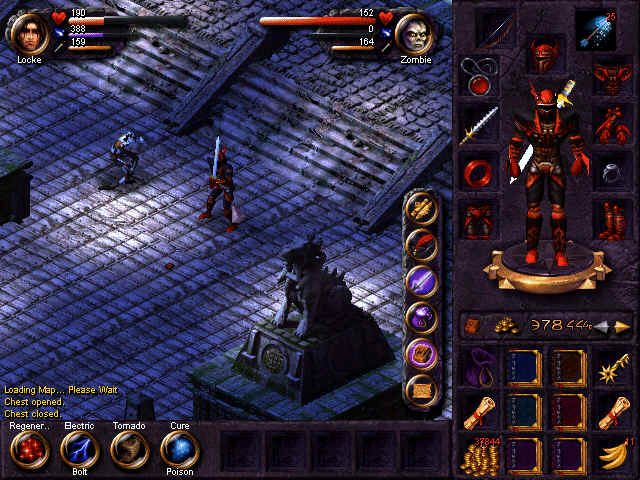   |
“Perhaps you can answer that question after I have ripped your heart out and shown it to you, little man.”
–Locke, responding to a castle guard’s inquiry of how it feels to be dead
Revenant is one of the more recent games to emulate Blizzard’s Diablo. Sporting eerily beautiful graphics and an intuitive combat system, Revenant had a good chance at becoming the best of the Diablo clones. Unfortunately, it will never reach such lofty heights, but still it is a good distraction …
As the name implies (the word “revenant” means one brought back from the dead), Revenant is the story of a man, Locke, brought back from the dead. Summoned by Tendrick’s (the King of Misthaven) sorcerer Sardok, Locke is given a quest to rescue Tendrick’s daughter, Andria, from a cult called The Children of the Change. The Children apparently took refuge on Alkuilon (the island on which Misthaven is located) some time before Locke was resurrected. They had started off as a few monks but quickly increased their ranks by enslaving different creatures with control spells. Remembering nothing of his past, Locke sets out on his quest to destroy the Children. As he goes about slaughtering legions of monsters, Locke learns that the actions he took in his past life have greatly influenced the world he inhabits now …
At first glance, the plot of Revenant seems vastly superior to its competition. And it is, but the story is presented quite awkwardly. From the opening scene, Locke is briefed by Sardok and Tendrick of the past events. The beginning of the game flows excellently–Locke slowly learns of the Children and his past by talking to townspeople, a librarian, and a little short mystic. As he completes his first few quests, he learns more. Then something happens–Locke enters an uber-dungeon (the caves), and there is nothing but monster slaying–no character development, no plot advancement–until the end of the dungeon, where a bunch of information is dropped on him at once. The game continues in this fashion–apparently, Cinematix put plot development at the bottom of their to-do list. However, the worst part of the story is the ending. Apparently, the programmers were trying to outdo Diablo’s depressing ending. And they succeeded. I obviously won’t tell you what happens at the end of the game, but trust me, it is very unsatisfying. Because of these squabbles, I give the story a C-.
Gameplay is incredibly stable. Locke can be controlled with only a mouse, a keyboard, or a gamepad (though I prefer a mouse/keyboard combination.) The four types of moves are controlled by the A, S, D, and F keys (could it be … home row?), which signal a thrust, swing, chop, or block, respectively. A left-click on an enemy will also serve the same function, choosing an attack at random. A right-click (or arrow keys) will move Locke around, and a left-click (or U) will talk to a character to use items. Needless to say, control is quite intuitive. Numerous types of armors and weapons can be used, and they each have their own image. Locke could dressed in gauntlets, ninja pants, a dragon helm, Celtic body armor (complete with a blue stripe down the chest!), and it would all show up on the model. Though not essential to gameplay, it is a nice addition. My biggest squabble with the game is with difficulty and length. Revenant has to be the shortest RPG I’ve ever played! I beat it in six days of noncontinuous play, and I’m bad at action-RPGs. The ease is wrung out of bad planning. I don’t know what happened at Cinematix, but Locke has the ability to get powerful weapons from the armory in Misthaven before he finds them on his quest. This may have been an oversight on the developers’ part, but gold is very plentiful and numerous teleporter pads back to town throughout the game make it easy to get advanced weapons. Though Revenant was an enjoyable experience, it was too short and too easy. Thus, I give gameplay a B-.
By far, the best part of Revenant is the graphics. They truly give the game an eerie quality, beautifully rendered in 3D with exquisite lighting effects. I was, needless to say, impressed by the graphics, but graphics alone do not make a good game. Still, I give the graphics an A+.
Sound, however, is a mixed bag. Though the music is wonderful and fits the mood of the section of the game, voice-acting is mainly horrible. Aside from a few characters like Locke, the voices sound very amateurish, as if they were done by the programming staff and their families. It really doesn’t matter, though, since conversation is very minimal, so I give the sound a C.
Overall, Revenant is a fine product from Cinematix. It you want a beautiful and strangely addictive, albeit short, action-RPG, Revenant should definitely be considered. However, if you are looking for an immersing plot and a challenge, look elsewhere.
Revenant final grade: C
System Requirements: Pentium 233
Windows 95/98
32 MB RAM
400 MB uncompressed hard drive space
100% DirectX 6.1+ compliant 8 MB PCI video card
100% DirectX 6.1+ compliant sound card
Keyboard and mouse