Review: Phantasmagoria
| Phantasmagoria
Developer/Publisher: Sierra By Ray Ivey |
This is one of the most notorious and controversial titles in the adventure game genre, and since I frequently like notorious and controversial things, I was looking forward to playing it.
Phantasmagoria has a fairly old-fashioned story line about an attractive young couple moving into a big, creepy old house where strange things begin to happen by tea time on moving day. In stories like this I always find myself thinking, “Were you comatose when you first looked at this house and decided to buy it? Hmm … so the dripping blood on the walls didn’t give you a clue?”
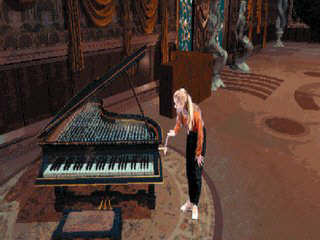
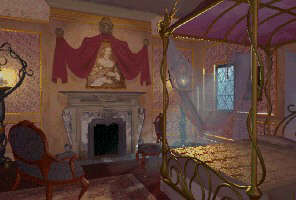
Visually, the game is attractive but feels very low-quality. There’s lots of pixelation in the video, and it’s just not done with much smoothness or fluidity. However, the house is very fun and creepy. Also, I had a surprising amount of technical trouble, considering the game was only four years old when I played it. I had a terrible time with the sound and with game crashes as well.
Unfortunately, the acting is uniformly terrible, and for this there is absolutely no excuse. Not for a company with the resources of Sierra. Much fun has been made of the irritation caused by watching Victoria Morsell play with her hair over and over. It’s a deservedly notorious feature. There is one bright spot in the cast, however, and Sierra’s casting department gets big brownie points for this one. The sweet middle-aged proprietor of the antique store is played by none other than 60s sex kitten Stella Stevens! Always a huge fan of hers, I got a big kick out of seeing her again.
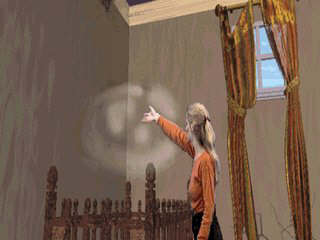
This is an extremely trashy game. Not that I don’t like trash upon occasion, but I have to ask, honestly, is Roberta Williams a grown-up? The story is simplistic, violent, and exceptionally misogynistic. Hmm … got some issues there, Bobbie?
Also, this has to be the shortest seven-disk game ever made. I couldn’t believe how quickly I got through it. I would say about 40 minutes per disk. What gives here?
What makes the game seem even shorter is that most of the time you’re simply watching long, tedious, badly acted videos. In fact, this is the first game I’ve ever played where I spent half of the time in an easy chair across the room, staring stupidly at my computer monitor.
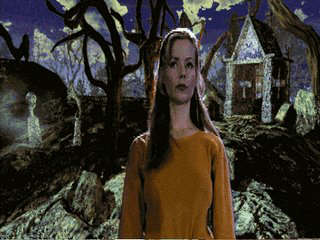
You could argue that Phantasmagoria isn’t really a game at all. It’s an interactive movie. Perhaps that should really be a separate genre.
And since it’s an interactive movie, it’s unforgivable that Sierra was so sloppy on cinematic details. The best example I can give you is the fact that, even though the story takes place over about 10 days, the heroine never changes her clothes once. In other words, even the game’s creators didn’t see her as a real character, but merely as a cardboard sprite that happened to consist of real life video. But then, Gabriel never changed clothes in Sierra’s GK2, either. And Curtis seems to only have one T-shirt in Phantasmagoria: A Puzzle of Flesh. Grr. Okay, so maybe this was a programming issue–but I don’t care. Figure it out, team. If feature films can deal with editing around changes in clothes, you can too.
I should also mention that there is a built-in hint feature in Phantasmagoria. This should be a good thing, except I don’t approve of the execution. Hints are all well and good: but this feature simply doles out spoilers. Hey, Sierra, look up “hint” in the gamers’ dictionary!
However, there is one area in which the game excels, and that is the finale. In the final chapter, the game follows the heroine’s desperate attempts to escape her possessed husband. Death waits for her at almost every turn. However, the game is structured in such a way that you immediately get to start over again right at the point where you made your mistake. There is a certain amount of ghoulish fun to this: “Oh, darn, she got her head split open again! Okay, let’s try turning at this door …” The game even allows you to “rewind” the movie again to retrace your steps so far. In a genre that has very, very few good endings, I did appreciate the rousing finale of Phantasmagoria.
Okay, here’s where you lose any shred of respect you may have for me. Despite everything I’ve said, I enjoyed playing Phantasmagoria. It was fun in a very base, trashy way. It had an interface that was intuitive and dependable. It’s got some of those sturdy video virtues that I always enjoy. I guess I’m so critical of it because I think Sierra and Roberta Williams squandered an opportunity to make a really fine, groundbreaking, and new type of game and instead went for the low road. It’s a pity.
I have also reviewed the sequel to this game, Phantasmagoria: A Puzzle of Flesh, which I actually enjoyed more.
Final Grade: C-
System Requirements:
PC:
486/33
8 MB RAM
2X CD-ROM
Sound board
DOSMacintosh:
68040 33 MHz
System 7.1x or higher
8 MB free RAM
2x CD ROM (4x recommended)
256 color
30 MB free hard drive space
Power Mac 601+ requires 16 MB RAM for Power Mac native mode