Review: Nocturne
|
Nocturne Developer: Terminal Reality 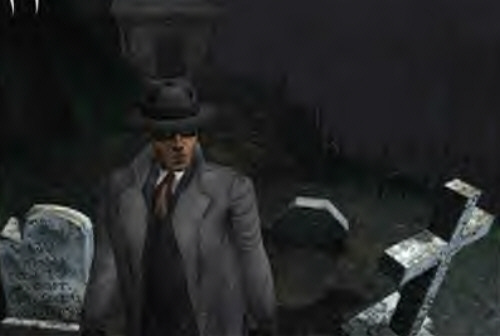 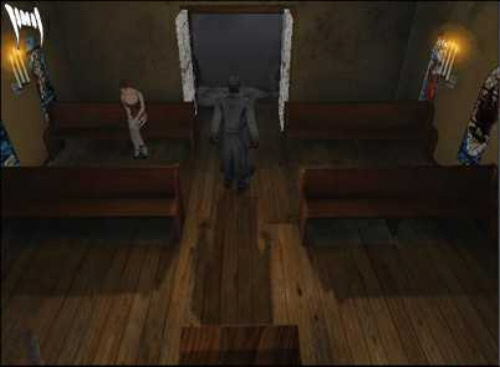 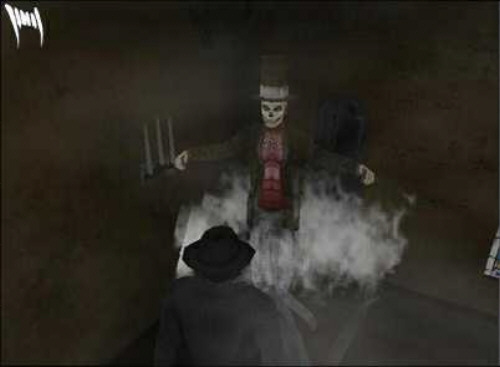 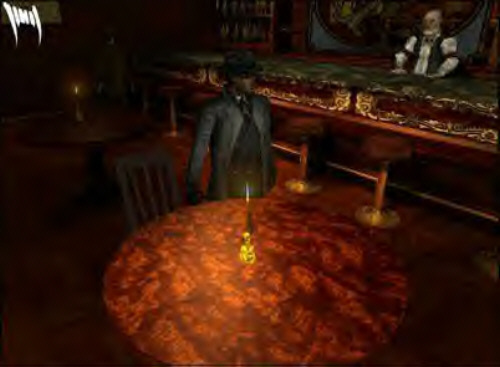 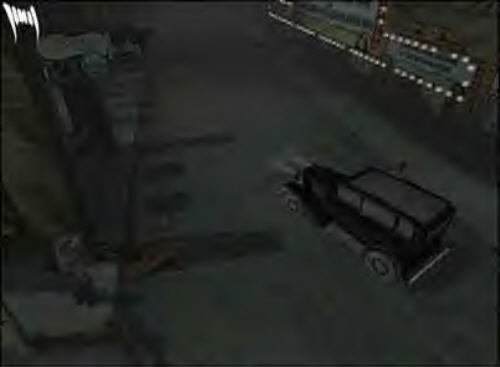 |
What is Nocturne? Nocturne is why computer games always have been and always will be better and more cutting-edge than any console game ever released. Nocturne is why grown men and women call off from work with the “flu.” Nocturne is why new computers are purchased and old ones are upgraded. I have emerged unscathed from the Spookhouse, and the journey has forever altered my perception of the legitimacy of horror on the computer.
To compare Nocturne to Resident Evil, as some have done, would be an insult to Nocturne. Resident Evil is a single-plot, no-theme gore-fest that thrives on cheap thrills and mistakenly believes that armies of the walking dead constitute fright. There has been a trio of Resident Evil games released, and we have yet to develop an emotional connection to any of the characters. Nocturne, on the other claw, is the eternal battle of good versus evil supplemented with the various shades of gray that defy categorization. It is a mélange of the heinousness of H.P. Lovecraft and the sexually tinged bloodletting of Clive Barker. Its excellent use of camera angles, dynamic real time light and shadows has already rendered Alone in the Dark 4 antiquated before it is even released. Nocturne does not raise the bar another level; instead it elevates action/adventure/horror gaming to an entirely new dimension. The character of the Stranger, your alias for the game, has been molded in the classic image of heroes of the past. Who is the Stranger? He is Elliot Ness. He is the Shadow. He is James Dean and the Fonz. He does his job, he asks no favors, and most importantly, he does not cheapen the flavor of the game by cracking wise. He is a cynical, enthralling character who is haunted by a mysterious past. Nocturne is not noir, as some reviewers have erroneously claimed (do some research, guys), but rather it evokes memories of an era when pure horror films elicited a perfect blend of form and content to drench the world in shadows and rainfall and only occasionally staccatos of sunlight. Noir, by definition, imparts a desperation and hopelessness that is reflected in the visual style. The Stranger is our portent of hope who transcends this fatalism so common to the noir genre.
Nocturne is, at times, a violent game and, I will not mislead you, it is not cartoon violence. Yet it is also a thinking game. It never approaches the mindless violence of a Quake or Kingpin. We view bloody limbs and flying body parts. Some scenes, though not many, contain wholesale slaughter. But this is a game that is enriched by the violence rather than being driven by its lure. It is the vicarious thrill of firing a silver bullet through a werewolf’s heart, plunging a stake into a vampire or blowing off a zombie’s head with a shotgun blast. It is marking your path in the woods by dangling a werewolf’s arm at your side so that its bloody stump drips a trail to follow. The primary person responsible for concocting this brew of violence and adventure, of action and puzzle-solving, is Mark Randel, president of Terminal Reality and Nocturne lead programmer. When we first met Randel at the E3, he seemed a pleasant young man, an all-American type. But there is a faraway look in his eyes that is bothersome. It is as though he is penetrating the darkness of your soul in search of fresh material for his project. Little did we know at the time that Randel was soon to be the John Carpenter of computer gaming (and like Hitchcock, Randel has managed to insert a picture of himself into the different chapters of the game), or maybe we did know and that is why we presented the–at the time–relatively unknown Nocturne our “Dark Horse of the E3 award.”
Nocturne unfolds in four acts that can, but don’t have to, be played in chronological order. Each act is proceeded by a cinematic that sets up the story to follow. Before we dissect each act, rest assured that the entire game is visually beautiful. For the first time ever, a game uses dynamic real-time lighting and shadows for more than just eye candy. Sound effects and music often provides aural and directional clues not to be ignored. Game control can be accessed through keyboard or gamepad (I opted for my Rage 3D gamepad), and auto-aiming is a must for those of us with no sense of direction. The game is presented in a third-person environment that is very familiar to adventure gamers, but there is quite a bit of camera repositioning to always attempt to present the most impressive cinematic viewpoint. While this is effective 90% of the time, the 10% that fails will cause accidental deaths and the reloading of a saved game. The sudden and multiple shifts in camera angles is a case where less would have been an improvement. I also experienced occasional glitches in control as my character would run in circles whether I used the keyboard or gamepad and intermittent voice stuttering that should not have occurred as the entire game was loaded onto my hard drive. These problems, though, were caused more by the limitations of my computer than by any bugs in the game. I’ll not go into a lengthy discourse on the high system requirements for this game; the specs are listed at the conclusion of the review. All minor problems, but nuances that are magnified and become a major annoyance when your “suspension of disbelief” is invaded by reality.
Based on events that might have (and, who knows, maybe did) occurred, the Spookhouse is a secret US government agency founded by Theodore Roosevelt in 1902. Its clandestine role is to protect the nation and the world from supernatural forces. The Stranger, sort of the 007 of the Spookhouse, is its most reliable agent and thus acquires the toughest assignments. Puzzle-solving and bloodshed are soon to follow as you guide the Stranger through four scenarios not for the weak of heart.
Act 1: 1927–Dark Reign of the Vampire King
A nice balance of puzzles and action make this a great starting point for action/adventure gamers. The Stranger and Svetlana, a female Spookhouse operative who is half-vampire, must travel to Germany to retrieve the Yathfoe-Gyuole, an artifact rumored to make vampires invincible. Together you will visit a deserted German town, fight your way through a forest populated by werewolves and explore Count Voicu’s castle. Though the puzzles in this episode are not too difficult; the plot twists and surprise ending are excellent. The puzzles mostly consist of the find-a-key, pull-a-lever, perform-some-jumps variety, but there are some nice touches. Memorable scenes: your first encounter with a vampire bride and a bone-chilling image of vampires at rest in the belfry. If there is a problem with this episode–play close attention here and you will spot a pattern–much of the wandering in the barren town and through the forest feels too much like a maze meant to extend the gameplay. This act is a good starting point, and I have in fact played through it twice. With the inclusion of more environmental and situational puzzles it could have been a classic. As it is, it still receives a grade of A.
Act 2: 1931–Tomb of the Underground God
You have been summoned to Redeye, Texas, to investigate why the dead are wandering the dirt streets of this old western town. The first half of this act is devoted to adventure as you escort the depleted farming population of a town besieged by zombies to a haven of safety, the local church. A great beginning soon slogs down into a maze-like–there’s that word again–search through an underground mine that consists of a lot of shooting, running and jumping. Mini-quests keep the aboveground part of the act interesting, but the mine scenes could have been eliminated. Without giving away any of the plot, the events following the mine excursion are well-balanced between action and adventure. Memorable scenes: the resurrection of your partner for this act, Scat Dazzle, and a confrontation with a zombie cow that in some games would be silly but in Nocturne is horrifying. A theme worthy of H.P. Lovecraft that could have been improved with tighter editing, though once again the twist ending is wonderful. Grade for Act 2–B+.
Act 3: 1933–Windy City Massacre
Something is not jake here, as this act is for action lovers only! Al Capone, unable to clone Geraldo, has devised a gang of Frankenmobsters–dead thugs that have been reanimated in the image of Shelley’s monster. You must discover proof of his twisted plan and then destroy the factory that houses the life-restoring solution. Stunning in its recreation of Prohibition-era Chicago, this lengthy act is eroded by its slavish devotion in turning everything into a meandering maze. The foggy streets, the dingy back alleys, the desolate movie theater, and Capone’s factory are all excuses to lengthen rather than enhance the gameplay. Tommy-gun battles with the bad guys soon begin to bore as piles of bodies mark your progression. Offering very little in puzzles, this is instead a paean to action gamers and a reflection on the mindset of the 1930s. Your accomplice is a monstrous brute named Icepick, but the inclusion of a “boss” character becomes ludicrous when he appears not once, but three times. Profanity abounds in this act, but in all fairness it is not gratuitous and is actually, at times, humorous. Memorable scenes: the torch singer in the speakeasy and watching actual film footage in the theater. At its worse, Nocturne is still better than most, but this act sputters to a B-.
Act 4: 1935–The House on the Edge of Hell
If Act 3 was a love letter to action gamers, then Act 4 is intended for the adventurers. Chock-full of puzzles and conundrums influenced by black magic and a demonic mansion, atmosphere also has a starring role–there where moments when I experienced chills as unseen clouds passed over the moon above and cast flickering shadows over tombstones and crypts. The Stranger has been enlisted to aid Killian, a former Spookhouse operative who now resides in France. You soon find yourself trapped inside a living, breathing mansion that would like nothing better than to make you part of the decor. The puzzles for this act are delicious and develop from the environment rather than as an afterthought. Again, the inside of the mansion is often maze-like, but it deviates from the sameness that haunted the forest, the mines, and the back alleys of Chicago. By far the hardest act of the game, it is also the best-balanced and most mature in its theme. There are some wonderful references to the previous acts that will be spoiled if you have not played in chronological order. When Nocturne was previewed at the E3, Randel promised there would be much to attract the adventure gamer and to be honest, I had my doubts. But he has proved to be a man of his word, and if Act 4 is any indication of what he is capable of–I say bring it on. Suspenseful and as smartly written as any horror novelette, Act 4 is a rousing A+.
Though Nocturne never literally scares, it does keep you constantly on the edge of your seat. Shadows flitting across rooftops and darting behind trees are briefly glimpsed from the corner of your eye. You know you saw something and that attack is imminent; it is just a matter of what and when. There are no cheap thrills in this game. No massive onslaught by swarms of the undead. No sudden loud explosions of windows crashing or dogs salivating at your heels. Instead, it is a horror that builds slowly and compels you to return to your computer night after night. It is deadly silence accentuated by a musical score that cuts you to the quick as you realize each note signifies the approach of something … but what?
The sudden proliferation of excellent action/adventure games during the last quarter of this millennium has been amazing. From the wondrous universes of Outcast to the soul-swapping of Omikron, from the high-flying fantasy of Drakan to the dark shadows of Nocturne, the genre has finally found its niche and seems poised to strike that perfect balance of adventuring and action to please even the most discerning gamers. I have professionally reviewed over 100 games and have yet to award any game with a grade of A+.
Yet I would, without hesitation, were it not for the niggling aforementioned problems, award Nocturne the highest grade possible. For now, though, turn off the lights, put on the headphones, and proceed with caution, for you are about to step into the past and enter the orb of the Spookhouse operatives, and before you know it, the sun will have risen on your monitor and outside your computer room window.
Final grade: A.
System Requirements: 233 MHz Pentium MMX (400 MHz Pentium II recommended)
64 MB of RAM (96 MB required for hardware acceleration, 128 MB recommended)
500 MB Hard Disk Space (1 GB+ recommended)
SoundBlaster Live