Review: Myst III: Exile — Part 2
|
Myst III: Exile Developer: Presto Studios By Ray Ivey
|
It seems we adventure game reviewers get a lot of flack these days. Whenever we give a bad review to a new adventure game, it’s seen by some as, well, unpatriotic or something.
What a pleasure it is, then, to be able to report on a new adventure with unabashed delight.
Rand Miller was not interested in creating the third game in the Myst series, and a search for a new creative team ended up with Presto Studios getting the job. This was very good news indeed for adventure game fans, because Presto is the team responsible for the venerated Journeyman Project trilogy, the second of which (Buried in Time) is on my all-time greats list.
However talented a team they were, it would be difficult to envy them the task. Myst and Riven are two of the most famous (or notorious, depending on your point of view) computer games ever released, and the expectations for a third game in the series were exceptionally high. Presto had a lot of opinionated people to please.
A significant part of the challenge they faced was the one of proportion. How much should the game be like Myst? How much should it be like Riven? And for that matter, how much should it be like other Presto games? Because let’s face it, sports fans, as much as some of us love the first two games, they weren’t without problems. Myst could feel sterile and empty, and Riven’s immense chain of island environments could be quite galling to explore and decipher. Plus both of the games had puzzles that could produce serious brain sprain–remember the obtuse fish clue to the stone circle puzzle in Riven? Eesh.
The remarkable news is that Presto managed to get the recipe just right. From Myst, they adopted the effective “hub world” structure, which is much less intimidating and bewildering than Riven’s bafflingly open-ended geography. The homebase age of Jnanin is a construct that most adventure gamers can readily hang on to.
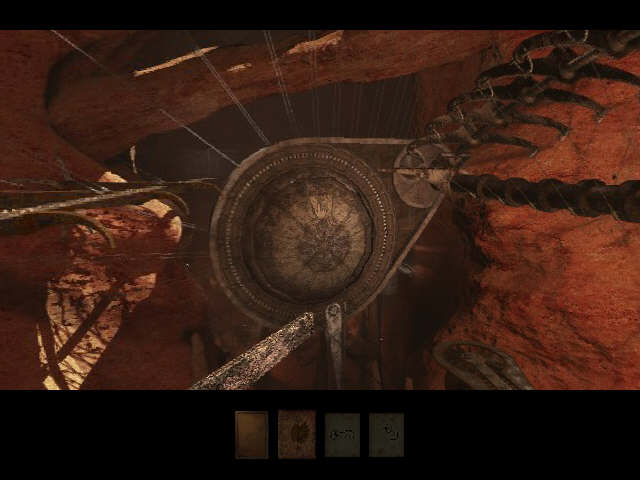
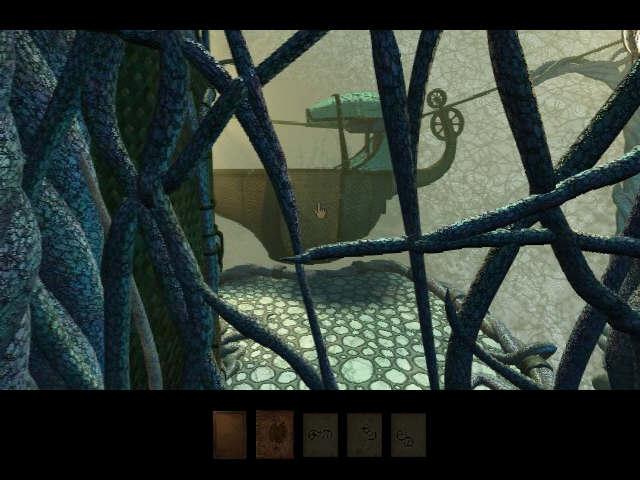
Next, from Riven, Presto included a much stronger and cohesive plot than Myst, with a tremendously evocative backstory. Myst felt like one big, pretty puzzle. Riven felt like you were rediscovering a rich and tragic story. Ditto Exile. The game also has ravishingly beautiful environments worthy of Riven–scenery so vivid you can smell it.
Third, and perhaps most important, the designers brought in the appropriate virtues from the tremendous Journeyman Project games. The tightness of the storyline and the coherence and creativity of the puzzles are pleasantly reminiscent of those dynamic games. Plus the game has dazzling 360-degree panning that’s an improvement even over the gorgeous JP3: Legacy of Time.
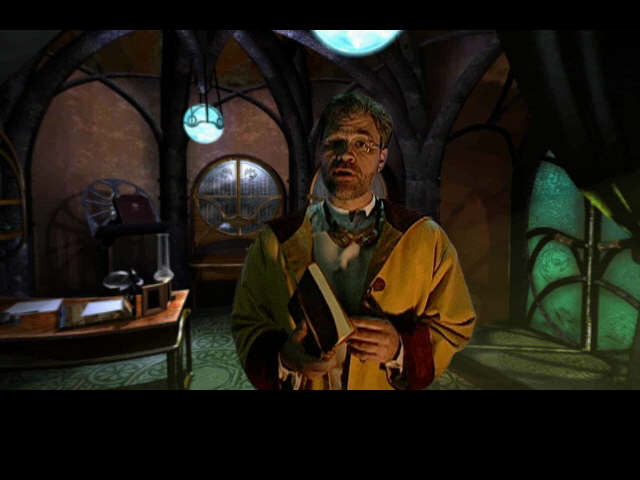
The game begins with a brief introduction, where we once again see the contemplative Atrus pondering the vicissitudes of his family and the various worlds that he creates with his books. It was a real plus to get Rand Miller, the very reluctant actor, to reprise his role as the Age-creating philosopher. His presence instantly gives the game an air of authenticity.
Soon you are visiting Catherine and Atrus in their new home in Tomahna. After only a few minutes, however, an unknown figure appears out of nowhere and steals the very book Atrus was about to show you, dropping another book that he had used to get here. As per your friend’s instructions, you place your hand on the magical book and are transported to your first Age to explore, Jnanin.
As you begin to wander around the gorgeous island and begin tinkering with the game’s first puzzles, you get a tremendously satisfying feeling. Specifically, the feeling is one of rightness, and it comes from the correct balance of two factors: first, that you’re in an honest-to-D’ni Myst game; and second, that while recognizable as such, it’s still a very new game in its own right. Too much or too little of either feeling would have made playing Exile an unsettling experience, and the fact that this vital balance is correct is Presto’s greatest achievement with Exile (aside, of course, from moving lots of units, baby).
I have no clue how much of the game’s budget was spent on actor Brad Dourif as the game’s villain Saavedro, but whatever percentage it was, it was money well spent. An extremely talented, Oscar-nominated actor not particularly known for underplaying anything, Dourif’s vivid acting style is perfect for the melodrama of an adventure game. We veterans of computer games have seen and heard many, many actors chew the scenery in our games. It’s a delight to see someone who can actually pull it off. Dourif’s angry, bitter, but soulful antagonist effectively anchors the game’s story. It’s a tribute to both Dourif’s acting chops and Mary DeMarle’s script that Saavedro comes off as both an effective villain and a sympathetic character as well. He’s a man who truly feels wronged, and you believe his anger comes from his passion for justice for his people.
Technically, there’s good and bad news about the game. The good news is that the 360-degree panning works with beautiful fluidity. The water effects are wall-to-wall spectacular–particularly the shimmering reflections in the puddles. Also, Exile has the smoothest (I’d say virtually seamless) transitions from cutscenes to playscreens that I’ve ever seen in a prerendered game.
The bad news. By now you’ve probably already read about the technical problems many gamers have been having with Direct3D on certain video cards. I find it a bit startling that the game doesn’t support hardware acceleration on the recent Voodoo cards. These are not obscure cards, ladies and gentleman, and my Voodoo3 card was state-of-the-art when I installed it about a year ago. To have to choose software rendering when I’m supporting such a good card is quite disappointing, as I know I’m giving up a great degree of video quality. I’ve also seen the game run on a newer machine that does have a supported video card, and the difference is notable.
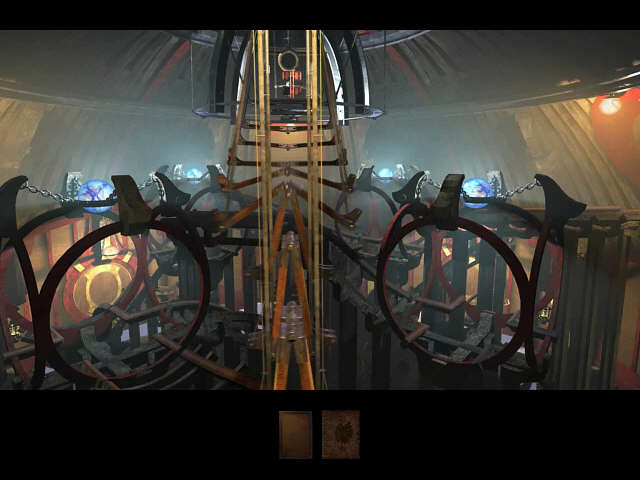
The game’s puzzles are varied, entertaining, and suitably Mystical. Not surprisingly, many of them have to do with getting arcane machinery to work. The crazies at Presto have worked overtime to come up with some wonderfully Rube Goldberg-esque contraptions to figure out. Some of the puzzles require some “outside the box” sideways reasoning to achieve success, like one that involves a cute little animal, some bait, and a trap.
The graphics in the various ages are drop-dead gorgeous. As in the first two games, Exile provides environments in which is being stuck in a puzzle is okay because your environment is so darned lovely.
There’s one problem in the gameplay of Exile, and it has to do with the cursor. As with most games with 360-degree panning, the cursor remains in the center of the screen. It has two modes, stationary and floating, which are easily toggled with a right-click of the mouse. However, the cursor does not change to indicate travel is possible in a particular direction. Perhaps this decision was made to make the game more challenging, but it can sometimes lead to frustration. This is a particular problem in Edanna, the Nature Age. There is one spot in this section in which the path to the end-chapter puzzle is in a dark and obscure direction with absolutely no visual clues whatsoever that it’s a directional option. If the cursor indicated possible travel directions, this murky exit would not be a problem. But with a neutral cursor the spot becomes almost impossible to find.
There’s also a very questionable costume, worn by Saavedro during the endgame sequence. The dramatic justification of the costume was graciously explained to me by producer Greg Uhler, and I understand, but still … The brutal truth is that the costume is so bad it looks like the production ran out of money when it was time to sew it together. It makes poor Dourif look like a refugee from a high school Dungeons and Dragons club, and it’s so distracting it can undermine the drama of the story’s conclusion.
However, the minor problems Exile has pale in comparison to the game’s many virtues. It’s a true Myst game but with a tighter storyline; it’s got elegant, creative, and coherent puzzle design; it’s got a beautifully evocative score by Jack Wall; and it’s gorgeous gorgeous gorgeous.
Before closing, I have to mention two moments of particular brilliance in Exile. The first is near the conclusion of the Amateria chapter. Most adventure gamers are very familiar with the concept of puzzle rewards. These rewards can vary from a bit of important information to access to a new area to a cutscene to a simple chapter division. Amateria has a series of puzzles that have to deal with successfully rolling a fragile crystal sphere through a series of rollercoaster-like loops. As you complete the chapter’s final puzzle, you might expect the reward to simply be the conclusion of the chapter. But what follows is a cutscene that is perhaps the most perfectly satisfying puzzle reward I’ve ever seen in a game. It shows the designers were truly working with the player in mind, and the spectacular generosity of the scene is flabbergasting.
Then there’s the moment at the end of the Voltaic chapter. Extremely minor spoiler: Each chapter ends with the acquisition of an important symbol, and in each chapter the symbol is revealed differently. The way it’s delivered at the end of this chapter is done with such surprising visual and conceptual acuity that it becomes a moment of transcendent beauty–true visual poetry. Your jaw is going to hit the floor.
Few recent graphic adventures get as many things right as Exile does. It reminds you of why you began playing adventure games in the first place. As a reviewer I’m supposed to be a coldly neutral voice, but I’m only human! My hat is off in true admiration to the talented team at Presto Studios. The sheer excellence of this game happily transforms me back into my true self–that of a gushing fan.
Now when do we see screenshots for Myst 4?
Final Grade: A+
If you liked Myst III: Exile:
Play: Journeyman Project 1, Journeyman Project 2: Buried in Time, and Journeyman Project 3: Legacy of Time
Read: Those Myst novels
See: Shrek (no, it has nothing to do with Exile, it’s just really good!)
System Requirements:
Mac:
233 MHz G3 processor or faster
Mac OS 8.1 or higher
64 MB RAM
200 MB available hard disk space
4X CD-ROM drive or faster
640×480 display, thousands of colors
Supports optional 3D hardware acceleration
Recommended 6 MB video cardPC:
233 MHz Pentium II or faster
Windows 95/98/ME
64 MB RAM
200 MB available hard disk space
4X CD-ROM drive or faster
640×480 display, high color (16-bit)
Supports optional 3D hardware acceleration
Recommended 8 MB video card