Review: Legacy of Kain: Soul Reaver
|
Legacy of Kain: Soul Reaver Developer: Crystal Dynamics By Adam Rodman
|
For millennia, philosophers have theorized about the soul. What is it? What does it look like? How does it taste? Unfortunately for those philosophers who toiled for the truth of the soul, it appears that Crystal Dynamics and Eidos Interactive beat them to it in a new action-adventure, Legacy of Kain: Soul Reaver. Would Nietzsche, Socrates, or Descartes approve? Probably not, unless famous philosophers are partial towards half-baked jumping puzzles (lots of jumping puzzles), threadbare plot, and an absolutely horrible save system.
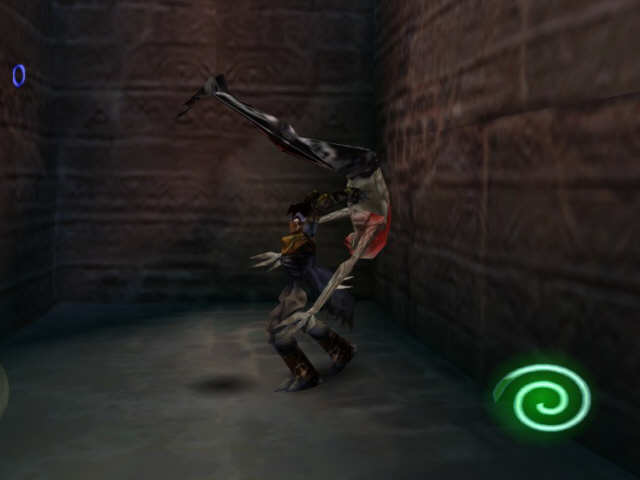
Apparently, after the big vampire boss Kain set his new capital in the ruins of the Pillars of Nosgoth, he set out to the underworld to get six souls for his lieutenants (one of which is your main character, Raziel.) With his band of merry undead men, Kain left to conquer the world, killing off scores of those pesky humans. And he succeeded. Once the world was thoroughly tamed, he and his lieutenants played a little game that would drive Darwin made–“Let’s See Who Can Win in Spontaneous Evolution!” Of course, Kain would always win this–every decade or so (vampires are immortal), he would evolve a little to become better than his cadre of lieutenants. In another decade they would then evolve. Unfortunately for Raziel, he soon won this game, growing wings. Kain, being a sore loser, ordered Raziel to be cast into the Lake of the Dead. While getting thrown in a pool of water means little to a human, water is the equivalent of hydrochloric acid to vampires. Coupled with the fact that vampires can’t die, Raziel was damned to eternal agony. Or so he dreaded … After about 1,000 years of decomposing at the bottom of the lake, a mysterious voice known only as “The Elder” rescued Raziel and gave the vampire a way to repay him for his kindness–kill as many vampires as possible. Ah … Soul Reaver’s plot is little more than an excuse to jump over big gaps and impale monsters with pole-arms. I give the story a C+.
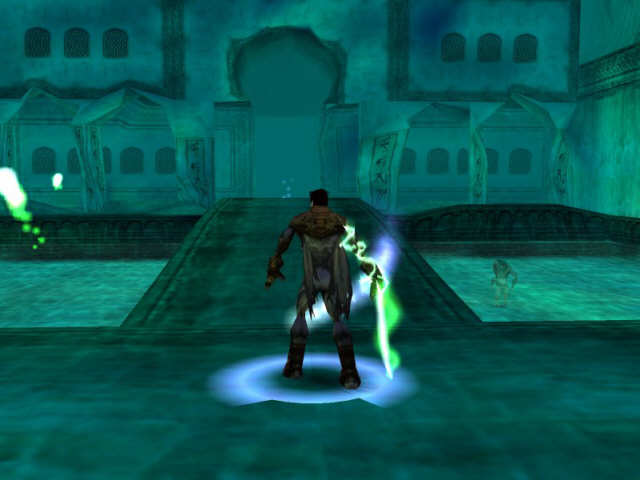
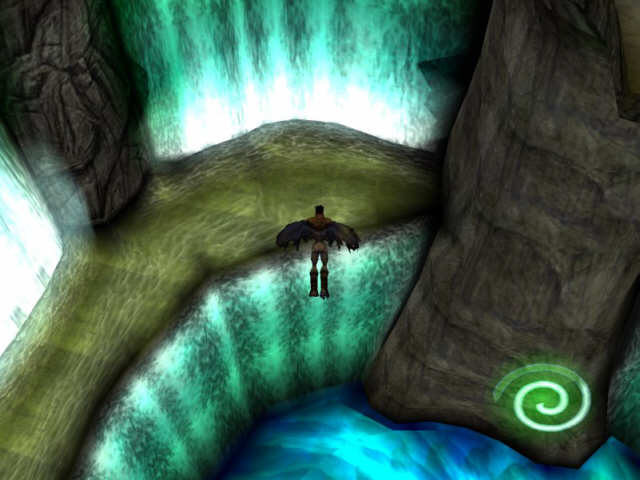
If you like jumping puzzles and block-pushing/arranging puzzles, you’ll love Soul Reaver. Why? That’s practically all there is in this game. However, jumping is made a little more interesting … Raziel has wings. Though they are decomposed (that’s what happens to flesh when it lies dormant in a pool of water for a thousand years), they are still useful for gliding. With a tap of the spacebar, Raziel can glide about the room. This may be interesting for a while, but the novelty of flying dies off fast. The other type of puzzle that can be found throughout the game is the notorious block arranger. I don’t know about the rest of the world, but pushing and flipping blocks around just ain’t my cup of tea. Raziel also can exist in two realms, the spiritual and material. While in the material realm (the place where most people live), Raziel’s health continually drops. The only way to regain health is to drink souls, which can be acquired after killing a monster. In the spiritual realm, Raziel continually gains health. The spiritual realm is a twisted and freakish rendition of the material world, and when Raziel dies in the material world, he returns to the spiritual. This brings up the most unique feature of Soul Reaver–death. Raziel is immortal. When he dies, he returns to the spiritual realm. If he dies in the spiritual realm, he returns to “The Elder.” Far eclipsing the annoying puzzles is the save system. Falling down wouldn’t be so annoying if you could save before the jump and return to that exact place. Is that too much to ask for? Apparently so, because after restoring a game, Raziel always starts back at “The Elder.” All progress is saved, but every single freakin’ jumping puzzle has to be redone. In Soul Reaver, the cons of the gameplay outweigh the pros, so I give the gameplay a C-.
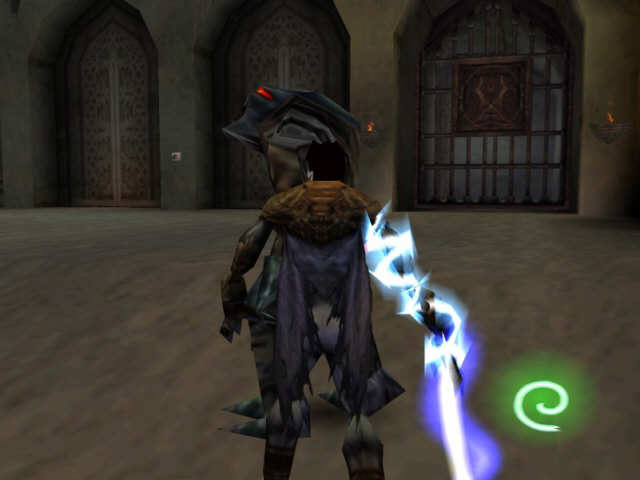
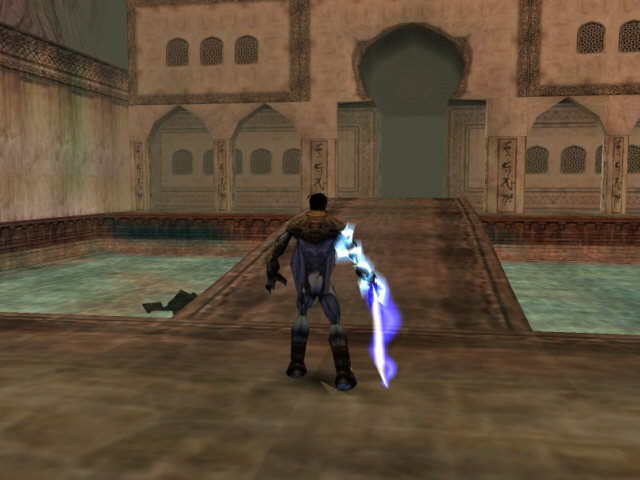
Graphics can’t make up for bad gameplay, but they can certainly try. Soul Reaver has some of the most beautiful and provocative graphics of any game I have seen. Instead of following a standard European gothic architecture, the game has a certain Middle Eastern feel to it. Large, spacious building are made out of stucco and clad with haunting arabesques. Hallways are meticulously crafted. Even dark passageways crawling with monsters have a mystical feel to them. All rendered in 3D, the graphics are stunning, so I give them an A.
Sound is the other high point. Though music is merely satisfactory, sound effects really fit the mood, with the cawing of crows and trickle of water through an abandoned cathedral. Don’t play this game with the volume too high–the suspense might cause you to soil yourself. Sound is wonderful; I give it an A+.
If you absolutely must have jumping puzzles, Soul Reaver is for you. If you don’t, there are better ways to spend your gaming dollar. Oh, and by the way, souls taste slightly like lime Jell-O.
Final Grade: C
PC System Requirements: Pentium 133 MHz
4 MB 3D card
Windows 95/98
32 MB RAM