Review: Lands of Lore: Throne of Chaos
|
Lands of Lore: Throne of Chaos Developer/Publisher: Westwood Studios By Ray Ivey 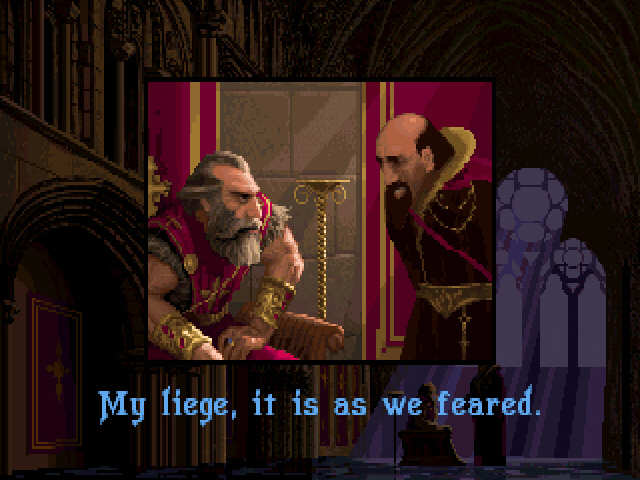 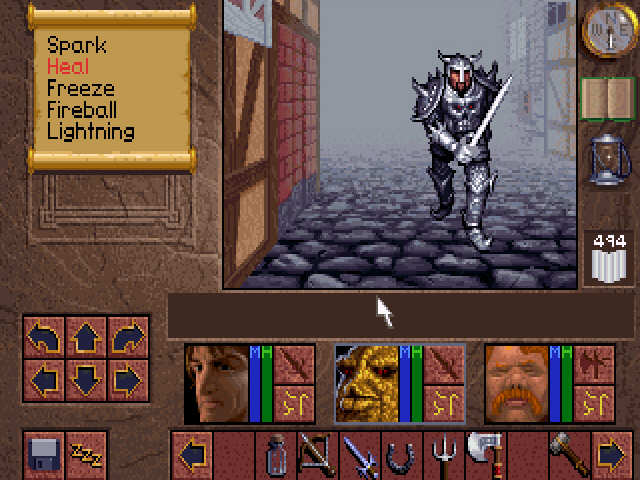 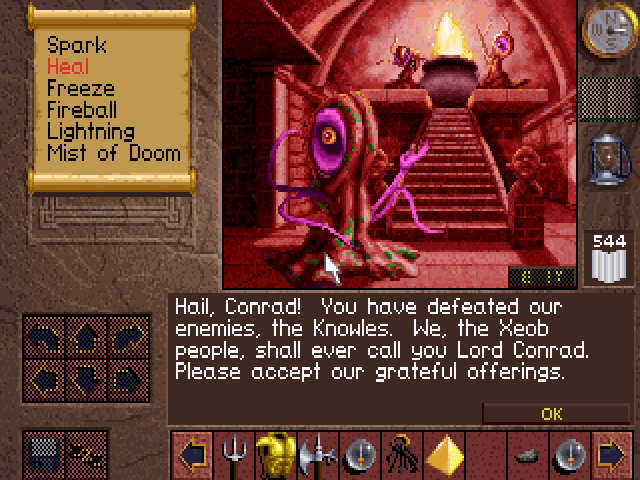 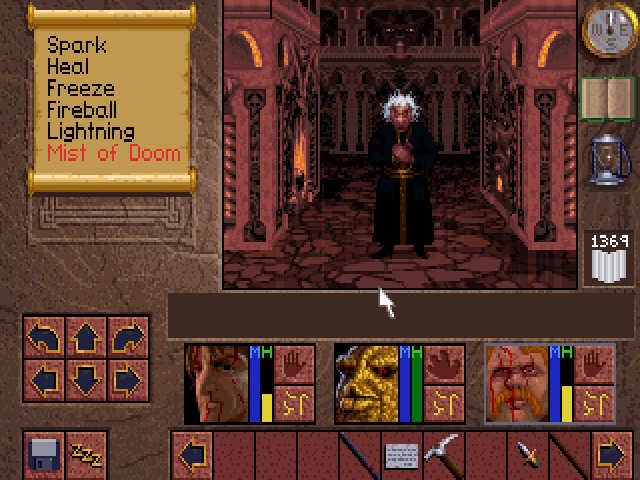 |
I’m a die-hard adventure gamer with a dash of wanderlust. I’m interested in the best other game genres have to offer. I’ve wondered about role-playing games for some time. The only game even arguably in that category that I’ve played is the original System Shock, and that was a hybrid of three genres (action, adventure, and role-playing).
I’ve always heard that Lands of Lore: Throne of Chaos was a great RPG for adventure game fans to try, so a couple of weeks ago I screwed up my courage, downloaded the patch, and installed the 1993 revised CD version of this famous game.
Let me emphasize that this is a review of LOL as an adventure player. I am by no means an RPG expert. Quite the opposite, in fact.
For those of you who are RPG virgins like me, let me explain just a bit of what I’ve learned. Unlike adventure games in which you play a set character, in an RPG you get to choose and develop one or more characters. These characters can develop new abilities through experience or puzzle-solving.
Combat in an RPG can either be “turn-based” (based, I believe, on the old Dungeons and Dragons games dice-rolling and probability methods) or “real time.” Lands of Lore is in the real-time category, meaning you’re thwacking away at the bad guys as they’re flaying away at you.
Like adventures, RPGs can be either first- or third-person. LOL is first-person, which of course appealed to me.
This is a DOS game with graphics that are attractive without being noteworthy. The game begins with a promising little movie that sets up the plot. Scotia, an evil sorceress, has discovered an artifact that will allow her to change her shape at will, rendering her an immediate threat to the kingdom. King Richard of Gladstone (voice by Patrick Stewart) calls for a champion to take up the cause. As the player, you have the choice of four different characters to choose from. Each has different abilities in the areas of strength, magical powers, and “rogue” skills (including lock-picking and using bow weapons). I chose Conrad, the most well-rounded of the four.
Richard gives you your marching orders, and you’re off! Into the woods of Gladstone to rescue a friend of the King. Very soon into your quest, King Richard is felled by a mysterious illness, put in a magical stasis by his court, and then stolen and imprisoned by Scotia (yes, it was an exceptionally bad day for the poor guy). Your goals during this game are to come up with a potion to cure the king, rescue him, and destroy Scotia.
Right off the bat you’re attacked by wild pigs and marauding bad guys in the forest. Oh, great, combat, I thought. Combat doesn’t usually do it for me in games. I’m just not that interested in whether I can shoot or not.
However, in an RPG like LOL, there’s more of a point to combat. Through successful combat you strive to improve your ratings in the three skill areas. After a certain amount of progress is made, your character goes up a level, and his skills become that much more effective.
This added a whole new spin to the combat thing for me. It gave it a real purpose! I lived to see my skill level indicator creep up, up, ever closer to the next level. I cheered whenever the game congratulated me for reaching a new level of magic or fighting or whatever.
It’s a good thing I found a certain satisfaction in this fighting, because it made up at least 90% of the gameplay of LOL. Sure, there are puzzles and cutscenes. There are vast areas to explore, characters to meet, subquests to fulfill, etc. But mostly it’s figuring out ways to cut down the bad guys before they kill you.
Along the way you make friends who become companions on your quests. In other words, you end up fighting as a party, not an individual. This adds interest to the game, as you decide which weapons, armor, and gadgets to supply each character with.
As I said, this is a gigantic game, one of the longest I’ve ever played. If you get sent into a cave, it’s not just a cave, it’s a four-level booby-trapped, monster-infested labyrinth, each level about the size of Rhode Island. If you get sent into the swamp, ditto.
This causes the game, for me, to become quite repetitive. The structure of the gameplay never changed: it’s always work your way through a maze (with automapping, thank you Westwood Studios), getting ready to kill the scary things that are probably around the corner. Only the scenery changes: we’re in a forest maze, now we’re in a cave maze, now a mine maze, now a swamp maze, now a castle maze, etc.
I guess I didn’t find it too tedious, because I never stopped playing over a period of about fifteen days. I did long for more puzzles to solve or more character interaction, however.
The game has a serious flaw near the very end that I must mention. To solve the final three puzzles that end the game, four artifacts are needed, one of which is behind a locked door that you have to pick open. Unfortunately, it turns out that this particular lock can only be picked by a character with a certain (high) “rogue” skill level. If you’ve reached this point in the game without achieving that level–as I did–you are in serious trouble. I almost had to give up on the game. Finally, after several brutal hours of fighting the toughest monsters in the game with a prissy little crossbow in a desperate attempt to upgrade my “rogue” rating, I managed to do it … but I almost had to call 911.
I’m glad I played Lands of Lore: Throne of Chaos, and I’m interested in playing its sequel, Lands of Lore: Guardians of Destiny. I also think I’ll give Betrayal at Krondor, Baldur’s Gate, Fallout, and Planescape: Torment a try. Wonder if I’ll be able to handle the combat in those games?
I know LOL isn’t representative of all RPG games, and I suspect that character building and development in later RPG titles becomes much more complex and interesting than the three simple qualities used in LOL. But this game did whet my appetite to learn more about this ever-popular genre. I recommend it to my adventurous friends.
Final Grade: B
System Requirements: IBM or 100% compatible 386SX/33MHz or better
Windows 3.1 or better/MS-DOS 5.0 or higher
4 MB RAM (3 MB XMS or EMS)
VGA/MCGA graphics
5 MB hard drive space
CD-ROM drive
MSCDES 2.2 or higher
Microsoft compatible mouse and mouse driver
SoundBlaster-compatible sound card
General MIDI