Review: Indiana Jones and the Infernal Machine
|
Indiana Jones and the Infernal Machine Developer/Distributor: LucasArts 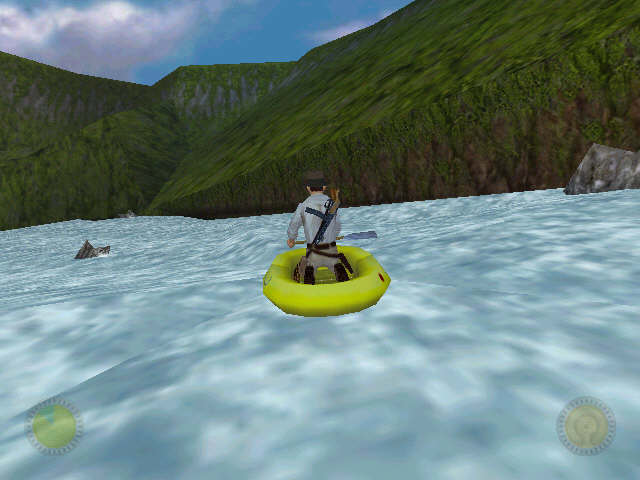 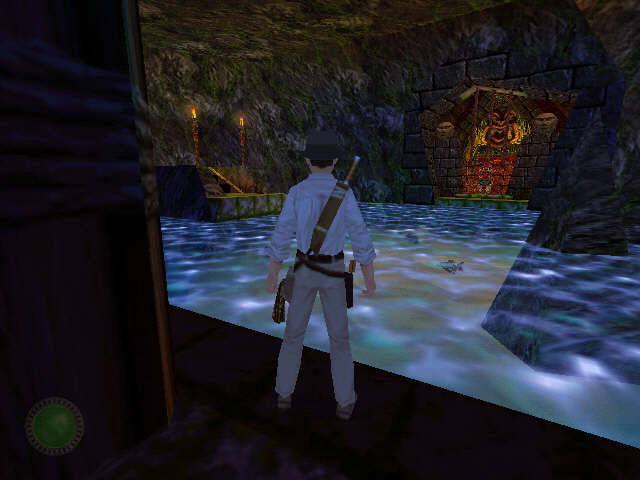 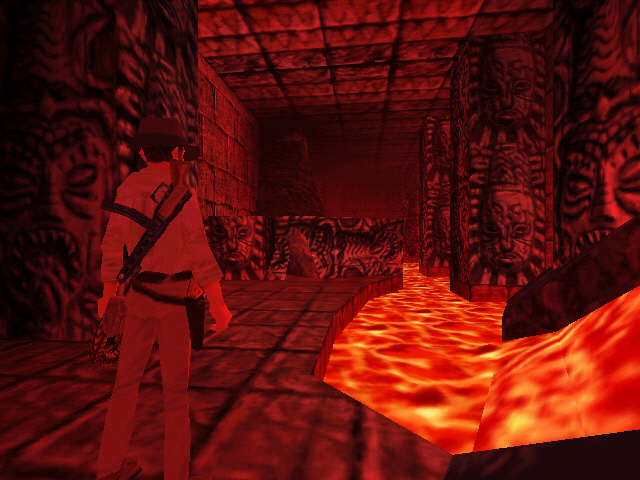 |
One thing Doctor Henry (a.k.a. Indiana) Jones has never possessed is good timing. Be it accidentally stumbling upon a pit of snakes or a den of Nazis, Indiana seems to have a proclivity for stepping into danger. Once again Indiana, and surprisingly Lucas Arts, has shown poor timing with the release of the 3D action/adventure Indiana Jones and the Infernal Machine. In a year punctuated with such excellent action/adventure releases such as Nocturne and Wild, Wild West–games that have found that delicate balance between puzzles and action–Infernal Machine almost feels as though it should have been released a year earlier when lever-pulling and block-pushing were acceptable as adventure substitutes. Yet, due to the bugs that impair but do not ruin the gameplay, Infernal could also have easily been delayed another month or three. Infernal is by no means a bad game; it just never reaches the lofty heights to which it so clearly aspires.
Infernal’s problems begin with its plot. Indiana Jones has always had one foot rooted in reality. Genuine, or what are believed to be genuine, religious artifacts such as the Ark of the Covenant or the Holy Grail are the centerpiece of the story, so that no matter how incredulous Indy’s escapades are, we are always willing to suspend our disbelief and go along for the ride. Infernal, on the other hand, takes a well-know story–that the Babylonians built the Tower of Babel to reach God and heaven–and discredits our disbelief by allowing that the Tower of Babel was actually built to house the Infernal Machine, a contraption that will open up a gate into another dimension called the Etherium, which is inhabited by an evil god named Marduk. This “other dimension,” of course, presents the opportunity for Indy to battle such inhuman foes such as the Lava Guardian, the Ice Guardian and its ice minions, and the bronze Robot Guardian. The most appropriate word I can think of to describe my feelings towards Indiana Jones battling lava and ice monsters is “sigh.” Any theological overtones that could have added depth to the plot are quickly discarded for the nineties version of religion–the supernatural.
Infernal takes place in 1947. The Communists have found the remnants of the Tower of Babel in the desert ruins. The Tower housed a machine that would allow the Babylonians to reach across time and space. When the Tower was toppled, the winged god Marduk’s four disciples and the machine parts were scattered to the corners of the earth. If the Communists can recover the parts and repair the machine, then we will all be guzzling vodka and playing Russian roulette as our national pastime. Indy, being a fan of baseball, makes it his mission to be the first to find the four missing parts (by the way, the missing parts have the powers to allow Indy to accomplish such diverse feats as invisibility and levitation). While the inclusion of Communists gives Indy the chance to utter a great line, “I’m starting to not like these guys,” and it is fun to see Indy involved with foes other than the Nazis, it also presents another problem. If one is to believe the official LucasArts Indiana Jones chronology, then Mr. Jones was born in 1899. That means he is 48 years old in Infernal, and believe me, some of the stunts he performs could only be accomplished by one other person–a twenty-something female supporting an extra thirty pounds of silicon.
Infernal’s action sequences are very similar to a game I swore I would not mention. In fairness, I have never completed one of Lara Croft’s adventures, as I have usually spent more time ogling than I have playing with her (hmm … I should have worded that better). I don’t know if Lara has ever faced supernatural beings or had an inventory item that allowed her to be invisible, but it would not bother me if she did. I do not have a preconceived notion of her as I, and millions of others, do of Indiana Jones. It is wonderful that Indy does not do back flips or swing from chandeliers in Infernal, but I did have a problem with some of the larger blocks he pulled and/or pushed and secretly hoped he was wearing a strong supporter. Jumps that would embarrass the Prince of Persia had me rushing for the Tylenol bottle to stop the ache in my arthritic knees. Yet, even this I could suffer if it were not for the ludicrousness of some of the situations. Very early in the game–and there are a total of 16 globetrotting levels and one bonus level–you find yourself alone in an excavation pit in Babylon. Rather than just exit the pit as any normal person would, Indy must climb upon the unearthed pillars from the dig and then leap to higher ledges. The excavation crew must go through pure hell coming to and leaving work every day. Most of the other action sequences do make sense within the context of the story, and there are even two enjoyable levels with a jeep and a mine car. A whitewater rafting sequence does not come off quite as well due to the limited control over the raft. Indy totes around the usual assortment of firearms, but his trusty whip is the most fun. It is used a great deal to swing from one area to another; once you have wrapped the whip around the appropriate branch or stone, the game reverts to an impressive cut-scene of Indy performing his Tarzan impersonation. If there is one thing that stands out most about the action portion of the game, it is that, with the exception of one level, Indiana Jones cannot shoot and kill any fur-bearing animals. They will run and hide from the retort of your gunfire, but you cannot wound them. Communists can be shot and killed, also scorpions and snakes, but no tigers or wolves. A politically correct Indy maybe?
The adventure part of Infernal is, well, nonexistent. This is a great game for exploration, though. You can run around and pull dozens of levers and climb dozens of blocks and push dozens of buttons, but this is more mind-numbing than it is puzzling. Puzzles that have potential are dumbed down to the lowest common denominator. During the rafting level, you must collect four candles to place in four candle holders to open a secret passage. Yet it does not matter what part of the holder you place the colored candles on or in what order, the door still opens. Around about level 7, Infernal becomes unbelievably repetitive. The scenery changes, new characters appear, but lever-pulling, block-climbing, and button-pushing can only be disguised in so many ways. The intriguing cut-scenes at the beginning and end of levels do more to advance the story than do the puzzles. In fact, if the cut-scenes would have been interactive, Infernal would have been a wonderfully balanced game. Instead, it is a pretender to the bidet.
Little things can make or break a game. The crackling snap of Indy’s whip is as authentic as possible, a fact I can attest to from my many nights spent at Madame Olga’s Parlor of … well, that is another story. The swell of John Williams’ score from the movie always exhilarates. But it is the missing the little touches that add immensely to the gameplay. In Nocturne, bloody footprints marked your path; in Infernal, walking through the snow leaves none. Seeing your breath almost frozen in front of you in Nocturne leaves you with chills; the lack of a similar touch in Infernal leaves the player in the cold. Ledges that are within fingertip reach cannot be climbed on so you can be forced instead to follow a predetermined path. Scorpions appear and poison without warning. While the controls are very responsive to your keyboard and joypad commands, a little thing like falling off the shore and drowning while attempting to place your raft in the water goes a long way towards submerging the gaming experience. The Communists speaking in their native tongue adds to the atmosphere, but a translation of their Russian phrases would have been a welcome addition (I do believe that one of my foes’ exclamations translated as “American adventure gaming wuss” as he stood over my bloody, bullet-riddled body).
If there is a strong point to the game, it is the strength of the Indiana Jones character. Though not voiced by Harrison Ford, Doug Lee (who also did the voice of Indy in Fate of Atlantis) does an admirable job. Again, though, it is the small overlooked details that hurt the gaming experience. Indy has a set of stock phrases he mutters whenever he stumbles across a medical kit or treasure. It was bad enough to still hear Indy exclaim, “Hmm … what is this?” every time he discovered an item in the third and fourth levels. Since this is a linear game that must be completed chapter by chapter, you can only imagine what I was shouting in response to Indy’s “Hmm … what is this” question by the tenth level. If you lower the difficulty of the gameplay (a feature that was obviously included for us Americans), you will hear more of Indy’s voice as he will emit subtle warnings about traps and potentially dangerous situations. This is a nice touch in deference to less-experienced players.
Another highlight of the game is the rich, colorful graphics. From Babylon to the Pyramids to King Solomon’s Mines, a feeling of vast and vacuous landscapes fill the screen. There is, though, an occasional blockiness to some of the characters, and a few ladders are difficult to find due to their flat 2D appearance against the 3D walls. The beginning of each level contains a nice touch as, like the movie, a map section is shown with a line slowly scrawling across the screen to your destination. All of this will be for naught, though, if you do not download the patch from the LucasArts website. That’s right, the game had not even been in stores for a week and a patch was available. Even with the patch, my game still constantly froze at the very beginning of level 4 and whenever I battled the ice monster. It is rare that I complain about a game bug or the need for a patch, but if a company as prestigious as LucasArts cannot release a bug-free game, then what can we expect from smaller publishers and distributors?
So is Indiana Jones and the Infernal Machine worth purchasing and playing? Sure, as long as you are willing to overlook its shortcomings. The Indiana Jones of the movies was always believable no matter what the situation. We never felt he was invincible, but neither did we feel he would perish when placed in a hopeless position (granted, much of this was due to Harrison Ford’s charisma). The game fails in this respect as death and reloading become a common occurrence. His fear of snakes and his conscious decision to think his way out of a dangerous situation before using violence are conveniently forgotten when the story needs to be advanced. But the most glaring problem with Infernal is that it tries too hard to be as epic as the Indiana Jones movies, and a computer monitor cannot convey the large-scale scope of Indy’s adventures as well as a movie theater screen. Though Indy, and Lara, may disagree–sometimes smaller is better.
Final grade: C.
System Requirements: Windows 95/98
200 MHz
32 MB RAM
3D graphics accelerator required
16-bit sound card
4x CD-ROM drive
Direct X 6.1 required (included)
