Review: Homeworld
|
Homeworld Developer: Relic By Ray Ivey 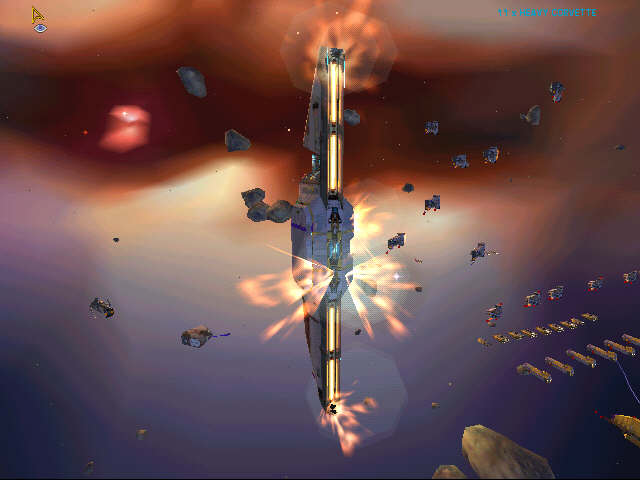 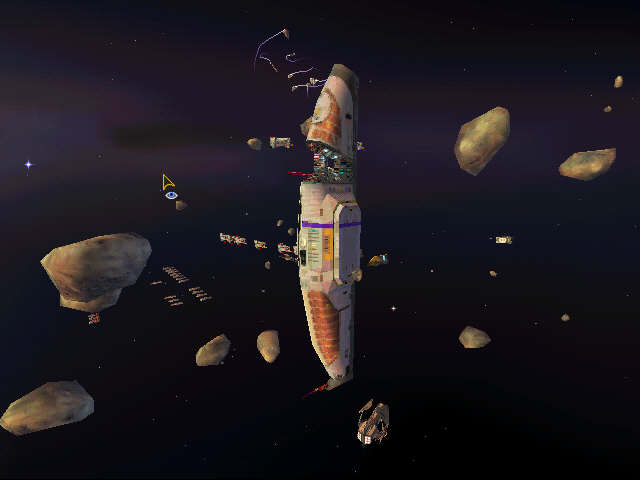 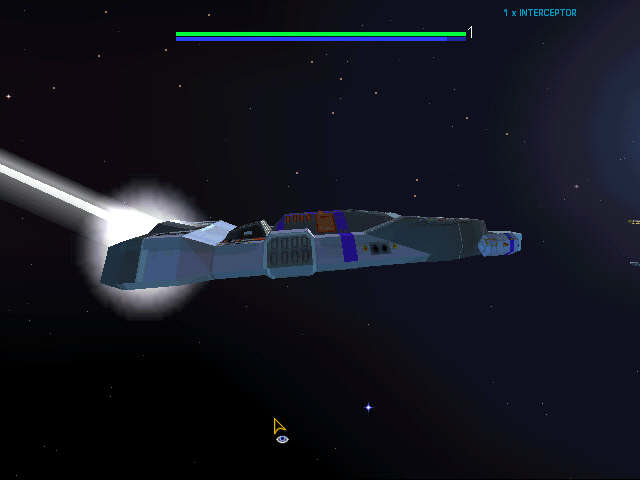 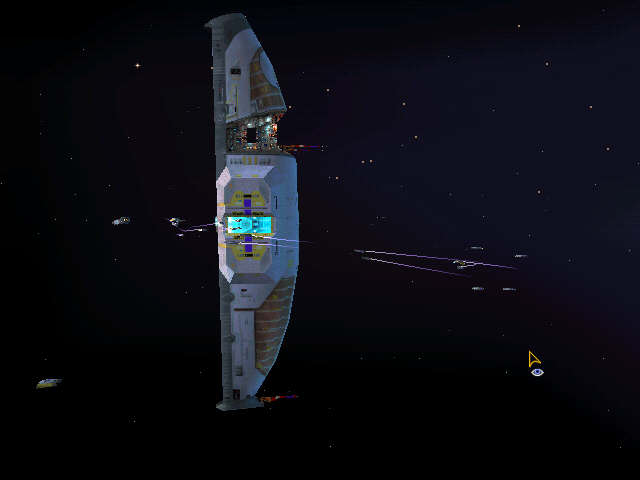 |
What in the world is an adventure game reviewer doing talking about a real-time strategy space game? Maybe it’s time to call security …
I admit, I’m no strategy game player, but I was so blown away by the incredible visuals of this game at the 1999 E3 that I had to get my hands on a copy. What follows, therefore, is obviously not a standard review of the game, but merely my impressions as a wide-eyed adventurer.
What is Homeworld? Homeworld is a visually remarkable 3D real-time strategy game. It follows the story of a castaway civilization whose planet is destroyed and who must find a new home in the galaxy.
The game takes place in space, in three dizzying dimensions. You are in command of the fleet, and you have this incredible God’s-Eye View of everything.
As commander of your forces, you can initiate the gathering of resources (cute little “resource collectors” who go out and harvest dust and asteroids to use as raw material for new ships), research (to learn how to build fancier ships), the building of new ships, and the micromanagement of your fleets in combat and other dangerous situations.
First and last in Homeworld are the stunning visuals. The easy-to-learn keyboard and mouse controls give you amazing freedom of perspective, allowing you to move the camera in literally any direction through three-dimensional space. Coupled with a remarkable zoom capability that one minute allows you to see a fleet of scout ships in beautiful sphere formation, then the next zoom in so close you can see the gun turrets on a single ship, the game becomes a dizzying visual experience. Especially wild is to focus tightly in on one small ship in the heat of battle!
A note about the screenshots that accompany this review. Trust me, they simply do not convey the true visual nature of the game. What gives the game its visual impact is the fluidity of the images, which you can’t really get across in a still shot.
The game begins with an optional tutorial. As with any “optional” tutorial, it’s a real mistake to skip it. I found the tutorial very helpful but no nearly detailed enough. When it was over I didn’t know all I needed to know to play Homeworld successfully. It taught me nothing about creating squads of ships and assigning hotkeys to the various ship groups, and nothing about the various keyboard commands necessary to have ships guard, repair, and other special functions. Perhaps I was spoiled by the superb tutorials in Thief and System Shock 2, which truly did prepare me to play the game effectively.
The single-player version of the game consists of sixteen missions of varying difficulty. The first mission is pretty much a training one, in which you build ships, gather resources, and play with probes. Quickly the missions get much more complicated.
The game is beautifully designed to be an addictive multiplayer extravaganza, as you pit yourself against swarms of enemy ships controlled by human opponents.
Between the missions are intriguing cutscenes done in a stylistic black and white that’s quite different from the look of the game engine.
Music is used quite effectively in the game, from bellicose battle music to the somber strains of Samuel Barber’s “Adagio for Strings,” which adds a very appropriate air of grandeur to the large-scale proceedings.
This game might not turn me into a strategy maven, and it might not turn you into one, either. But it’s hard to deny the poetic appeal of watching your fleet of ships slowly docking into the huge mothership, creating a space ballet worthy of 2001: A Space Odyssey. This is a game worth trying even if you’re not going to turn into a Jagged Alliance 2, Tiberian Sun, Star Craft strategy stud. I challenge you to check it out just for an amazingly different game experience.
Final Grade: A
If you liked Homeworld:
Watch: 2001: A Space Odyssey
Read: Childhood’s End by Arthur C. Clarke
Play: Command and Conquer: Tiberian Sun
System Requirements:PII 233 or equivalent
32 MB RAM
4X CD-ROM
4 MB VRAM
150 MB free disk space
Mouse
Sound card
DirectX 6.1