Review: Game Design: The Art & Business of Creating Games
Game Design: The Art & Business of Creating Games
Author: Bob Bates
Publisher: Prima Publishing
Retail Price: $29.99
 Before we discuss Bob Bates’s Game Design: The Art & Business of Creating Games, let’s bring to the forefront two conspicuous omissions. First, nowhere is there a photograph of the man who penned this book. Now I’ve met Bob Bates in person, so I know what he looks like, but millions of others have never had the pleasure. Being the suspicious type that I am, I strongly suspect that if Bob were not a renowned adventure writer and were instead John Romero or American McGee, his picture would probably be splattered on every other page. The second omission? Just Adventure is never mentioned, not once, even though Bob had the opportunity to do so for 300 pages. Sigh, we adventure people sure do toil in anonymity. So to correct the first slight, to your right is a photograph of Bob Bates. As for the second slight, well, Bob, the ball’s in your court. 🙂
So who is this Bob Bates and what gives him the right to tell anyone how to design a game? Well, Bob’s credentials include numerous, award-winning adventure games that he either wrote, codesigned, or produced, including Infocom’s Sherlock Holmes: Riddle of the Crown Jewels and Arthur: The Quest for Excalibur. More recent are John Saul’s Blackstone Chronicles, Eric the Unready, Frederick Pohl’s Gateway, and Timequest. He is also a cofounder of Legend Entertainment and presently serves as Studio Head for Legend, now a division of Infogrames. In other words, Bob knows his stuff (you may substitute another word here if you so wish).
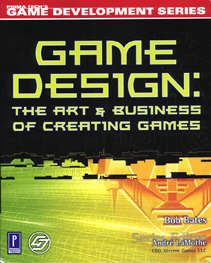 Game Design covers the production cycle of a game from beginning to end, from the initial concept to its life cycle on the store shelf. Chapters cover “Principles of Game Design,” “Genre-Specific Game Design Issues,” “Storytelling,” and “The Development Team,” among others. The author has done an admirable job of always keeping his language and industry descriptions readily understandable to a nonprofessional. Yet never does the reader feel as though he is being spoken down to, but rather like a private invitation has been offered to the inner world of game development. Instead of wasting valuable time deciphering industry jargon, you often feel as though you are in the middle of the creative process, and if you are like me, you will find yourself inserting your own design and story ideas into Bob’s suggestions.
But it is when Bob speaks about adventure games and puzzle design that his prose really shines. Now he is in familiar and cherished territory, and it shows. The chapters on “Storytelling” and “How to Design a Puzzle” should be required reading for anyone considering creating an adventure game. All of the different types of puzzles are dissected: information puzzles, word puzzles, people puzzles, timing puzzles, logic puzzles, sequence puzzles, machinery puzzles, trial and error puzzles, gestalt puzzles … and there are even more! After describing the many different types of gaming puzzles and their pluses and minuses, we are then taught how to design a puzzle and increase the levels of difficulty. Of most interest, though, is the section on how to avoid the common puzzle pitfalls that can destroy a player’s enthusiasm for a game. There is a fine line between what constitutes a memorable puzzle and one that will have the player scurrying back to the store to return a game.
One mark of a good writer is the ability to bring the reader over to his way of seeing things. I’ve always been a proponent of red herrings in adventure games, but Bob makes such a good case against them–“Players spend so much time generating their own false theories that it becomes completely superfluous for you to do so as well”–that I now have an entirely different outlook regarding their inclusion.
What else did I learn from Game Design that I did not already know? Well, you know those Sunday inserts from chain stores like Best Buy and Comp USA advertising sales on computer and video games? “It’s not because the store has singled out those products as the ones it recommends–each of those squares is actually an advertisement bought and paid for by a publisher.” Did you also know that companies buy premium store space to get their products maximum exposure? Neither did I, but rather than divulge any more information from the book, I would rather you put down that joystick for a brief time and lose yourself in the world of game development. If you have ever wondered about a tchotchke, looked for a maguffin, or speculated over “foo” or “frob,” then look no further.
Game Design is highly recommended for anyone who has ever considered developing a game, or anyone who is just interested in the development process. The chapters on marketing and advertising are an added, and welcome, bonus and provide a wealth of information. Potential adventure game developers could not ask for a better instructor or one more willing to share his experiences in the gaming industry.