Review: Fallout
|
Fallout Developer/Publisher: Interplay By Ray Ivey 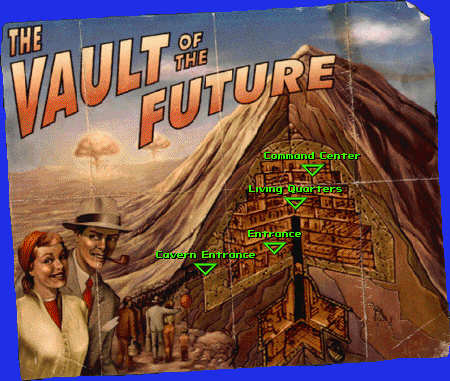 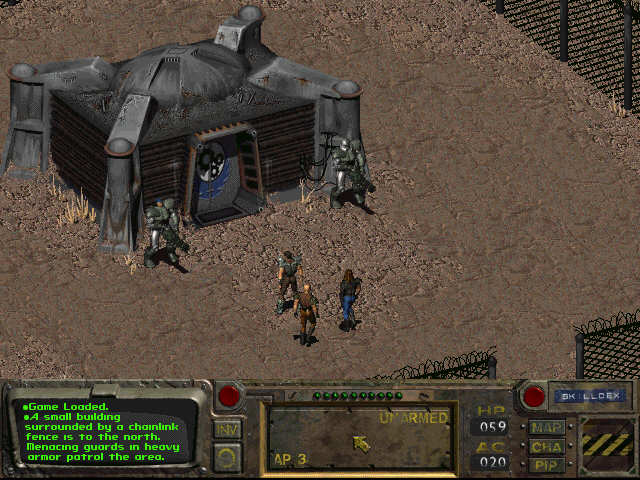 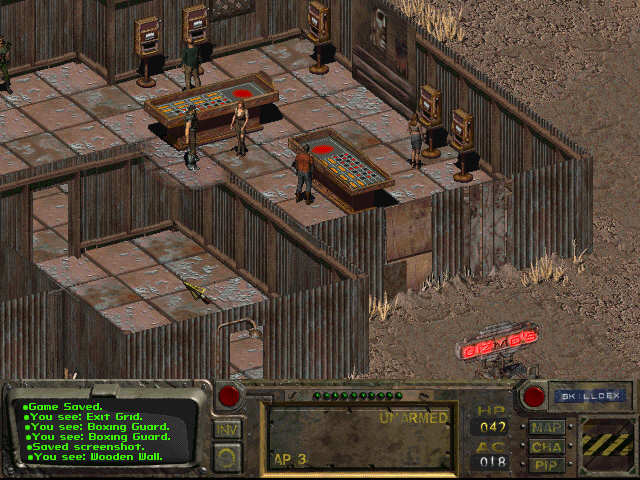 |
I picked up Fallout because I’d always heard it was a great RPG for adventure players to try. And is it ever, brother.
One of the off-putting elements of RPGs to some adventure players, well, to me at least, is that it seems they’re all set in the land of dungeons, dragons, wizards, spells, gnomes, goblins, etc. I can only take so much of that particular fantasy milieu.
In 1997 Interplay released Fallout, the game that kisses those tired old scenarios goodbye. The setting is a post-apocalyptic future. Your clan has been huddling in the comparative safety of a huge underground vault while the outside world is going to hell. After more than a generation of isolation in the vault, however, some of the technology that keeps your clan alive is beginning to fail. Specifically, the computer water chip needs to be replaced. Your character is elected to Leave the Vault and venture into the scary post-war wilderness to find a new chip.
Unlike most good pure adventure games, RPGs really do need good manuals. And Fallout has one of the best I’ve ever encountered. It’s comprehensive, easy to use, and very amusing to read.

The designers also employ for the manual and certain other game elements a wonderful retro-50s style that’s quite fun. It’s a concept that doesn’t quite fit with the actual meat-and-potatoes portion of the game, which is a shame. I would have enjoyed more integration of this style.
The character creation system in Fallout is fascinatingly complex. You begin with several base characteristics, such as Strength, Endurance, Intelligence, Perception, Luck, Agility, etc. You get to “spend” points setting up what the balance of your characters personality will be. Next you pick three key skills–among them Lockpicking, Talking, Barter, Sneak, Steal, First Aid, Light Weapons, Heavy Weapons, Energy Weapons, Melee Combat, etc. Finally you can pick up to two “traits”–such as the fact that your character is good-natured, or a fast learner, or more or less susceptible to drugs or radiation.
Every single choice you make has a consequence, both positive and negative, on your character’s overall makeup. The documentation within the game gives you very good and easy to access information on all these ramifications, making what could be an intimidating chore a fun and fascinating project.
Once you set up your character, you’re off into the scary world beyond the Vault.
The format of the game is third-person, with both mouse and keyboard controls. The graphics in the gameplay engine were a bit of a disappointment, though I guess the post-nuclear war environments would be pretty drab and repetitive. Still, the gameplay is so fun the drab graphics don’t do too much damage.
There is a lot of combat in Fallout, and it is done in the “turn-based” mode. This means that your character takes his/her turn, using a set number of “action points.” Each possible thing you can do in your turn–shoot, apply a medical patch, move, reload–uses up a certain number of action points. When you’ve used your points up, your turn is over, and the bad guys get to take their turn.
This method of combat (contrasted with “real-time” combat) really appeals to me because it makes confrontations feel more tactical and deliberate and less frantic.
Everything you accomplish in Fallout, whether it’s snagging radioactive rats or helping rescue missing children from desert raiders, gives you experience points. When your experience points reach a certain number, you move up a “Level.” When this happens, you get more points to spend on skills, giving you a chance to further refine (and improve) your character’s abilities.
The subtlety in the interactions with other characters is astounding. Here’s an example: I needed to talk a character into helping me go rout a nest of giant scorpions. He said no, not interested. A bit later in the game I made it to a higher level and spent some points on my “Talking” skill. When I went back and tried again, I was able to convince the character to join me.
Like the brilliant recent game Outcast, everything you do in this game affects your interactions with the characters, both positive and negative. As you move through the world you develop a reputation that either helps you or hinders you.
The interface is full of useful tools, including automapping and even auto-note taking, which is a huge help in a big, complex game such as this.
The game has three uber-quests, and unfortunately the first one (find the water chip) really put me off, because it’s timed. In a game world as huge and fascinating as Fallout’s, I wanted to be able to take my time and explore and try new things. Until I completed this first quest, I couldn’t really relax. Fortunately, there’s no such time limit for the other two main quests, and I was able to enjoy myself a lot more after delivering that damned water chip.
This is one of those rare games that oozes quality from every pore. You get the impression that Tim Cain, the game’s producer and lead programmer, really likes computer games, and he made sure that every element of the game is enjoyable. From the opening cinematic, a chilling, multilayered introduction made more ironic by the sweet strains of the Ink Spots singing “Maybe,” you’re hooked by this intriguing game.
The game also features terrific voice acting performed by a cast of fairly big names, such as Richard Dean Anderson, CCH Pounder, Richard Moll, David Warner, Tony Shaloub (a personal favorite actor of mine), Ron Perlman, Keith David, Tony Jay, and Clancy Brown.
The music, by Mark Morgan, is superb; it’s diverse and atmospheric.
The game also features one of the best endings I’ve ever seen in a game. It wrapped up all the major storylines (with variables according to how I played the game, which was cool), and it even threw in a surprising, poignant, but very believable twist that gave the end of the game a great deal of pathos.
I would agree wholeheartedly with my friends to who turned me on to this game. If you are an adventure player who’s been interested in trying an RPG, this is the game to try. Personally, I can’t wait to play Fallout 2!
Final Grade: A
If you liked Fallout:
Watch: The Postman
Read: The Stand by Stephen King
Play: Sanitarium
System Requirements: IBM or 100% compatible Pentium 60 MHz or better
Windows 95 and DirectX 3.0a or higher or DOS 5.0 or higher
1 MB VESA-compliant SVGA card
16 MB RAM when running under Win95 (32 MB RAM when running under DOS)
2X CD-ROM drive
100% compatible Microsoft mouse required
100% compatible SoundBlaster card recommended