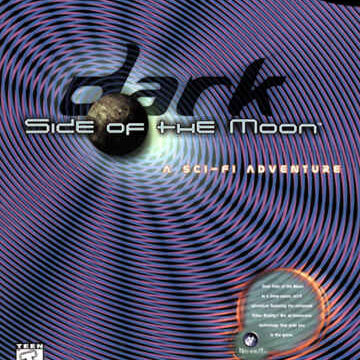
Review: Dark Side of the Moon
|
Dark Side of the Moon Developer: Southpeak Interactive By Craig White 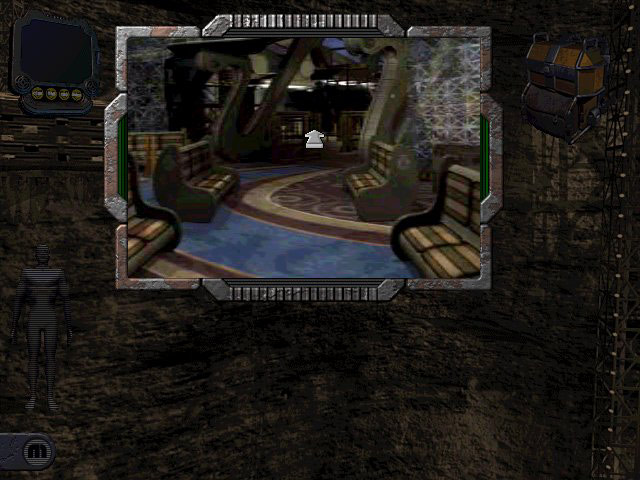 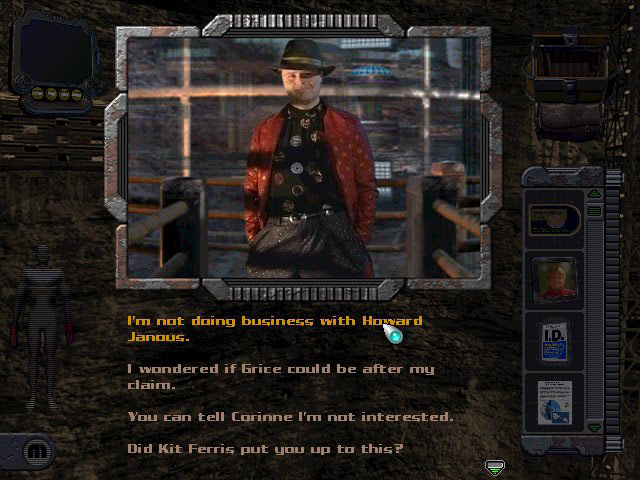 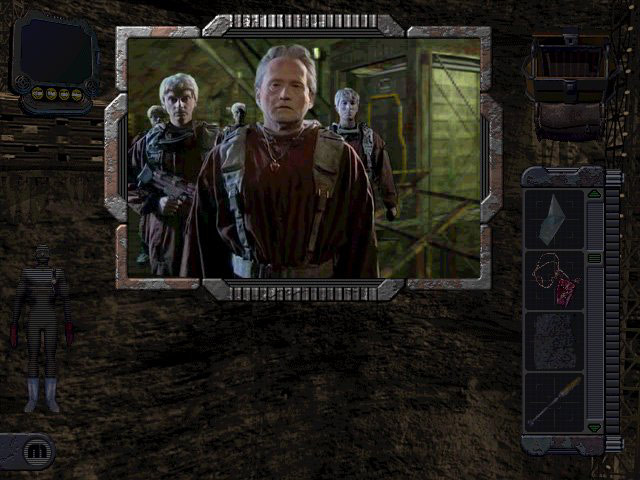 |
I’ve been immersed in the world of Southpeak Interactive’s Dark Side of the Moon now for weeks. After finally finishing the game, I can now say that I am speechless–it’s that good. If you’ve played Southpeak’s first Video Reality game, Temujin, and found it to be disappointing, you will be happy to hear that Southpeak has learned its lesson and showed us how such an engine can make an excellent game. Move over, Mask of Eternity and Grim Fandango, because Dark Side of the Moon is here to take over the spotlight.
As the game opens, you (Jake Wright) find yourself aboard a space shuttle on its way to Luna Crysta. You’ve received work that your Uncle Jacob has died under mysterious circumstances and has left you his mining claim in his will. Praying for great riches and success, you decide to check out his stake. Aboard the shuttle, you meet two main characters in the story: Kit Ferris and Oliver Whistler, who play a large role in this game. In addition to these characters, the game includes a selection of 13 main characters who may not be exactly who you think they are. As the game progresses, more things are revealed and people turn against you. The game gives a constant rush of what will happen next, but at the same time does not rush the player into reaching a certain part more quickly. While I was playing, the game I was not worried about how I could do something wrong or what if this happens. The game was made to be played at a leisurely pace, allowing the player to enjoy the atmosphere and the wonderful story written by industry veteran Lee Sheldon. The plot has many twists and does not seem to get boring at all. It can be said that the game is split up into several mini-quests that are combined brilliantly into a magnificent experience. I need not think twice about awarding the plot an A+.
Thankfully, Southpeak managed to iron out some of the problems with the Video Reality engine that ticked off gamers with Temujin. But if you complained about the small playing area before, you may be disappointed to hear that this has not changed. As seen in the screenshots above, the actual “interaction” area of the game takes up a fraction of the screen. The rest of the screen is filled with the inventory (which is almost unlimited), the speech area (where the player selects which text the character will speak), the VDA (receive video messages and mail), and a full body image of your character for you to wear things (i.e., thermal gloves, lava boots). The graphics abilities of Southpeak have improved since Temujin; they seem to be more crisp and clean and pleasant to look at. The environment has an overall dark look to it, which fits great with the sci-fi theme. The graphics receive a grade of B+.
The puzzles of DSOM fit in well with the plot and are challenging but don’t require a degree in brain surgery. Quoting the press release, this game provides you the opportunity to “survive a wild and deadly roller-coaster” and “traverse a tunnel that seems to have no end.” While there is not a whole lot of new material here, the choice of puzzles is certainly not bad. Gameplay is entirely nonlinear, making the game somewhat replayable. There are two endings, but both are basically the same with a slight difference. Seeing that the puzzle/gameplay is not entirely original or bad, they receive a grade of B.
Since the game is FMV (remember the good old days?), acting is a major area of the game. Thankfully, Southpeak did not opt for actors who “will act for food.” All actors in the game played their parts well and put some effort into doing the job right. While you won’t find the next Tom Cruise here, most should be happy with the results. Sound effects were all well-done, not too loud or too soon/late. The music of the game all fit in well and rounded off the atmosphere. Music, sound effects and acting receive a grade of A-.
An annoying fact about the game is that it requires an enormous amount of disk swapping. Played over six CDs, there has never been a game that cried out for a DVD version more than Dark Side of the Moon. Game designer Lee Sheldon comments: “For the record, the game is designed so that when it becomes necessary to return to another disk, there is a lot to do on that disk, but only if you want to. For example, you can play the game and only need to return to the upper levels via the ‘secret method’ a single time. And we specifically duplicated assets so that the end sequences all play from the same disk.”
Despite the annoying disk swapping, I found the game to be extremely enjoyable. While I am not a huge sci-fi fan, the story drew me in and kept me on the edge of my seat. The game is creepy and will make you jump up in the air at least once, and then you’ll look over your shoulder to make sure no one saw you. Such a deep game as Dark Side of the Moon gives you the feeling that you truly got your money’s worth. If you thought Grim Fandango was a classic, wait ’til you set your eyes on Dark Side of the Moon.
Final Grade: A-
System Requirements: Windows 95/98
Pentium 166 MHz
DirectX 5.0 (included)
32 MB RAM
8X CD-ROM Drive
16-Bit Windows compatible sound card
150 MB Hard Drive
2MB SVGA Graphics