Review: Bud Tucker in Double Trouble
|
Bud Tucker in Double Trouble Developer: Merit Studios |
Bud Tucker in Double Trouble is another one of those extremely rare and much sought-after games that we here at JA play and review from time to time, for what I don’t know–it’s not like they’re readily available to our readers. Perhaps you think we do it just to make you all jealous because we are the privileged adventure gaming gods of the universe and you are merely the hoi polloi, but the real reason is that we want to be your one-stop site for information about any adventure game ever published (yeah … that’s it!).
I was able to borrow a copy of Bud Tucker, and I am once again led to wonder why all the brouhaha about this and other games of its ilk (such as Flight of the Amazon Queen and Orion Burger). Sure, it is an okay game, but it is far from being one of the greats. One thing that surprised me is the lateness of the release date: 1997. How did this game become so rare so quickly? Plus the whole game looked and played as if it were from a much earlier period … say, 1993, which is deep into the Jurassic era of graphic adventure games. In style of gameplay and graphics quality, it was comparable to The Secret of Monkey Island or Beavis and Butt-head in Virtual Stupidity, although those are both much better games than Bud Tucker. (I’m guessing the programmers started the game in 1993 and it took that long to finish, and meanwhile their efforts did not keep up with the fast changes happening in the computer world.)
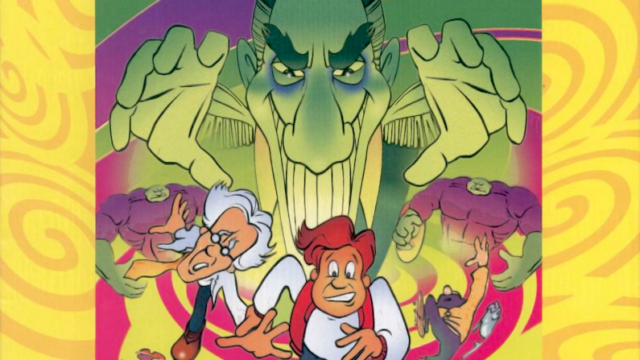
You play as Bud Tucker, a pizza delivery boy. Your best customer and friend, the Professor, has invented a machine that can clone inanimate objects. Oh boy, you think, pizza for everyone, all the time. But alas, it is not to be–in bursts the evil Dick Tate and his two henchmen. They steal the cloning machine and kidnap the professor. Dick Tate goes on to adapt the cloning machine to duplicate people and starts populating the world with his brainless creations. The game plays out in three distinct chapters: Your first mission is to locate the professor, your second mission is to escape from Dick Tate’s stronghold, and last but not least, you must save the world.
The mechanics of the game involve an inventory and a wide selection of verbs. You choose how you want to interact with what, and combine inventory items, and all of those standard strategies that have served you so well in the past. It’s just pure point-and-click, no dying, and no timed sequences. One nice thing is that the inventory dumps out after each chapter, so you get a fresh start in your junk acquisition.
In theory, you can’t make a mistake, but I ran into a huge programming loop kind of thing that is worth mentioning: I took certain actions that landed me in jail, escaped from jail, went back to the place where I started the actions that landed me in jail, and then went back to jail again. However, the second time I was in jail, all of the things that appeared onscreen right before I escaped from jail were still there, but they were inactive and I could not get out. I tried pretending that nothing had changed from the first time I was there and clicked on where the things used to be, but that didn’t work, either. I just had to restore an earlier game and repeat those parts. The beta testers overlooked a major point. Other than that, though, the game played flawlessly, in a DOS window using Windows 98.
The graphics are high-quality … if the game had been released four or five years earlier than it was. For a 1997 game, they were substandard. The pixels were biggish, the animations were sparse, and the hotspots did not match up in some instances with the items’ location onscreen, making it damn near impossible to find these items. (This is one game where you will definitely need to get some hints because of that nasty little factor.)
The music is in annoying short loops, but in this game, it fades out about 20 seconds after you arrive at each location. However, you do visit each location several hundred times over the course of the game, so it definitely becomes an irritant. The voice acting is passable, and the sound effects are actually quite good.
The humor is just plain lame for the most part–Bud Tucker’s name is the best joke in the game. And you know how quite a few games are programmed to insult you when you do something wrong? Bud Tucker does that, too, but he always called me “dude” or “guy” or “[insert your own synonym for male],” and that really started to bug me after a while. And the insults aren’t cute or clever, they are just, well, insulting, not to mention repetitive–Bud’s repertoire consists of about seven different slurs to cover 2,000 mistakes that a player will make.
“So,” I can hear you saying, “lame dialogue, hackneyed gameplay, sexism in the insults, subpar graphics–this game must really suck.” Well, surprisingly enough, it isn’t that bad. I’m hard put to think of one specific good thing to say about it, but it definitely had some measure of that all-important intangible–the fun factor. Actually, now that I have thought about it for a second, here are some really good points: no mazes, no timed sequences, no sliding tile puzzles. Absence of those three things is worth a whole grade point in itself. I am not sorry I played Bud Tucker. But I am glad I played a borrowed copy and didn’t pay big money or trade away something good for it.
Final Grade: C
System Requirements: 486/33
8 MB RAM
2x CD-ROM
DOS 5.x
Sound card