Review: Arthur’s Knights: Tales of Chivalry
|
Arthur’s Knights: Tales of Chivalry Developer: Cryo Interactive By Tom Houston |
The year is 1428. In a castle in France, an eleven-year-old boy of nobility hurries through the halls and into the library, where he fulfills his appointment with his teacher, Master Foulque, who is also the family scribe. The young lad anxiously pleads with Foulque to tell him stories about the legends of King Arthur and the escapades of the brave Knights of the Round Table.
Foulque obliges and begins to unravel the storied history of Arthurian legend in Fifth Century England, where myths and reality are often difficult to distinguish. Known as Britain in the Fifth Century, England had been conquered by Roman legions, who had spread their Christian beliefs to these remote lands and established ruling provinces.
The troubled Roman Empire at home began to crumble, and the Romans abandoned Britain. Without the protection of the Roman legions, the provinces were attacked, pillaged, and burned by Saxon barbarians. What resulted was a Britain that became a land without law, where survival of the strongest was the way of life.
Dismayed and disillusioned, Britons returned to the ways of their Celtic ancestors. Numerous small kingdoms were formed, and the competition for power and land led to frequent wars among these fiefdoms. The times were dark and brutal, so some Britons sought solace and protection from the “new” Christian god, while others turned to Merlin and the old beliefs of the ancient druids and their great magicians and goddesses.
It was into these Dark Ages that Arthur was born, as the illegitimate son of Uther Pendragon and Igraine, who at the time was the wife of the Duke of Cornwall. Legends tell us about Arthur’s successful campaigns on the battlefield, particularly against the Saxon barbarians and their supporters, and how he was able to ultimately establish himself as the High King of Britain.
Along the way, Arthur formed his fraternity of Knights, who were usually of noble birth and who had the financial means to outfit an army. When the Knights attended a meeting at King Arthur’s castle (Camelot), they would squabble over who would get the preferred seating near the head of the table, so Arthur, at the suggestion of Merlin, had a round table constructed, thereby assuring that no one Knight would have precedence over others. Thereafter, the Knights, renowned for their strength, courage, and skill in combat, were known as the Knights of the Round Table. The Round Table could seat 150 knights, and each seat had the name of a Knight written on its back, except one seat (the Siege Perilous), which was to remain unoccupied until the true Grail Knight was found. According to legend, the original Grail Knight was Perceval, who was later succeeded by Galahad, the son of Lancelot.
Over the eons, historians recorded the legends of Arthur and Camelot, because they were symbols of using might for right. Arthur was a king who strived to protect his people from evil and to provide justice for all. In spite of these lofty goals, Camelot was not the perfect society. There was jealousy, intrigue, betrayal, adultery, and a number of other problems, but always Arthur tried to do what was right.
As such, he established his Code of Chivalry, which demands that the Knights employ the virtues of Courtesy, Honor, Justice, Loyalty, Courage, Faith, Humility, Charity, Hope, Generosity, etc. in their daily endeavors.
And so, as the Arthurian legends abound, we listen as Master Foulque introduces his young pupil to the story of Bradwen, son of Cadfanan, King of the Atrebates, who like Arthur was illegitimate and who would face many challenges and persevere to become one of King Arthur’s Knights.
The Story’s the Thing
The young boy is told that he can choose between a Red Book, which chronicles the story of Bradwen as a valiant knight who follows the Celtic traditions and serves the magic of Merlin and the power of the great goddesses, or a White Book, which tells of Bradwen the Paladin, a pious knight, who is a Christian and defender of the cross.
Although, for the most part, many of the characters and the locations are the same no matter which book you choose, the story changes, and you will encounter different situations that require totally different approaches in order to accomplish your objectives. The result is that you have two different games to play, which makes for more hours of gameplay than you would normally get in an adventure game.
In each story, Bradwen will travel a difficult road that will take him from his family home in Uffington, where he must constantly be aware of the hatred and danger presented by his half-brother, Morganor, to the forests of Arden (the home of Merlin), to the religious sanctuary of the town of Magovenium, to the magic, mystery, and treachery of Avalon, where fairies and the great goddess Morgan reside, to the village of Tintagel (Cornwall), where the ogre’s camp is a very serious threat to his survival, and then to Camelot, where he will seek justice from Arthur.
Two different journeys along similar paths will provide the player with two fascinating stories of how Bradwen overcomes injustice and deals with life’s challenges and decisions in completely different ways, while he seeks to use the power of might, as represented by the sword or by the cross, for the benefit of his family or friends and to bring right to the wrongs that are fostered on humanity.
Along the way, Bradwen will meet many of the legendary characters of the times (i.e. Gawain, Lancelot, and Guinevere) and the fairies and goddesses, who will offer challenges, temptations, betrayals, friendships and rewards, all of which gradually introduces him to the Code of Chivalry. The choices that Bradwen makes will silently be measured against the Code, and the result will be crucial to the player’s survival in the game. So, when given choices, and you will be given many tests of honor, choose wisely and remain true to the Code.
Looking back on my experience playing Arthur’s Knights, I think the stories were definitely the strength of the game. I always found myself eager to move on to the next interchange or the next challenge. The history, characters, and legends of the times (the Dark Ages) are just as fascinating in this game as they are in the history books. The stories flow energetically and ever with an aura of excitement that brings you to the edge of your seat as you pursue the goals of justice, even though they somehow seem to be often slightly out of reach.
Each story is presented as five main quests, generally with eight to ten episodes that take you from location to location, as you follow your adventures. In an interesting twist on the usual adventure game, progress in your adventuring, involving all of the important actions you make and results that you attain during game play, are recorded/written down by Foulque in the Book of Adventures, which can be accessed onscreen at any time.
The Gameplay
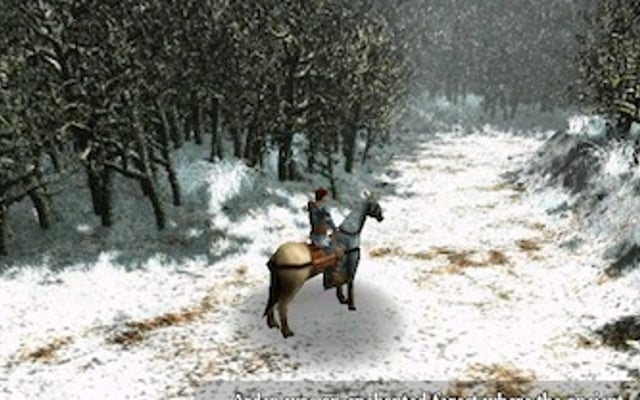
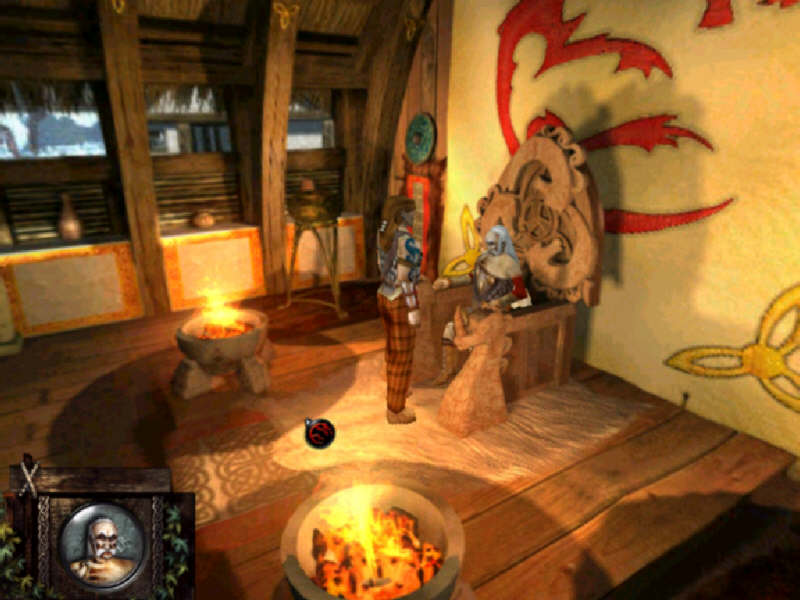
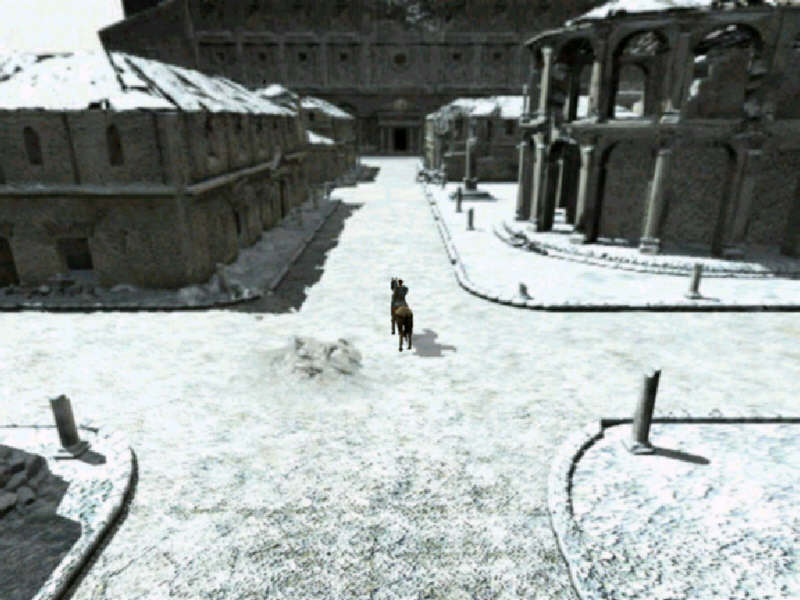
Arthur’s Knights is played from the third-person perspective, and the camera angles are always appropriate, giving the player a good view of the activity and the surroundings. The transitions from one scene to another are smooth, and you won’t have any problem maintaining your orientation on the screen.
Movement in the game is accomplished by using the arrow keys on the keyboard. The arrow keys will cause Bradwen to walk, to run (use the shift key with the arrow key), or to ride his horse within a scene or from one screen to another. Bradwen must be on horseback to be able to travel from one regional location to another (i.e., from Arden to Camelot). He may travel to places within a region either on foot or by horseback.
The mouse is used to access the menus and to make selections from the menus. The mouse brings up the interface bar at the bottom of the screen, which gives the player choices from an activity screen, the inventory area, the Book of Adventures, or the menu globe.
The activity screen indicates where you are in the game (location), if a conversation is possible, and if you may engage in combat. Now, before you get too distressed about combat choices, it should be noted that if you do choose combat, you have no control over the actual combat or the result of the combat. It is all scripted. You just sit back and watch a video that will determine your fate. When I died a few times, it was because I made the wrong choice, as determined by the Code, rather than because my reactions or prowess with the sword were too slow. That suits me just fine.
The inventory area contains three types of inventory: the inventory of objects, the inventory of subjects (clues that can be discussed with other characters), and the destination inventory (regions that are available for you to travel to). When objects, subjects, and destinations become available to you, an icon of the item appears on the screen with a moving arrow indicating that the item is becoming available to you.
The Book of Adventures allows you to check on your storyline progress, and the menu globe provides you with the ability to return to the game, access the historical database (yes, this is an “edutainment” game), save your game, or quit your current game and return to the main menu.
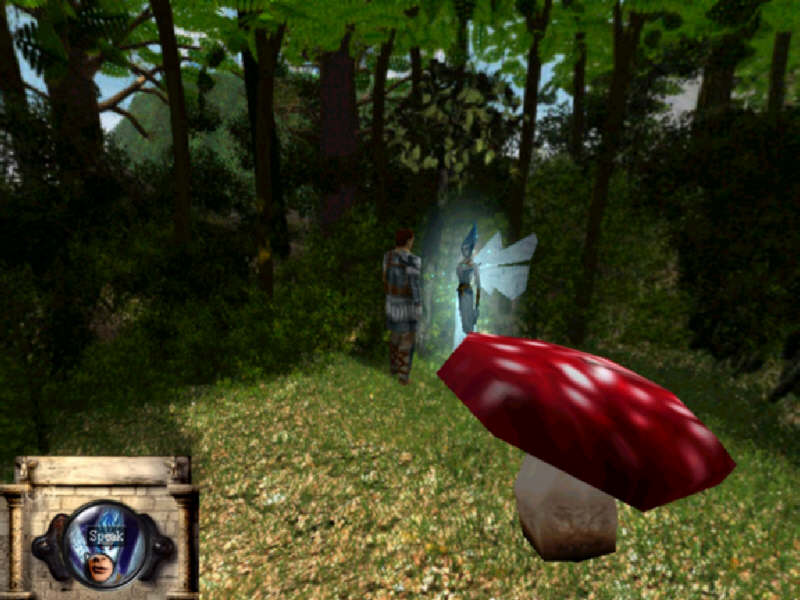
One last thing–the space bar is the action key, which lets you speak to someone, open a door, or pick up an object.
Although I generally become concerned when I find out that I’m going to have to use the keyboard for action in a game, I had no problem with this in Arthur’s Knights, because the use of the keyboard was limited to the arrow keys for movement only. In fact, I now prefer to use the arrow keys for movement, so long as I can perform the other functions with the mouse.
The Graphics, Sound, and Music
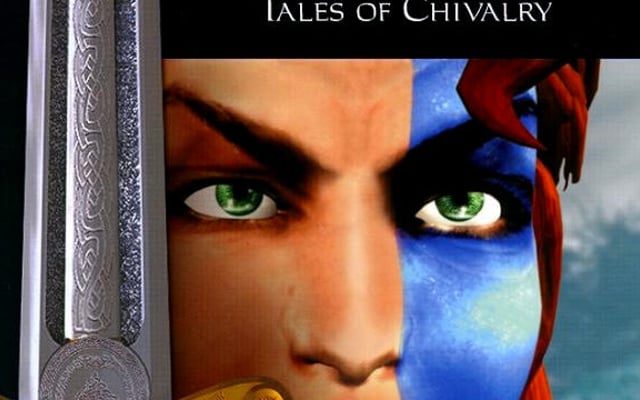
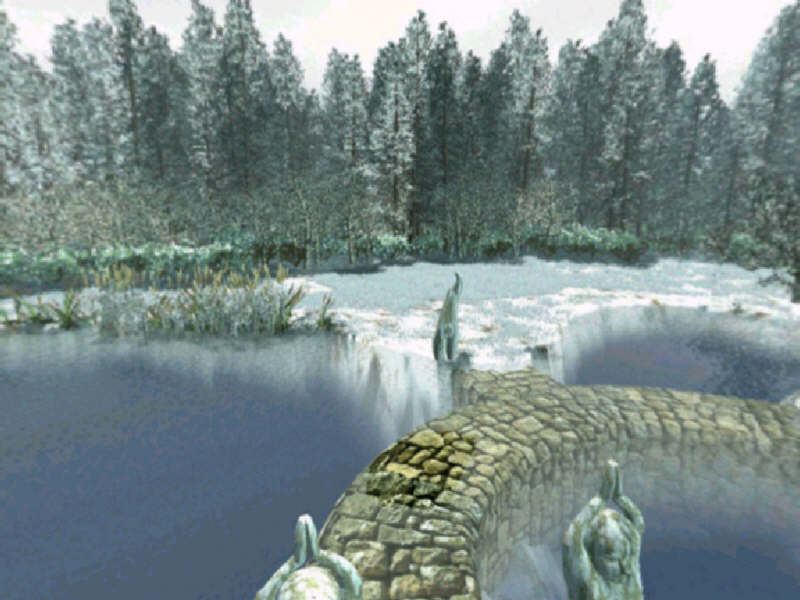
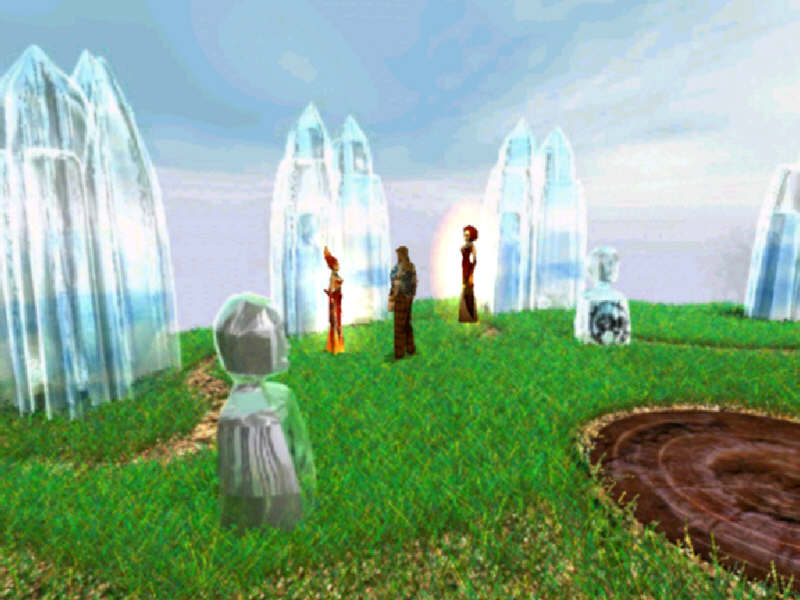
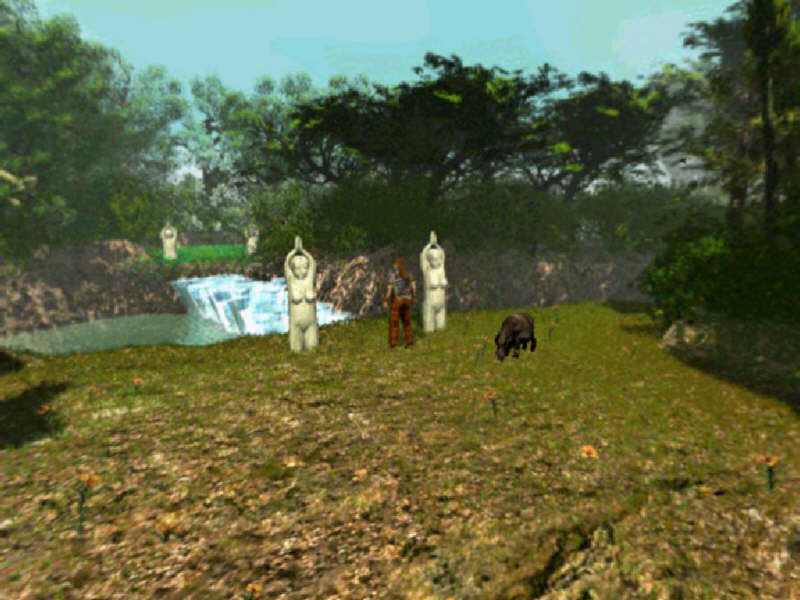
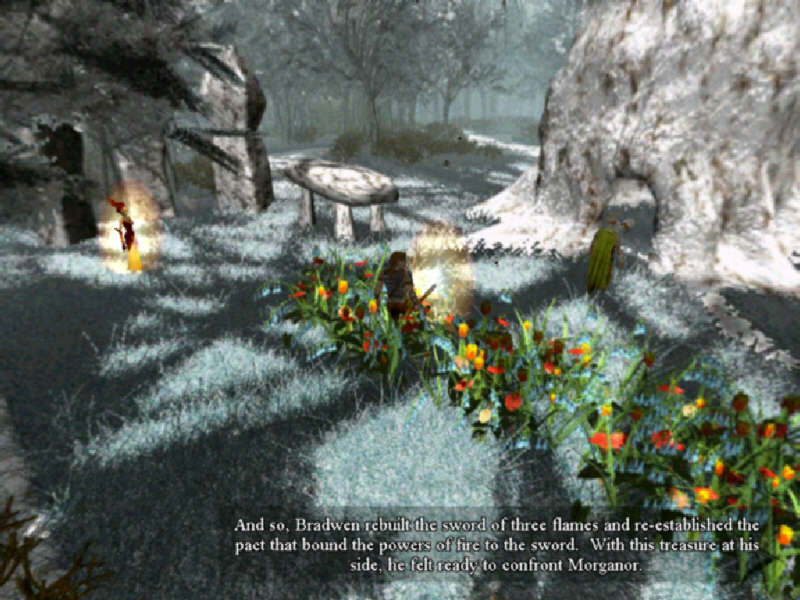
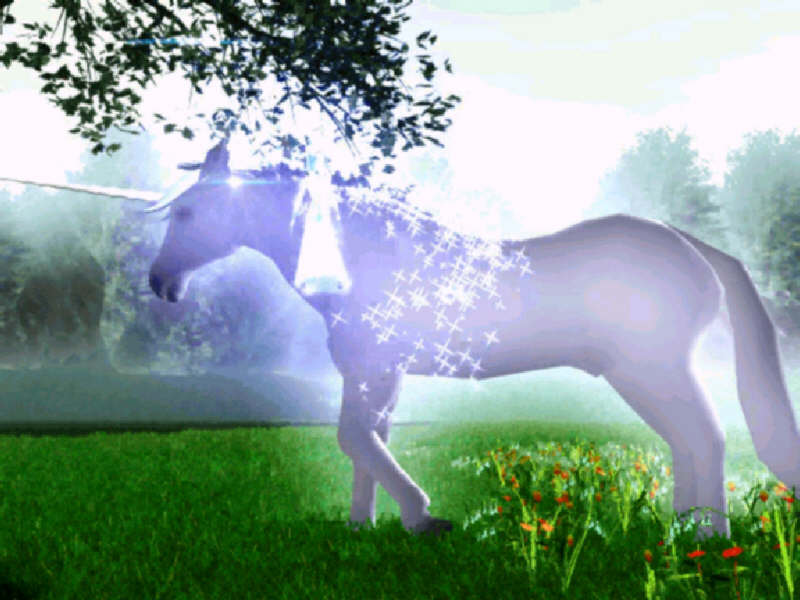
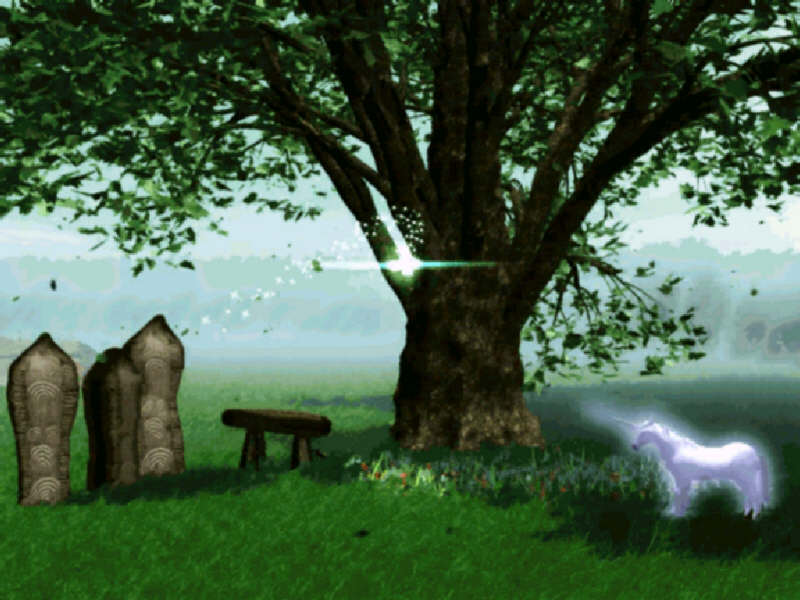
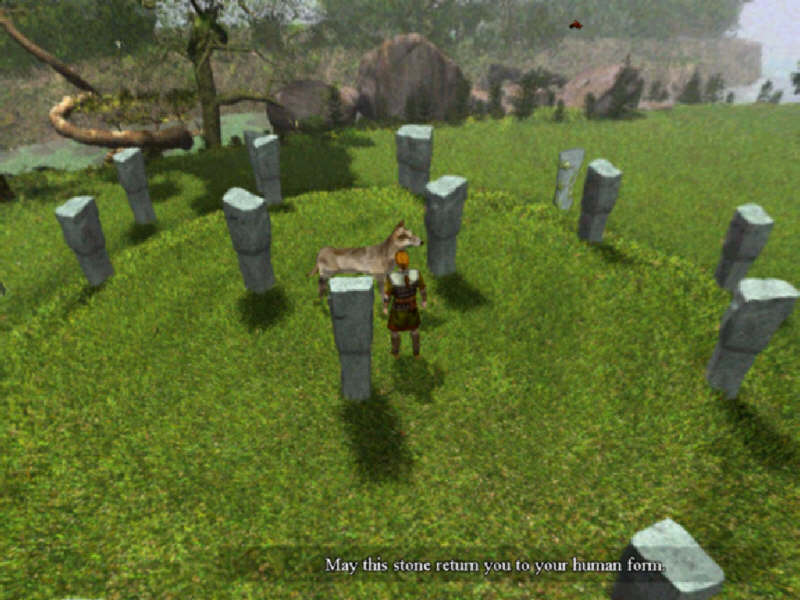
Like all of the Cryo games, the graphics are magnificent. The 3D characters are among the most realistic that I have seen to date, and they are beautifully presented on stunning 2D backgrounds that abound in detail with terrific colors.
The animations, which are also provided in 3D, are very fluid in movement, showing shows the motion of characters walking, horses galloping, flags flying or the numerous animals, birds and butterflies that punctuate the scenery, so wonderfully. The sight of fairies appearing with beautifully colored wings fluttering is a sight to behold. Also, as previously mentioned, the combat scenes are scripted as video animations, and they are very well done with smooth movements that are extremely realistic.
Well, everything isn’t always just right, and in Arthur’s Knights, it’s the sounds, the music, and the voice acting that comes up woefully short. No, it’s actually very annoying. There is no music. This means that at times when Bradwen faces particularly suspenseful situations, there is no enhancement of the suspense from a crescendo of pulse-stopping music. When Bradwen is at peace with his mission, there is no music to soothe the soul. What there is, however, is chanting, particularly from Bradwen’s troubled wife, Gwen, and his revered uncle, the Bishop Novelius, all of which is very unnerving.
The voice acting is generally fairly good, except that at times, for no explainable reason, the tone of Bradwen’s voice changes dramatically to offer much higher-pitched vocal sounds that are too weird to describe adequately. I supposed that he was just excited at those times, but the vocal result is pretty awful. Also, Sir Lancelot’s voice has a very profound French accent, and Sir Gawain’s voice has a very strong Scottish tongue-tipped trill sound, each of which is curious, at best.
The Puzzles
The puzzles consist primarily of collecting and using objects, gathering clues that can be discussed with various characters in the game, and making the right choices when honor is at stake and the Code of Chivalry needs to be upheld. All of the puzzles in Arthur’s Knights are logical and must be accomplished or performed according to a linear sequence of events.
You will not have to worry about going off in the wrong direction, because you will not be able to travel to other regional destinations until you have fulfilled all of the required tasks, gathered all of the needed clues, and found all of the necessary objects in the region that you are presently in. Obviously, only those gamers that like to be guided linearly need apply for Arthur’s Knights. Again, suits me just fine.
Camelot Awaits
Bradwen’s stories are the strength of the adventure of Arthur’s Knights, and you will enjoy the adventure, if you have a passion for historical adventures, because this game is packed with the legends of King Arthur, Merlin, and the famous and courageous Knights of the Round Table.
The weakness is the absence of music, woeful chanting, and voice acting, which shows that attention to supporting details is important so that the game player gets a fully satisfying experience.
Arthur’s Knights is the third game in Cryo’s Legends series of historical adventure games, after The Time Machine, which I never finished because it was horrible, and Odyssey, which languishes on my shelf of unplayed games because I was so discouraged by my experience with The Time Machine. However, this time, with Arthur’s Knights, I think that Cryo has really improved its effort, and the result is that it has developed a historical adventure game that a great many of you can enjoy. No, it’s still not perfect, but it’s a distinct move in the right direction.
As you contemplate whether Arthur’s Knights is for you, you might want to consider the fact that Camelot awaits. All you have to do is face the challenges of enemies, outwit rivals, seek glory and justice by forging your fate with the aid of many of the renowned characters of the Arthurian legends, and finally choose your destiny.
How will you deal with the treachery and hatred of your half-brother Morganor? What secret power does Morganor possess? Will you be able to protect your wife Gwen and infant son Madog from danger? Is Lancelot guilty or innocent of the crime for which he is accused? Can you outwit the great goddess Morgan and convince the fairies to help you? Will you be able to convince Arthur that your request for justice is justified? There’s much more, but the rest is up to you!
Final Grade: B+
Minimum System Requirements:Windows 95/98/ME
Pentium II, 300 MHz
64 MB RAM
12X CD-ROM
8 MB Direct-X Compatible 3D Video Accelerator Card