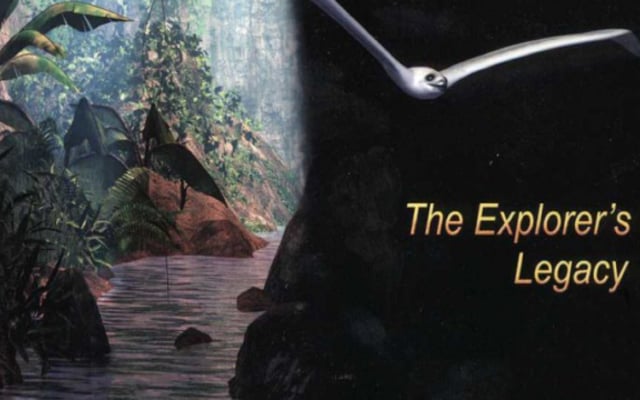
Review: Amerzone: The Explorer’s Legacy (English Version)
|
Amerzone: The Explorer’s Legacy Developer: Benoit Sokal By Tom Houston |
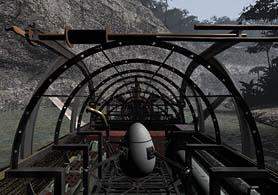
From the moment that you encounter the postman riding his bicycle down a country road near the seaside in Northern France and learn that you are both headed for the same destination, an old explorer who lives in a lighthouse, you have a strong sense and eerie feeling that you just might be in for an unusual, exciting adventure.
You, as the player, are a journalist who has been summoned by the aged explorer who has been “branded” with questionable credibility for over 50 years. The old explorer’s tale of travel to the mysterious Central American country, called Amerzone, and his story claiming that the large egg that he brought back was associated with native Indian tribal beliefs and rituals involving the proliferation of great white birds that fly continuously from the time that they are born and never land seems incredible, yet curiosity and the opportunity for a good story probably will get the best of you.
Upon entering the lighthouse home of the old explorer, Alexandre Valembois, the story unfolds as you learn more about what happened in the Amerzone almost 60 years ago.
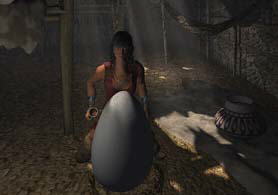
The Amerzone was a sort of “lost world” in which the native Indians for centuries had lived an idealistic existence, which had at its core their rituals and beliefs in providing assistance to the birth, life, and survival of the great white birds.
The “perfect” world of the Amerzone will be changed forever by three “invaders” who come there, each with their own agenda, and each with objectives that will have destructive effects on the culture, ecology, and very survival of this country.
The politician turned dictator, Antonio Alvarez, is a native of the Amerzone region, educated in France, who wants to use his power and influence to modernize the country, even though the consequences of his “march toward progress” will be the destruction of the idealistic lifestyle and beliefs of the native Indian peoples.
The missionary, David Mackowski, wants to foist his more modern religious teachings on the native Indians, in order to “rescue” them from their “misguided” beliefs in the mythical great white birds.
The explorer, Alexandre Valembois, has heard the stories of the great white birds and the rituals involving their egg and wants to make a name for himself. His visit to the Amerzone leads to a relationship with a native Indian girl, Yekoumani, who nurses him back to good health after he is injured. Eventually, his greed gets the best of him, he betrays the native Indians, Yekoumani and their culture, by stealing the egg and bringing it back to France.
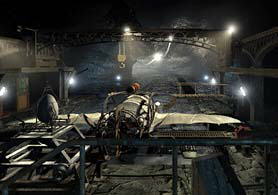
It is here where the story really begins.
The Story’s the Thing
You, as the Journalist, have been asked by Valembois to “right the wrong that he has done” by returning the egg to the Amerzone and to the “nest” of the great white birds. It appears that the egg is still fertile, and it is the hope of Valembois that once returned it can be replaced, and the restored proliferation of the great white birds will regenerate the ritual beliefs and the culture of the native Indians and relieve him of his lifelong legacy of guilt.
Unfortunately, Valembois dies before he can advise you about the location and use of his transport invention, the Hydrafloat, or the location of the egg. If you are to accept his dying plea and return the egg to the Amerzone, you will need to gather more information from within the lighthouse and locate these items.
The lighthouse turns out to be much more than just a home for Valembois, and your tasks become more challenging as you uncover more hidden secrets and explore the premises.
The excitement is just beginning, so it is impossible for me to tell any more of the story, because you are about to embark on a thrilling adventure that will take you from the lighthouse to the Amerzone jungles, the native village of Puebla, and eventually the volcano “nest” and home of the great white birds.
The story is told in seven chapters that are contained on four CDs. I found the story to be fascinating and riveting, such that you may have difficulty leaving your gameplay for such mundane things as sleeping or working. The story deserves an A+.
The Gameplay
This is a first-person perspective adventure game with 360-degree vision that allows the player to rotate around his/her perspective and to observe or interact with what is within the current range of view. The 360-degree rotation feature may take a little time to get comfortable with, but the speed of “panning” can be adjusted through the options menu.
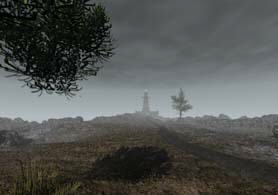
The main menu, which is accessed by pressing the “Esc” key, provides a choice of options, save game, load game, and quit game.
The inventory is accessed by right-clicking the mouse, and inventory items can easily be selected and used by employing typical methods of manipulation.
All movement and actions are controlled by using the left mouse button. Icons appear at “hot spots” to indicate direction of possible movement, listening to a character speak, actions that can be performed on an object, zooming in for a closer look, picking up or holding an object, turning pages of a book or journal, and exiting back to the main screen.
You can only listen to other characters speak, as there is no ability to converse with them or to ask questions.
All in all, it’s a pretty simple and familiar interface that any adventure game player should be comfortable with.
Your progress through the game will be linear, in that, unless or until you solve certain “puzzles” or perform certain activities, you will not be allowed to finish the chapter of the story that you are in and, therefore, you cannot go forward to the next chapter. Fortunately, the problems that you encounter and the solutions that you seek are “right under your nose,” so you won’t need to backtrack to previously explored locations. Personally, I like this linear approach. Probably due to my structured, engineering training, I function better in a somewhat controlled environment, rather than a random environment. The Gameplay receives an A.
The Graphics/Animation
Since Amerzone was created by comic strip artist, Benoit Sokal, it won’t come as a surprise that the graphics and animations are superb.
The wonderful graphics provide breathtaking visual images of the game’s environments as you explore the lighthouse, travel the Amerzone rivers, jungles, and villages, and eventually reach the volcano “nest” of the great white birds. The colors are vibrant when they need to be, i.e., plants, flowers, birds. In fact, they’re almost photographic.
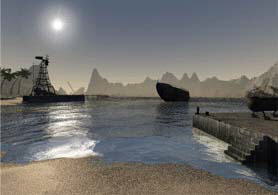
But for me, the real plaudits should be extended for the spectacular animations that are used throughout the presentation of the game, often to raise the impact that a particular visualization will have on the culmination of an important part of the storytelling. At other times, animation is used to bring to life a number of strange creatures (animals) that inhabit the Amerzone. For instance, my favorite was an animation that follows a task in the story where the Journalist is required to free a whale that has been trapped in a fishing net. What follows is not just spectacular but pure beauty.
The fabulous graphics and excellent animations cannot really be described. They have to be experienced. Why is it that the French are so accomplished at graphic presentation? The graphics and animation are off the scale with an A++.
The Sounds/Music
The sounds and music are also excellent and provide just the right ambient feeling as you progress through the various game locations. Never intrusive, the music is nonetheless captivating and contributes greatly to the overall atmosphere, changing appropriately as the situation or locale in the game changes.
But it is the sounds that really got my attention. Whether it was it the unique sounds that were associated with each of the unusual creatures (animals) that were encountered along the way or the background sounds that would enhance the feeling of the environment that you were in, the sounds were always “right” and always would allow the game player’s experience to be heightened.
At the risk of being judged to be rather obtuse (or worse), I will nonetheless offer the following experience from my gameplay as an illustration of the effect and power of this game’s aural presentation. At one point during the game, I was distracted by what sounded like a cricket. I was convinced that the cricket was in the house, behind my computer. I went to get a can of Raid and sprayed liberally behind the computer. Almost immediately after doing this, I noticed that the cricket sound was “louder” near the computer speakers. Well…I guess I felt stupid … but impressed by the sounds. Now admit it … something similar to this probably has happened to you. Maybe not.
The sounds and music get an A+.
The Puzzles
Generally, the length of time that it will take me to finish an adventure game will be determined by the difficulty and frequency of puzzles.
The puzzles in Amerzone are always solved by being diligent in moving around and observing what is before you as you explore your environment and collect objects. As long as you are careful and thorough, you can solve the puzzles without too much difficulty.
Except for a couple of challenges, I found the puzzles to be easy to moderate, so you aren’t going to suffer much frustration and can expect to move through the game at a comfortable pace.
The puzzle factor did have an effect on the overall game, in that it shortened the game somewhat, which is the only slightly negative thing that I will contribute to my experience in playing Amerzone. I wish that it had been longer-lasting.
The puzzles get a B.
My overall rating for the Amerzone is an A+.
At the risk of “turning off” some potential buyers of the Amerzone, I’ll say that this game has the look, feel, and quality of a Myst-like game. But with a much more engrossing story, excellent graphics and animations, marvelous sounds and music, and less difficult puzzles to solve, the overall experience for me ranks right up there near the top of my list.
At a time when good, new adventure games are a scarce commodity, if you are partial to the true adventure game (no shooting, jumping, or action/arcade sequences), I would recommend that you consider Amerzone. Buy it and enjoy it.
You can download a demo here.
System Requirements:
Windows 95/98
Pentium 166 (200 recommended)
32 MB RAM (64 MB recommended)
8x CD-ROM drive (16x recommended)
Soundblaster or compatible sound card
2 MB graphics card (4 MB recommended)