Review: Age of Wonders
|
Developer: Triumph Studios/Epic Games By Adam Rodman 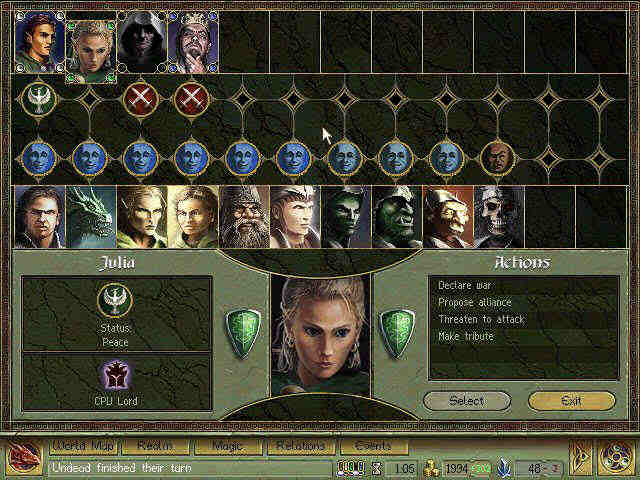 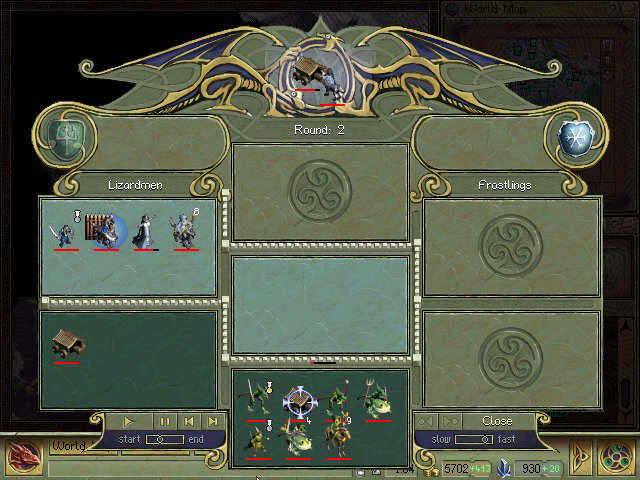 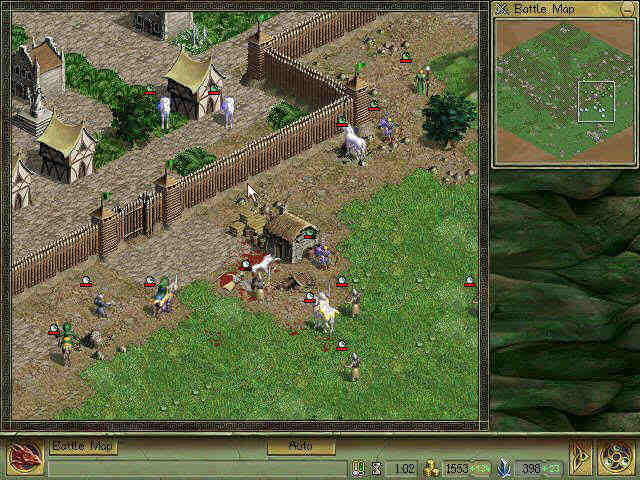 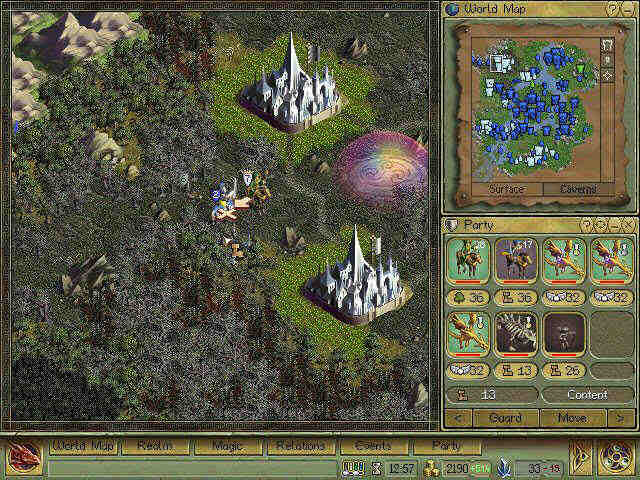 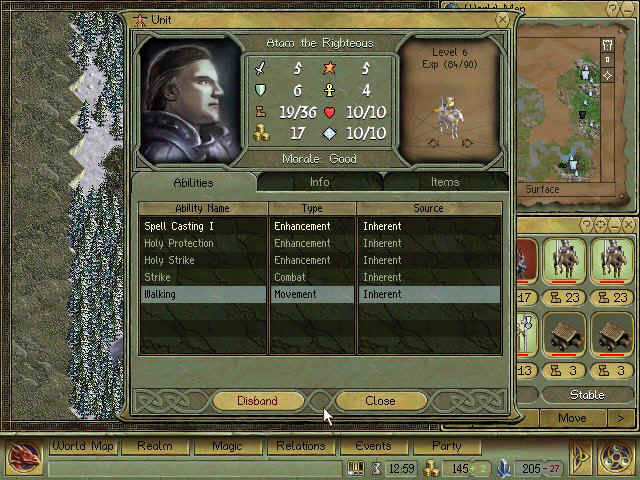 |
The races are aligning. The armies are gathering. The apocalypse is approaching. Peace is curled up in the fetal position, whimpering.
—Age of Wonders ad slogan
Consider for a moment that the role-playing genre, turn-based strategy genre, and The Lord of the Rings series by Tolkien were thrown into a blender set on puree. What would come of this unusual recipe? The resulting amalgam would be Age of Wonders, and it would be (and is) superb. Why? Age of Wonders manages to mix an absorbing plot (rare in the strategy genre), well-paced and entertaining gameplay, and almost limitless replay value into an admirable product that should be greatly considered by all fans of either the RPG or turn-based strategy genre.
Though Age of Wonders draws heavily on J.R.R. Tolkien’s work (there’s actually a goblin with a Ring of Invisibility in the game), the story is a breath of fresh air from other games that emulate The Lord of the Rings. A long time before the game began, the continent was ruled by the Elven Court, located in the Valley of Wonders, led by the magician-king Inioch. Peace reigned across the land and the races were happy. Happy, that is, until a new race known as “Humans” sailed to the continent. These newcomers apparently didn’t like the Elven Court, for they slaughtered all of the members, including Inioch, and made the Valley of Wonders their new home. The remaining elves were split into two factions, the Keepers, who wished only to live in peace with humanity, and the Cult of Storms, who wanted to ultimately annihilate humanity. The two Elven factions were led by half-siblings, both children of Inioch. When a new star appeared above the Valley of Wonders, both the Keepers and the Cult of Storms took it as a sign and began advancing upon the Valley. The campaign in Age of Wonders is centered around these Elves and Dark Elves. Upon beginning, the player must choose which side he or she will service. Aside from the great back-story, the developers inserted a little extra into the campaigns–branching missions. Thus, the player can directly control the flow of the story to his or her liking.
Age of Wonders is easy to learn yet hard to master. Essentially, the player must collect resources, build up armies, and conquer enemy cities, much like any strategy game. However, the game goes much deeper. There are 12 unique races in the game, each of which you can be allied with, at peace with, or at war with. Each race is also controlled by a Hero, including yours. If this Hero happens to die, the Hero’s empire will fall. As in an RPG, Heros can gain levels and new abilities and spells. This makes them much stronger than the average unit. Because of the fact that your Hero’s death will cause you to lose, it is usually a good idea to keep him or her safe. However, the enemy AI doesn’t do a very good job at Hero protection–it is possible to beat otherwise hard scenarios very easily simply by attacking the computer’s Hero in the very beginning. Other than the minor hero squabble, Age of Wonders’s AI is brilliant. It will strategically retreat, plan ambushes, and surround large cities so none may evacuate.
Since Age of Wonders is a turn-based strategy game, everything in the game is measured by turns. Units can only move so much in a turn, units take x amount of turns to build, etc. However, one of the game’s biggest problems stems from the turn system–the computer can take forever to complete a turn if the AI has a large empire. On a Pentium 600, the AI’s turns on the last level reached up to 30 seconds. While that may not seem like a lot, when your turns are lasting around 15 seconds, the time can add up. The game is also very hard, even on the “easy” setting. Another squabble I have with the game is its graphical presentation. While the main screen and introduction have beautiful hand-painted art, the in-game graphics are small, and their animations are cartoon-like. Sound fares no better. While the music is dark and moody, completely fitting the setting, sound effects are few and far between and only appear during battles. I find it somewhat hard to believe that every single melee weapon makes the exact same metal-clanging noise.
Age of Wonders has too many useful features to list here, but some of them include a choice between tactical and automatic combat (though Masters of Magic did have that feature), multiple nonessential Heroes, a relations screen, 12 truly unique races, branching campaigns … the list goes on and on. Overall, the pros of Age of Wonders greatly outweigh the cons. This game is a must-have in almost any gamer’s library.
Final grade: A-.
System Requirements: Pentium 166 MHz (PII 266 MHz recommended)
Windows 95/98
32 MB RAM
4x CD-ROM drive
350 MB uncompressed hard drive space
100% DirectX compatible, capable of 16-bit high color, video card
100% DirectX compatible sound card
Keyboard and mouse
Multiplayer:
TCP/IP connection for Internet play
TCP/IP or IPX for network play
E-mail account capable of attachments for play by e-mail