Puzz3D Neuschwanstein Bavarian Castle
|
Puzz3D Neuschwanstein Bavarian Castle Developer/Publisher: Wrebbit Interactive Release Date: 1999 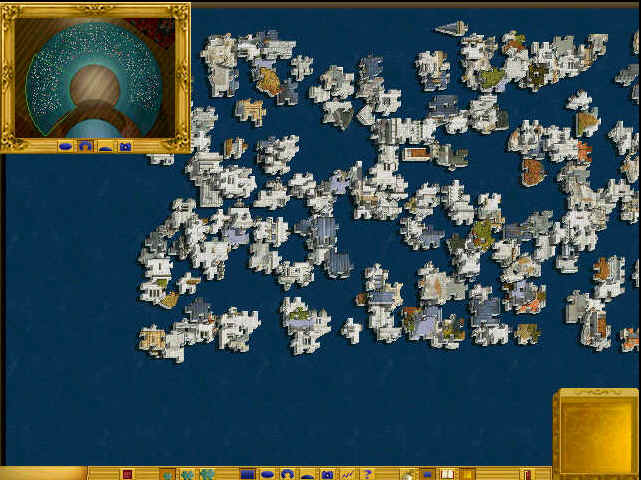 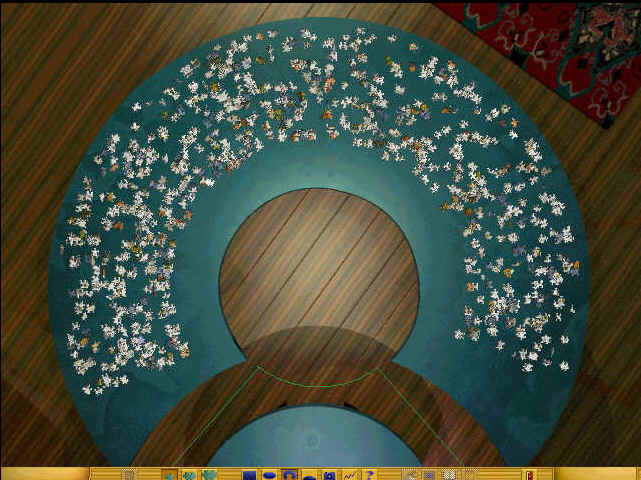 |
I am writing this review to help put the “+” in Just Adventure +. These Puzz3D games are not adventure games, but puzzle-loving adventure gamers will probably like them.
Basically, this is a virtual version of those 3D jigsaw puzzles that we have all seen but probably few of us have tried. My problem with doing any kind of jigsaw puzzle is that they take such a long time to complete, and meanwhile all of the pieces are laying around on the table–this just does not cut the mustard (aren’t you glad I didn’t say “cut the cheese”?) in my house with two young boys running around flailing like mad. This computerized jigsaw puzzle is a perfect solution–the unfinished puzzle is nothing but a file on my computer.
The puzzle pieces are very easy to manipulate, and every time you finish a segment, you can put it in a special gold tray and then either switch views to the construction site and place the completed segment or just stay on the table view and build some more. You can create as many “trays” as you want to carry groups of pieces to another part of the table, sort pieces, etc. You get three different zoom levels and several different table views to aid in completing your building. The whole puzzle-building part was somehow tedious and yet addicting–I found myself glued to my screen for what seemed like a few minutes and surfacing from my reverie only to realize that several hours had passed.
There are three versions of these Puzz3D games: the Bavarian Castle is the home of mad King Ludwig, he of Gabriel Knight 2 fame (spoken like a true adventure gamer, right?) and sponsor of the classical opera composer Richard Wagner. There is also a Victorian Mansion (generic, I guess) and Notre Dame Cathedral (I bet the back story has to do with the ol’ hunchback).
By completing the jigsaw puzzle, you earn a key to enter one or more rooms of the finished castle, depending on the skill level. You choose one of four skill levels at the beginning of the game, the differences being the number of total pieces and whether your construction site will have a wireframe guide on which to place finished segments. You must complete the hardest level to get the key that will allow you to explore all of the castle, so of course that’s what I did–I would have hated not knowing what I missed had I chosen a lesser path.
I was treated to little video vignettes of the increasingly strained relationship between Wagner and Ludwig as I progressed. These scenes apparently are triggered by how many pieces are left on the table. Also, there are little summaries of the Wagner opera plots (or subplots in the case of the Ring). And on top of that, sometimes you get building tips instead of Wagner/Ludwig stuff, but by the time these tips pop up, you’ve likely already figured it out yourself, so this is not a useful feature. I wound up just ignoring the “book” that contained all of these things and then reviewing it at the end of the puzzle construction phase of the game. Otherwise, it was too distracting.
After the puzzle is completed and you have earned your key, you may use it to enter the castle and explore. There are four standalone puzzles inside for you to find and do as you look around, one of which involves finding and putting together, in another little puzzle, pieces of a sword to slay the Dragon that guards the Ring in a rousing video finale. (No spoilers here; you can read same in the manual.) Another of the puzzles involved putting pieces of music together to duplicate eight snatches from Wagner’s Ring opera, another involved restoring the colors to a painting of Tristan und Isolde, and the last involved rotating pieces of King Ludwig’s unfinished throne to complete it. All of these puzzles were fun, and I was especially proud of myself for completing that music puzzle–I usually stink at those.
In addition to the puzzles and the sword pieces, you find rings that, when clicked, yield up yet more video clips. In these Tristan and Isolde are trying to obtain the Ring so that they no longer have to die at the end of each performance of the opera. One unnerving thing was that the same actor who portrayed King Ludwig in the puzzle-putting-together portion of the game played Tristan in the exploration phase–it took me a while to catch on to who he was supposed to be.
The inside-the-castle segments are beautifully illustrated, and you have the ability to pan 360 degrees on the horizontal plane and look nearly all the way up or down on the vertical.
The acting is totally cheesy, but the costumes are nice. The music is also nice, all Wagner to my unschooled ear, but there is not much of it, usually just a bit here and there as you are moving and then nothing while you’re standing still.
Everything I know about Wagner and Ludwig I learned from video games. Between this and Ring and GK2, I feel ever so edumucated on the subject. (I was waiting for King Ludwig to turn into a werewolf in this game, but it never happened.)
My final grade for Puzz3D Bavarian Castle is an A, and I liked it enough to seek out the other two versions so I can play them too.
System Requirements:
Windows 95/98:
Pentium 100 MHz (200 MHz recommended)
16 MB of Ram (24 MB recommended)
Microsoft-compatible mouse
45 MB free hard disk space
640×480, 16-bit colors, DirectX certified video driver (1 MB of cache video memory recommended)
2X CD-ROM drive (minimum)
Direct Sound compatible sound card
Note: Windows 95 virtual memory should be onMac OS:
MacOS 7.5 or higher
PowerPC 80 MHz (200 MHz recommended)
20 MB of RAM (32 MB recommended)
32 MB free hard disk space
640×480, 16-bit colors video and display
2X CD-ROM drive (minimum)