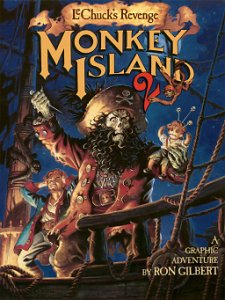
Monkey Island 2: LeChuck’s Revenge
|
Monkey Island 2: LeChuck’s Revenge Developer: LucasArts By Sean Siberio 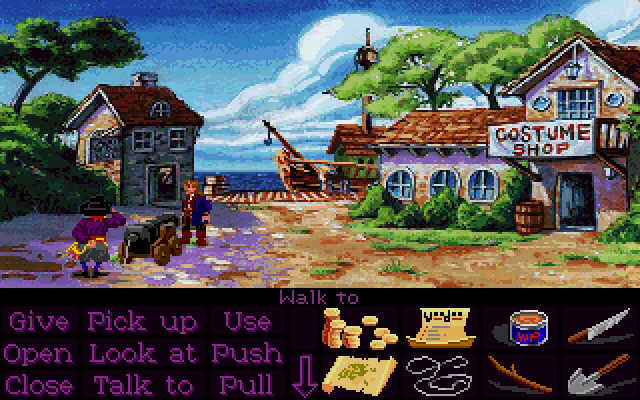 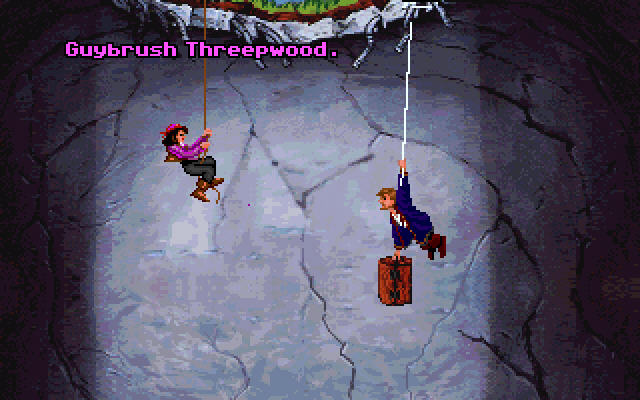 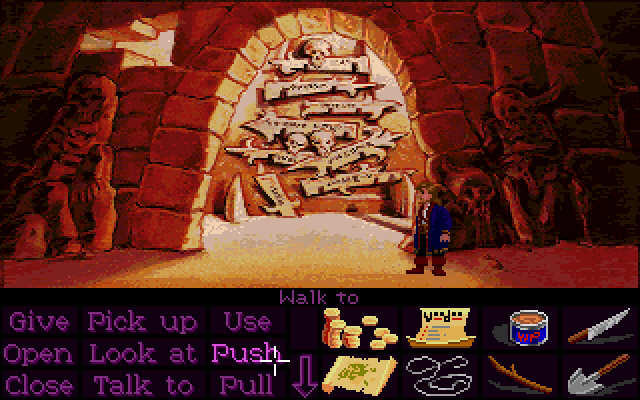 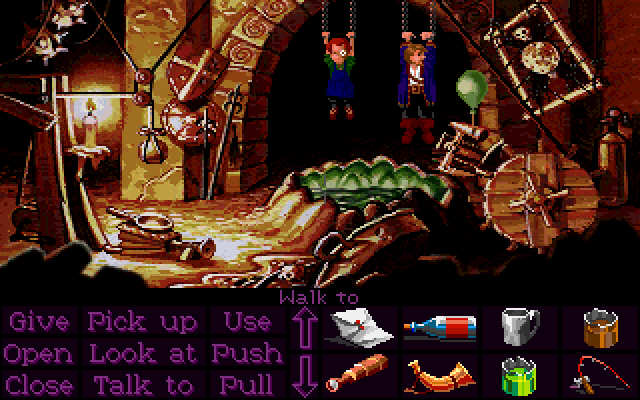 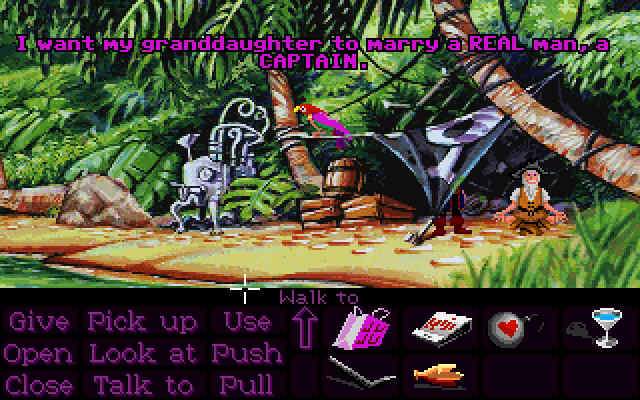 |
Note: This review is based on the version found on the Monkey Island Madness CD. This review was also written without the Monkey Island 2 SoundFont.
I once read in an interview (circa 1991) with Ron Gilbert (creator of Monkey Island 1 and 2) that he believed CD-ROMs would never be popular (he referred to their slow loading speed). You really have to wonder about his decision-making with a comment like that, and you have to wonder even more after playing Monkey Island 2. What’s with the sudden inclusion of arcane puzzles? Why the hell does the game go breakneck speed to the end when it slogs through the story in the middle? All these questions and more (like how to find true happiness) are included in this here review.
Guybrush Threepwood is back again, and this time around is searching for the mysterious treasure called (drum roll, please) Big Whoop. Already having defeated LeChuck and becoming a pirate, he assumes it’ll be smooth sailing on his new voyage. He only has a few things standing in his way–namely he’s stuck on a strange island run by pirates, has no boat, no map to the treasure, and recently lost all of his material possessions to LeChuck’s former right-hand man, Largo LaGrande. Not to mention the fact that Largo has stopped all pirates from setting sail, in effect ending all hopes of Guybrush ever reaching the Big Whoop.
Of course, Guybrush does overcome these obstacles (otherwise, there wouldn’t be a game) with the help of some good old voodoo magic. Now that he can leave, Guybrush sets sail to find the four map pieces that will let him find Inky Island, the resting place of the infamous Big Whoop. The four pieces of map are distributed on three islands: Scabb Island, the one you started on, Booty Island (which happens to be run by none other then Elaine), and the oppressive dictatorship of Phatt Island.
It is at this point where you really start to question Ron Gilbert idea’s for the future of the Monkey Island series. The plot of the game slows down to a snail’s pace once you start to explore the three islands, as you slog through puzzle after puzzle with very little return in the way of story advancement. But once you have completed the three islands, the game picks up at an insane speed and hurtles itself into an anti-climatic conclusion. It’s like going down one of those lazy rivers at a water park, only to find that at the end there’s a 50-foot plunge. Funny thing is, Ron said in that same 1991 interview that they had to cut out six or eight scenes to fit the game in floppy format (that’s probably why the story had such an odd pacing). If only he had believed in the future of CD-ROMs!
Another low point in the story is the ending. It’s so odd, you’ll have to play the end sequence again just to understand what happened on screen. It’s probably the most god-awful ending I’ve ever seen in a game, and it really kills the entire atmosphere and mood of the game. Overall, I would give the plot a C for its off-kilter pacing and a downright horrible ending.
Luckily, though, the game’s artists did an excellent job. It is a definite improvement over the first Monkey Island game, The Secret of Monkey Island. Sure, it still has to deal with the horrible resolutions of DOS, but it conveys the sense of coming from a oil painting instead of some computer art program. The characters themselves are also a lot more lively, as their extensive body gestures imply. This is taken to the extreme in many instances, with cartoony-looking bulgy eyes and the like (more so than the occasional ones in MI1).
While on the subject of oil paintings, gone are the strange cinematics and talking sequences that use strange, realistic portraits of characters instead of keeping the whimsical style of the in-game graphics. There are indeed small cinema scenes, but none of them includes any portrait of a character and instead they focus on the action (when Guybrush lights a match, for example, it only shows his hand lighting the match), retaining the feel of the in-game graphics. Strangely, however, Guybrush looks too cool to be pulling off some of the dorky pirate antics they make him do. Graphics get an A- since Guybrush’s new look doesn’t strike me as quite right, but the overall quality is well beyond the already high achievements of MI1.
Ron’s previously noted comments really baffle me in the audio and music department. There never was a talkie version of this game, nor was there ever a redone score like that in MI1 (which strikes me as odd since you would think they would have done the same thing for both games). What MIDI music is in the game is well-done, but it’s sparse and happens only at somewhat dramatic moments (nothing that can even be remotely considered ambient). Let’s face it, MIDI can’t touch CD audio with a ten-foot pole unless it’s on a Amiga. The sound effects, on the other hand, are whiny bleeps and pings that are always used in the places that you’ll be spending the most time (meaning you can’t get away from the horribly insane noises). Occasionally, the sound effects actually do help immerse you in the game, but whenever there’s a parrot squawking on screen, it’s time to shut off the PC speaker. Music earns a B even though it is a bit on sparse side. Sound effects, however, barely earn a D for being downright annoying.
Finally, we arrive to the meat of any adventure game (next to story of course)–the puzzles. Scabb Island has the most logical puzzles of the three island areas. However, once you hit the other two islands in search of the other map’s pieces, things get downright silly. You always know what you need to do, but that isn’t the problem. The inherent problem is what might seem a perfect solution is not, because you forgot to do some arcane thing. I mean, who would think of using green beer anywhere but the grog-drinking competition with the old man on Booty Island (what it is used for instead makes absolutely no sense at all)?
Once you do get past the three-islands stage, you are faced with a flurry of easy puzzles, which lead up to the final showdown with LeChuck (which would actually be quite clever if it wasn’t for his previously sporadic appearances). The puzzles are oddly paced and have more to do with another M-titled series than they have to do with Monkey Island. The uneven quality gets the puzzles a grade of C-.
This game as whole is a decent package, but it can’t even hold a candle to the brilliance of Monkey Island 1. The creators conveniently ignored the ending of MI2 in The Curse of Monkey Island (MI3), and it’s a good thing, too, because the Monkey Island series wouldn’t even be worth fighting for if future episodes had to go down the same offbeat road as MI2.
Final Grade: C+
System Requirements:
Macintosh:O/S version 6.0.7 or higher
16 MHz 68020 or higher
2 MB RAM
256-color, 13″ or larger display