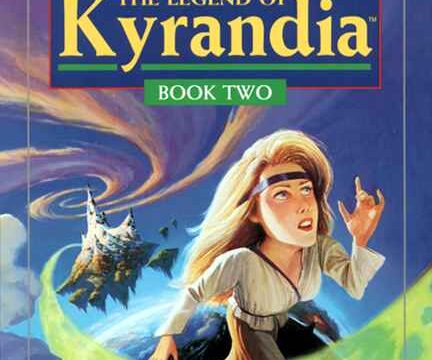
Legend of Kyrandia: The Hand of Fate
|
Review Legend of Kyrandia: The Hand of Fate Westwood Studios Review by Scorpia |
 |
Hand of Fate is the second in Westwood’s Fables & Fiends series, a sort-of sequel to Legend of Kyrandia. Sort-of, since the main character is Zanthia the alchemist (a supporting character in the first game), rather than Brandon.
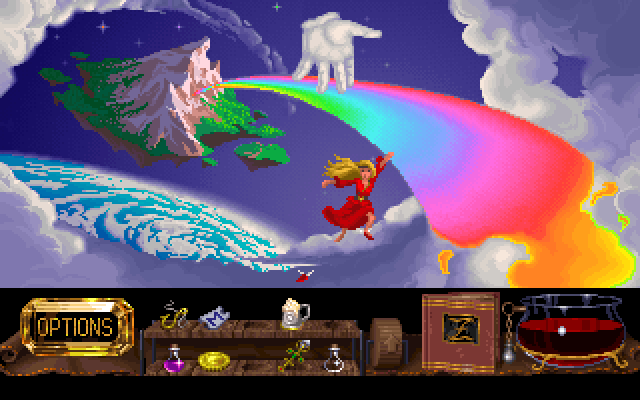
Kyrandia, as usual, is in trouble. This time, the trouble is more than a megalomaniac jester: slowly, piece by piece, Kyrandia is disappearing. If that goes on much longer, there won’t be any Kyrandia left at all. Not a pleasant prospect to contemplate.
Naturally, all the mages and sages paw frantically through musty old volumes, hoping to find a solution. Just as naturally, they don’t find anything, and the outlook is pretty grim until Marko (a wannabe mage) shows up with his new assistant, a hand. The hand, through diagrams, explains that they need an anchor stone from the center of the world to keep Kyrandia together. Zanthia is unanimously chosen to go get it. Lucky Zanthia!
The task would seem to be a simple one, until Zanthia returns home to find all her equipment smashed and supplies stolen. Obviously, someone doesn’t want her fixing up the problem, and now she has to get to the center of the world the hard way. This is where the game actually begins.
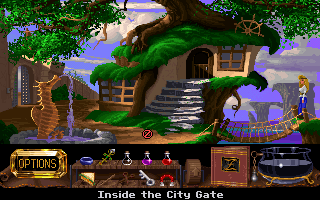
Hand of Fate is a linear adventure, done in sections, starting with the swamplands around Zanthia’s house. Each time a section is completed, you move on to the next one, and there is no going back to a previous area. Usually, this makes players nervous, as often linear games require that some obscure item from the start be used at the end.
Happily, this is not the case here. Every time Zanthia moves on, she tends to lose most or all of her inventory. Thus each new section provides everything necessary to solve the puzzles in it, and there is no need to worry about having overlooked some crucial item back in the swamps, or anywhere else, for that matter.
Graphically, and in terms of the interface, the game is similar to Legend of Kyrandia. So Hand is visually pretty, and the point-and-click system easy to use. Clicking on an item picks it up to become the cursor; the item can then be placed in the inventory, or clicked on something else (or a person) to “use” it.
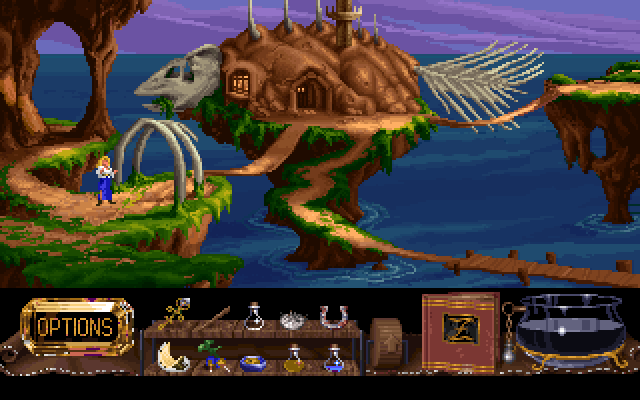
Conversations are handled in a similar manner, but they are automatic sequences. Clicking on people usually starts them talking, with Zanthia making predetermined responses; there are no choices to make as to what she will say. Then again, conversations are not a main item here, although it is important to talk to everyone you meet at least once.
It was nice to see a female lead character for a change. Too many adventures these days are still male-oriented as far as the main character is concerned. Featuring Zanthia in this one is definitely a point in Westwood’s favor.
There has been a definite improvement in puzzle construction over Kyrandia, where too many solutions depended solely on trial-and-error. You can, of course, solve almost any puzzle in any adventure with that method, but it is often time-consuming and tedious to use. Most players prefer situations where there is a logical connection between the item(s) and the solution, even if it takes them awhile to figure out what it is.
So it’s good to see that many of the puzzles in Hand can be thought out, if you take the time to think about what needs to be done. Naturally, some answers are going to be a little obscure, but games that are too easy usually aren’t all that satisfying.
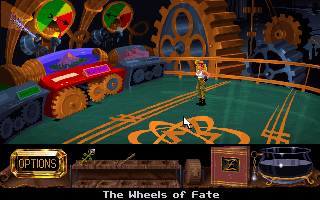
However, Westwood is still a little too fond of red herrings, which can be found all over the place. One or two are traditional in adventures, but Hand of Fate has more than its share of them. This can become frustrating, with players wasting time over things that really aren’t important at all. Mustard Island is a case in point. You can easily spend hours trying to deal with the cannibals, when in fact the real puzzle is to avoid the island completely in the first place.
There is also a certain amount of subtle misdirection that can lead you down the garden path if you aren’t careful. For instance, throughout the game, Zanthia concocts little potions to help in different situations. The trick is that she won’t be making all the potions listed in her recipe book. So it’s easy to get caught in a mindset that looks to magic instead of logic for a solution to a particular problem.
The best way to approach Hand is to keep in mind that everything you need can be found in that section of the game. If one or more ingredients for a potion can’t be found, it’s a good bet that magic isn’t the answer to the puzzle you’re trying to solve. Look for another way of doing it.
One of the surprising things about Hand of Fate is that it’s really a rather short adventure. There are only about seven sections to it, all of them fairly small. Some areas may be more difficult than others, but in general experienced gamers are likely to finish this one quickly.
If the game has one really sore point, it’s the ending. Having gone through up to there using your head, you are suddenly thrust into what is a type of mini action sequence, which is done in real time. The only “puzzle” here is figuring out which ways Zanthia should jump to avoid an unpleasant demise. The use of what is basically an arcade sequence is a jarring note, and really doesn’t fit in with the rest of the game as a whole. A less active, and more puzzle-oriented, endgame would have been better.
Overall, Hand of Fate is humorous, moderate-level adventure game. Much of what was wrong with Kyrandia has been cleaned up, although Westwood’s technique still needs a little more polish (and a few less red herrings). Anyone looking for a short-term adventure workout is likely to enjoy this one.
Final Grade: B
System Requirements:
- Floppy disk version: IBM or 100% compatible 386-20MHz or better, MS-DOS 5.0 or higher, 2 megabytes of RAM (1 megabyte of XMS or EMS), VGA/MCGA graphics, Hard Drive with 20 megabytes available, High Density Disk Drive, and Microsoft compatible mouse and driver. Supports: Sound Blaster, Sound Blaster Pro and compatible sound cards, AdLib, AdLib Gold and Gold Standard, Roland MT-32/LAPC-1, General MIDI.
- CD-ROM version: 5 Mb free on hard drive, 560K RAM, 2 Mb XMS or EMS, 386/33, VGA graphics, CD-ROM with MSCDEX 2.2, SoundBlaster and other major sound cards, MS-DOS 5.0