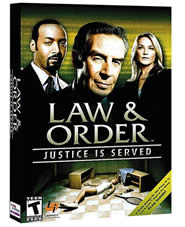
Law & Order: Justice is Served Interview
Interviews
Law & Order: Justice is Served Q&A
Christina Oliver, producer at Legacy Interactive
Interview conducted by James Saighman
1. The first thing that many fans of the games will notice is that S. Epatha Merkerson’s character of “Lt. Anita van Buren” is gone in JiS, while this time around we get to interact with Jesse L. Martin’s “Det. Ed Green” (as well as our old friend Jerry Orbach/Lenny Briscoe). Can you talk about this? Was it a decision based on game design? On Merkerson’s availability? A choice that flowed naturally from the script you started with?
The decision had mainly to do with Merkerson’s availability, although we know that the fans of the show have their favorite characters, so we thought it would be nice to change up the stars we had in the game to appeal to more players over the course of the game series.
2. Suzanne Oshry, writer of Law & Order: Dead on the Money, once again provides the writing for JiS. Although she has proven quite talented at writing the L&O games, Oshry seems at first to be an odd choice. My research indicates that she only ever scripted a single episode of the L&O TV series. Are there other skills that Oshry possesses that led you to approach her in the first place?
Suzanne has a great sense of the characters and structure of the show, as well as a true interest in adventure games and the game industry. We found her to be very adept at translating her skills as a television writer to the more complex and non-linear demands of an adventure game script, so we were delighted we could work with her a second time.
3. The script of JiS bears more than a passing resemblance to both the L&O TV episode entitled “Doubles” as well as the real-life Monica Seles stabbing incident. Was this a conscious choice going into the game– an effort to make players feel more deeply immersed in the L&O world? Or is it simply a case of “this is the script we were given?”
The resemblance to the episode entitled “Doubles” is purely coincidental, although the Monica Seles stabbing incident was certainly in our minds as we planned this case. We wanted to set a story in the world of professional sports, where there is tremendous pressure on the characters coming from all directions, and many people involved with the athlete that have a stake in their success. After tossing around several ideas, such as focusing on an Olympic swimmer, we settled on women’s tennis.
4. I know that L&O:DoM was criticized in some adventure game circles for its relative lack of “puzzles”. With each succeeding game, you have included more of the type of puzzle fare that many adventure game players like and expect. Would you like to talk about the challenge of incorporating such puzzles into the games’ very realistic approach to police investigation?
To be honest, including puzzles in the first Law & Order game was something of an afterthought. At first the game was just going to include collecting and testing evidence and interviewing witnesses, as well as figuring out the search and arrest warrants. As we were moving through the development phase of the game we felt that there wasn’t enough variety in the gameplay to make it engaging enough for players, so we added the puzzles and the bargaining with witnesses feature. For Law & Order: Justice is Served we knew from the beginning that we wanted to include puzzles, and that we wanted to make them satisfying to the adventure gamer, whom we consider an important part of our target market. It is certainly challenging to come up with a wide range of unique puzzles when the game world is set in modern day New York. It is easier to design puzzles for a fantasy world where realistic conventions don’t apply. We worked very hard to find ways to create organic puzzles that aren’t too basic, like your standard finding of keys for locks and opening of safes, and while we have our share of the basics, we are proud of the ways we were able to incorporate some innovative puzzles without completely ignoring the convention of reality that we’re working under. As we’ve progressed in this series we’ve also allowed ourselves to take more liberties and stretch the “realism” concept a bit in the interest of fun and unique gameplay.
5. Next up for Legacy is your Law & Order: Criminal Intent game. For fans of the TV series, much of the show’s attraction lies in watching Vincent D’Onofrio’s “Det. Robert Goren” use subtle (and sometimes not-so-subtle) psychological attacks on suspects until they crumble and confess. Goren’s other primary attribute, of course, is that he knows absolutely everything! Can you talk to us about whether these attributes will be incorporated into gameplay, and if so, how?
We’re building a brand-new game engine based on a new design for this series, partly to account for the particular characteristics of Detective Goren. When the player questions a witness in the Criminal Intent game, they will always select topics along with an approach or attitude, such as confrontational, flattering, deceptive, or empathetic. The witness will respond differently based on how the player as Goren treats them. The game also incorporates a criminal profile feature, that emulates Goren’s understanding of what types of crimes are committed by what kinds of people, a skill which helps him hone in on the right suspect.
6. Can you give us any hints as to what lies ahead for Legacy’s L&O franchise?
Another Law & Order title is just now starting development for release in the Fall of 2005, and we’ll have a second Criminal Intent game following on the heels of the first.
Thank you for taking the time to answer these questions and “speak” with our Just Adventure+ audience.
You’re welcome!