Just ASCII +
Just ASCII + A Column Covering Interactive Fiction and Other Nongraphical Adventure Games
Adventurer vs. Red Dragon
by Simon de Vet
(click to enlarge)
By Erik Reckase
When I first started going to college at New Mexico Tech in 1990, the computer lab was practically nonexistent. Visualize a room about the size of a living room with about twenty VT100 terminals spread out around the edges, with metal folding chairs as the only furniture. There may have been a few Suns in there–if there were, they were almost always occupied by some serious programmers or system administrators. I spent countless hours in that room during my first semester … but I wasn’t doing schoolwork or writing code. I’d leave my dorm room at about nine o’clock every night and stay at the lab for about five hours, doing nothing but playing Nethack, Rogue, or Moria–adventure/RPG games that could be played on a text-only terminal, as all of the graphics were represented by ASCII characters. These games were unique in that they were different every single time you played them, similar to the Diablo series today–and they were the most addictive wastes of time that I’d ever experienced.
Not long ago, while searching for something entertaining to put onto my Palm Pilot for a business trip, I ran across a free Palm-ported version of Rogue called PocketRogue. As it turns out, these games are a perfect fit with the Palm’s small screen, and I began to slowly slip back into my old habits. Curious as to the fate of the other ASCII games that I had played ten years ago, I did a few Internet searches, and to my surprise, not only are these games still around, but they are flourishing in the face of faster processors and graphics accelerators–and they’re absolutely free. I’ll discuss more of these Rogue-like games in future installments of this column; these games shaped history, and it is my pleasure to present these games, free for the taking. I may even review some of those old text adventures … you’ll have to wait and see.
Part 1–Rogue
This is the game that started it all. The year is 1980, and a student at U.C. Berkeley by the name of Ken Arnold put together a library of routines that allowed programs to address different cursor positions on a terminal screen and place text there (up until this point, text normally scrolled off of the top of the screen, disappearing into oblivion–a concept hard to visualize for the Windows generation, I’m sure). This library of routines was called “curses,” and it rapidly spread to other universities across the country.
Michael Toy and Glenn Wichman, students in Santa Cruz, California, began experimenting with this new library and attempted to write a new pseudo-graphical adventure game. The most important aspect of the development was that these two students wanted to have fun playing the game themselves. Other adventure games (including the original Adventure, Zork I, etc.) had puzzles, but once finished, there was very little replay value. Michael and Glenn decided that the program should build the dungeon from scratch every time the game started, making each game different and unpredictable. Glenn came up with the name of the game: Rogue.
Around the time that the core part of the game had been completed, Michael transferred to U.C. Berkeley, where he met up with Ken and continued the game’s evolution. Keeping Glenn in the loop proved to be too difficult, so Glenn let Michael and Ken take over the development completely. The fact that this development took place at U.C. Berkeley was critical in the proliferation of Rogue around the country–Berkeley was also the home of BSD (Berkeley Standard Distribution) UNIX, and when Version 4.2 of BSD UNIX was released, Rogue was included. Over the next few years, Rogue easily became the most popular game on college campuses.
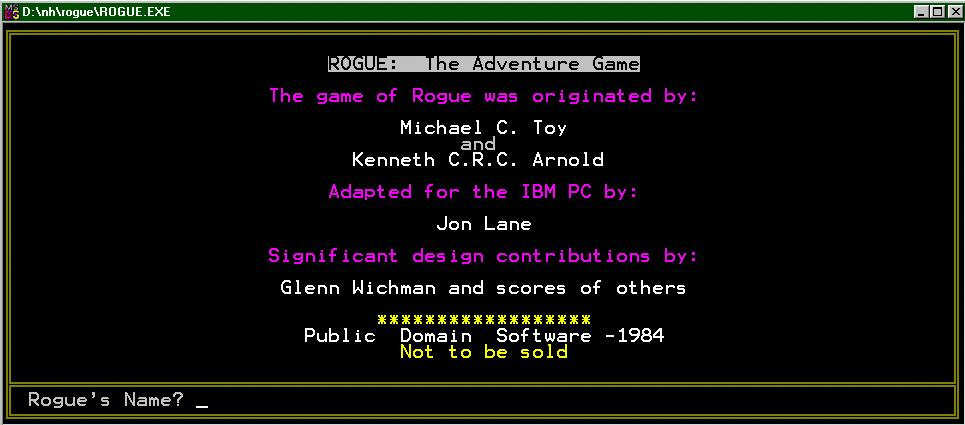
Title Screen for MS-DOS version of Rogue, 1984 (click to enlarge)
The goal in Rogue is simple: explore the Dungeons of Doom and retrieve the fabled Amulet of Yendor. Each floor’s rooms and connecting passages are randomly generated when you enter the levels, as well as the monsters and items contained in them. Everything in Rogue is represented by a character in the standard ASCII character set. For example, your character is represented by an @ symbol. Monsters are represented by capital letters (B is a bat, R is a rattlesnake, etc.). Punctuation marks represent different items or special locations (] is armor, ? is a magic scroll, % is a staircase, etc.) You can use the arrow keys or the “hjklyubn” set of keys to move your character around in the dungeon–moving your character into a monster attacks it. The map of each dungeon level starts out empty, but it fills in as you explore.
Rogue truly is the granddaddy of computer role-playing games. Your character has a single statistic, Strength, which affects the speed with which you can dispatch your foes. Strength can be reduced by certain monsters and poison dart traps and can only be recovered by using a Strength potion. You character also has hit points, reflecting the total amount of damage you can take before death. Both hit points and strength are affected by your experience level; the more monsters you vanquish, the higher your experience level, and therefore the higher your maximum strength and hit points. Sound familiar?
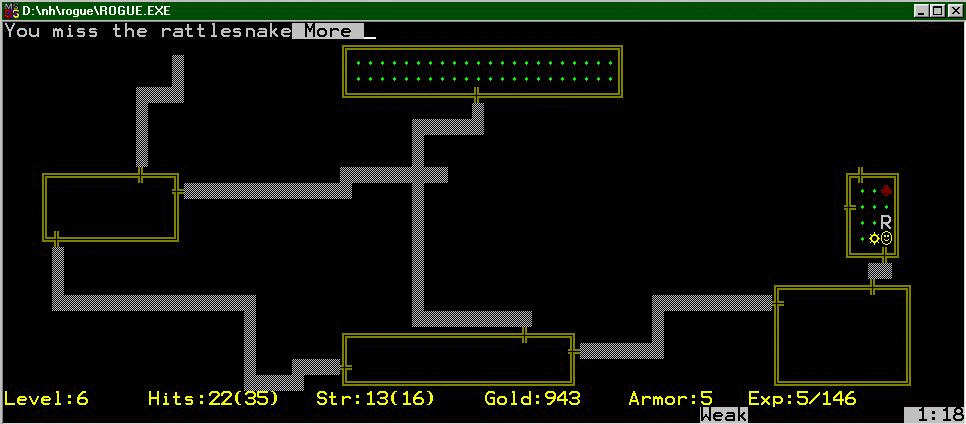
Weak with hunger, my character attacks a Rattlesnake on dungeon level 6,
trying to reach the food behind it (click to enlarge)
There’s not much information out there on Rogue, due to its age and relative obscurity. However, I have found the following sites.
The Dungeons of Doom: Maintained by Edwin Rots in the Netherlands, this site is a great starter site for players just starting their journey for the Amulet. There’s information here on the different monsters and items that populate the dungeon, as well as an online guidebook complete with hints for beginners.
The Rogue Home Page: Maintained by Boudewijn Waijers, also in the Netherlands, this site is download central for Rogue. Versions of Rogue for MS-DOS, Macintosh, Amiga, and Linux are available here, as well as a zipped spoiler list for the MS-DOS version. (The Macintosh version appears to be a graphical interpretation of the original, which may not have all of the monsters represented.) I’ve played the MS-DOS version from this site, and some of the characters have been replaced by small bitmap graphics (a little smiley face for your character, for example), but otherwise it is identical to the original UNIX release.
PocketRogue by Takebayashi Tomoaki; iRogue by Half-Dead Spider Entertainment: Both of these links are for versions of Rogue that have been ported to the Palm Pilot. I’ve used tried both of these, with success, on my Palm IIIx: PocketRogue is fast and small, but iRogue has some very nice features that add to the experience.
Let me remind you that all of the available versions of Rogue are free!
I’ll be honest–I haven’t retrieved the Amulet of Yendor yet, but I’m still trying. I’m of the opinion that very few people have successfully completed this mission over the last twenty years, which makes it all the more enticing.
That’s all for this installment–next time, I’ll cover some developments in the world of interactive fiction over the last few years, with more Free Stuff!