Interview with Darren Eliker
Darren Eliker
By Debra Toma
One of the great things about our readers is that they are just as devoted, if not more so, to adventure games as we are! A perfect example would be Debra Toma. Debra is a huge fan of Take 2’s Black Dahlia and in fact managed to obtain an exclusive interview with Darren Eliker, who starred in the game as Jim Pearson. (The most amazing part to me was that I was not even aware that Mr. Eliker only lives a few miles from me in Pittsburgh!) We are printing this interview with Debra’s permission. After you have enjoyed your visit with Darren Eliker, please take some time to visit Debra’s excellent Black Dahlia fan site.
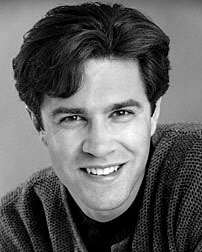 Hi, Darren! Great of you to take the time to do this interview for us. We really appreciate it! Black Dahlia has got to be one of the best and best-made adventure games ever made. Do you play adventure games yourself? If so, what are your favorites?
Black Dahlia was actually my introduction into the world of PC computer gaming as it is today. Technology has come along so fast and furious in the last decade it’s almost impossible to keep up with. I remember when I was a sophomore in high school playing one of the first versions of Zork on my father’s old Apple Lisa, which moved like a dinosaur. No visuals, just interactive dialog, but my friends and I all though it was the coolest thing. I do love adventure. Tolkien was a big influence for me growing up, and my friends and I would often have all-night D&D sessions, but the computer gaming industry really didn’t take off until I was well-ensconced in college. When I emerged, it was kind of like coming out of a time capsule. It’s amazing what they’re able to do now.
How did you come into the role of Jim Pearson? You played the part well. Do you have anything in common with the character?
Well, first off, thank you for saying so! The company that produced Black Dahlia has two branches, one in New York and one in Latrobe, Pennsylvania, not far from Pittsburgh. It was the Latrobe branch that was the creative force behind the game. So, when they went looking for talent, while they did do a national search they also did a great deal of looking here. When my agent first talked to me about auditioning, I have to admit to a little concern. I knew of the graphic nature of many of the games on the market today, and I wasn’t sure I wanted to be on a project that could possibly turn pretty vile and I have very strong feelings about delving into the world of the occult. When you do an audition, most of the time you will never have read the script, only a part. Sometimes all you have to go on is a description of the character. That’s when you simply make the best educated guesses you can. So, my involvement with Black Dahlia might have ended right there. But something told me it was okay to go forward. Maybe it was a sense that it was just the right part for me. That began a process of several auditions beginning in October and ending in a call from my agent the weekend before Christmas where he said, “Well you got the part. And you’re not going to believe who your costars are!”
The more I got into the script, the more I really liked Jim. I liked his sense of honor and duty. I liked his skepticism and his tenacity. I liked how he had simple desires to settle down and have a family. I liked how he cared about people. Perhaps those are some of the areas where we coincide. Besides, we all want to be the hero to believe that under pressure, we would rise to the occasion and show courage we didn’t think we had.
 What kind of differences did you see in playing a role in an adventure game compared to mainstream acting?
The biggest difference is the constraints of the game world. In theater, everything has an arc and a flow. Each moment builds upon itself, and you can use that momentum to carry you through the piece. With film, the challenge is shooting everything out of context because of location and budget constraints. That’s just practicality. With the filming of a game like Black Dahlia, you have the same out of context shooting where you do as much as you can with a particular setup. All the scenes in Merylo’s office, for instance, are shot one angle at a time. So you cover all of the CDs with all the costume changes for that angle. Now here’s the tricky part. Add to that the notion of nonlinear time. All of the questions can be asked out of sequence, and that has to be taken into consideration. What could have happened just before? We had to deal with a physical limitation which director Eric Trow and I dubbed “Neutral-Man.” Every time you begin and end a scene, you have to return to a neutral position that would be physically consistent with whatever could have come before. This can feel particularly awkward and hard to justify when you’re in the middle of a heated confrontation like that with Louie the Fish or Von Hess.
What were your favorite parts or least favorite, and why?
If you mean that in terms of the end-product, I’d have to say, believe it or not, my scenes with Teri. Again, the constraints of the gaming world frustrated us here. Madame Cassandra’s character is belabored with information. It’s not dialog that is very actor-friendly, and I don’t know that I agreed with the decision to take a wonderful and spontaneous performer like Teri Garr and force her talent into a box. And because the dialog was so unnatural and given on short notice, she was having to use a prompter. Unfortunately, Teri was unable to look directly at me and this can be a real consternation for a performer’s natural desire to give and receive. Writer Patrick Freeman had actually written a whole other scene between Cassie and Jim which took place just before the train ride to L.A.. It was very sweet and actable, but because it didn’t really further the necessities of the game, it wound up on the cutting room floor. There were a lot of other elements that never got into the game because of the sheer size of it. I was disappointed they couldn’t include several first-person battle sequences. The one in Louie’s loft was much more involved, plus there was a second in the sewers involving a kind of cat-and-mouse hunt with the Torso Killer. The third was an out-and-out one-manned brawl with the Nazis after Jim escapes the vestry. We shot tons of running, shooting, grenade throwing, diving combat encounters for that, and the whole thing was scrapped because it was making the game too big.
How were the special effects done, for example, the torso killer sequences, the dream sequences at Madam Cassandra’s, with the door and planets, the falling in the wine cellar sequence, and labyrinth with the hidden rooms, the train, the fire in Winslow’s abandoned loft, and, of course, the end sequence at Al King’s?
Most of the actual effects are handled in postproduction by the programming guys. On our end, the tedious part was matching the camera angles up so the final shot would be in line with their environment. The door was fairly simple. You have a master shot of Jim from behind approaching the door. Then you switch point of view to a side angle as he gets sucked through the door, during which I had to arch backward as though I was being pulled into the vortex. The loft shots were more involved. The original fall began with a shot of Jim trying to open the window. We shot that on-level, and I just did a pratfall to the ground. The second piece of the puzzle was the actual fall. To accomplish this, I dropped from a bar suspended at about 12 feet with the camera lens cutting just below my feet. Then, I drop through the frame of the camera. The final piece is a shot of the landing, which consisted of me throwing myself onto the floor into a pool of sticky red goop and the crew dumping debris on my head. Cut it together, and then the programming crew works their magic.
The environment for BD was so interesting! And so realistic. Who did it, and how was it done? It was a masterpiece of art! Did you see any of that while filming? What was props and what was real?
I felt like I was swimming in a sea of chroma-key blue. For eight weeks, we shot at Jay Verno Studios on the south side of Pittsburgh from 7:30 am till 5:30 pm, five days a week, at a frantic pace that sometimes reached 80 shots a day. To put that into perspective, a normal film might do 12 to 15 a day depending on location. Blue screen shooting allows you to accomplish a lot more a lot faster. The tedious part is making sure the angles of the shot match those of the 3D environment created by the programmers. Everything was blue. Blue, blue, blue. A desk was a big blue box. A doorway was a blue frame. A comfy chair was a blue stool. A coffin lid was a piece of cardboard clamped to a light-stand. Props were minimal. Even the newspaper Sullivan is holding in the beginning of the game is a blue-coated piece of cardboard. Everything you’re reacting to everything is in your imagination. The first day of filming, we did nothing but walk paths for the crypts. They dressed me up like Indiana Jones, lit a live torch, put it in my hand, stuck me on a big blue stage 40 feet tall and 50 feet wide, and said walk from here to there. I do. The director says, “Cut. I’ll buy that. Moving on!” After a couple of these I had to stop and say, “Guys, I need some context, where am I? What am I seeing? How big is the room? What’s in it? Where have I come from and where am I going to?” Before each shot, the camera angle is matched to a superimposed image on the monitor, which the director can see. The image is a rough of the room environment built on a three-dimensional blueprint. Each room is painted by individual artists in the postproduction process. Then the edited video footage is digitized and married to the finished environment with a computer called a “Flame,” where the final lighting and special effects are added to make it as seamless as possible.
Did you know any of the cast or crew before making BD? What were they like to work with? Do you keep in touch with any of them now?
During the time I’ve worked in this city, you come to know people. A number of the crew, like lighting genius Ed Letteri and makeup guru Patti Bell, are people I’ve worked with on other projects. The director, Eric Trow, and I had worked the summer prior to this project on a series of commercials for Pittsburgh Brewing and knew each other well. He and I, along with Black Dahlia’s author, Patrick Freeman, still keep in touch or get together when we can. Working with these people was fantastic. They are pros at what they do, and there is a certain comfort that comes with familiarity where you simply get down to the business of making it happen.
I loved some of the costumes as much as the scenery. Especially the coat and hat and some of Winslow’s–very stylish! Did you have any input in your characters dress or any other parts of your character’s makeup?
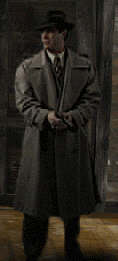
Outside of shirts and ties, all of my costumes and many of David Whalen’s, who played Winslow, were handmade. There was no need really for input from the actors because the era was well-researched by the gentleman who designed the costumes. I really wanted to keep the coat! And I thought Winslow’s ensemble for the California sequences was pretty cool–I told David it kind of reminded me of Shaft.
Would you ever be interested in doing another adventure game? Of course, we’d like to see BD come back. Kinda disappointing ending, but it could be done. How would you feel about that?
I’d love to do another one as long as it had the same kind of class this production had. There was some chat toward the end of this filming about a sequel, but I’m sure that’s fallen by the wayside. This scale of project is extremely expensive, and Take 2, like so many other gaming companies, has more of an interest in what is expedient and profitable. Believe me, I don’t condemn that. A company has to do what it can to survive when competition is fierce. Actors cost a lot of money, and when you can do it all with computers, why pay for the hassle of using us temperamental and slightly neurotic human beings?
As adventure gamers, we’ve been very disappointed to see the decrease of new games as opposed to the increase in action games. Do you have any insight as to how Interplay/Take2 Interactive feel about that or if they have any plans to do any new adventure games? Is there any way to contact them to express our feelings about it? I never felt BD got the attention it deserved. It beat most other adventure games hands down! How come it didn’t get more marketing? How come there’s no access to it by Interplay or Take2 over the net?
I’ll just continue with my answer to the last question. I don’t believe there are any plans in Take 2’s future to develop more adventure games on the scale of Black Dahlia, and I agree with you that it’s a shame. And I agree with you that Dahlia didn’t get the attention it deserved. You’ll recall I said there are two offices to the company. The one in New York who foots the bill, and the one in Latrobe, Pennsylvania, that developed the game. I always had the impression that the president of the New York office looked at Black Dahlia as something to be tolerated rather than encouraged. Why, I have no idea. Perhaps he didn’t really believe it would be successful and just saw it as a project to throw some money at and not expect much of. After the project was completed, there was a big shakedown at the local office, and many who worked on Dahlia were laid off or left because they knew something was coming. It’s a shame, really, because I feel that if they tried even just a little bit, this could have become something truly wonderful. It simply comes down to shortsightedness and a lack of creative managing ability. In spite of all of this, I still hear from gamers around the globe who have enjoyed the game, and to me, that makes it successful.
I loved the Easter eggs in BD (Angelo’s mother while visiting the Santini home, the spinning/dizzy sequence, the hotel phone, and the file cabinet at ABC). Are there any other Easter eggs to find? Whose idea were they?
There is one that involved drinking out of one of the bottles in the wine cellar. Off the top of my head, I can’t think of any other ones we shot. The producers were trying to place at least one in each of Dahlia’s eight CDs, but a number of them didn’t make it in for the same reason many of the extraneous scenes were cut. The sheer size of the game meant that anything that wasn’t absolutely necessary to furthering the action had to be left out.
Most of us adventure fans are fans of Access’s Tex Murphy series as well. At the end of one of his games, they added the bloopers. What kind of bloopers were there in BD? Any interesting behind-the-scenes stories?
Aside from my typical giggling fits, which normally happen when I start getting tired, and my usual goofing off, one particular episode comes to mind. We were filming the end sequence where Jim leaves Alice to follow Winslow through the portal to Odin’s Pool. To do the actual jump into the portal, the camera had to be back far enough to allow for distance. A blue apple box was placed on the floor pretty close to the back wall. The box is used to get some height and give the appearance of jumping. I was covered in dirt, soot, and blood from head to toe. Now, the shot was toward the later part of the day. I was pretty exhausted already. I think I was starting to lose depth perception facing the back wall and staring into the blue field. To make matters worse, the joint between the stage floor and back wall is curved so it appears seamless to the camera. It also would appear seamless to me as you’re about to see. We did a number of dry takes to make sure the physical action looked right. Here comes the funny part. I guess I didn’t realize how close the box actually was to the wall. You can probably already see where I’m going with this. Action is called. I stagger toward where the portal should be gaining some momentum. I get to the box nearing run speed. Step up, arch back, swing my arms outward as though the vortex is pulling me through. I must have gone too far. Because the next thing I know I’m lying on the floor looking up at the wall amidst much laughter from the crew, where I can make out a rough impression of my head, hands, and upper body left on the wall where I had careened into it. I think I was seeing a few stars. But at least I provided everyone with a moment of levity after a long day! They had to wash down the wall before we could reshoot.
On a more personal level, you really are a wonderful actor. I was surprised to find you reside and do most of your work from Philadelphia. Why? Aren’t you from Chicago? What brought you there, and what keeps you there? Do you have family or friends in Philadelphia? Are you married, or do you have any children?
Actually, I reside in Pittsburgh. Originally, I am from the Philadelphia area of New Jersey, born in Camden. My family still lives there, all within three miles of each other. I first came to Pittsburgh to attend Carnegie-Mellon University’s drama program. I spent the majority of the summers here, and I grew to like the town and how easy it is to live here. One of the areas of the training I seemed to excel at aside from acting was voice and speech. Fortunately, that’s something I’ve been able to capitalize upon in the real world. About seven years ago, I fell into a job at a local radio station, where I now write, produce, and voice the majority of commercials for local advertisers. It’s garnered me a number of awards and also allowed me to develop a substantial freelance business doing voice-over work for television and radio outside the station. In turn I have a lot of flexibility and freedom to choose the theatrical projects I get involved in, which I do about three or four times a year. It’s also kept me out of having to do so many of the other odd jobs like temp work and waiting tables that many other performers have to do, even those that have conservatory training, just to make ends meet while you wait for the big job. I met my wife Jennifer here about four and a half years ago, and we’ve been married for three of those years. No kids yet! We look forward to it; sometimes I think I do even more than her. But the thing about children is once you have them, you have them. We want to enjoy being married for a little while yet!
You get very good reviews and it seems you stay busy there, too. I’m not sure I have this right, but I read you went to New York before and they found you too young to get the kind of roles you wanted, so you returned to Philly. How old are you? Will you try again later or maybe go to Hollywood?
Pittsburgh has been very kind to me. You’re right, I did sign on with two New York agencies (one commercial, one legit) after I graduated and commuted for auditions from my parents’ home in New Jersey. At the time it seemed like things were going to really open up. But after a year, I had to reevaluate things. As I looked back over that year, what I kept hearing was, “Hey, I’ll definitely remember the acting, but you’re just too young for the role.” This wasn’t exactly a surprise, because I tend to identify with the mindset of more mature characters, and that is what I tended to play in college. But it would probably be about ten years before I grew into physically being able to play the parts I could emotionally relate to. So, instead of sitting and waiting in an expensive city, I decided to come back to a place I’d become familiar with where at least I could live and work. Now, Jen and I often talk about the possibility of taking another shot at it, but you still have to live life in the meantime. The work for me in this town continues to grow, and one thing that you have to realize is that the world has changed. Computers, ISDN lines, and the Internet have made it much easier to actually do things like voice work long distance. I also happen to be a very patient person. I’ve watched as friends of mine who are very talented either go and sit or go and come back. That’s not the way I want to go about it.
I see you do a lot of plays. Is that your favorite expression of acting? Do you ever direct? What was your favorite role or medium, and why?
I get tired of hearing performers criticize the different mediums as though one was necessarily better than the other. You tend to hear things like, “I did film for the money, but theater is my true love.” Or, “Television is for lightweights you’ll never see me in daytime.” Or as Dennis Miller has said with his tongue in his cheek, “Do commercials!? That’ll ruin your career!” Look, there is a distinct magic and challenge to each medium that the others don’t have. Theater has the magic of live performance. But while you have the pressure of having one shot to get it right without retakes, a theater performer has the luxury of building moment by moment. You can’t do that in film. You have the challenge of making a moment happen totally out of context and have to make it believable under the pressure of a daily shooting schedule. In television, sometimes you have the combination of both, depending on whether you have a live audience or not, and you often will have a tremendous schedule of rehearsal and rewrites and shooting every week. A lens can make you as a viewer see things with a precision that stage can’t. Then there’s advertising and voice-over acting. I look at commercials as little plays in 60 or 30 seconds. Like a song, the essence is boiled down to its most essential elements, and it requires good acting to make it believable. How many of us, when watching a show, are more often entertained by the commercials we see (I mean the good ones, now) than the show itself? And most actors would kill to have Don LaFontane’s workload and pay scale for voicing a good percentage of all of the movie trailers and TV promos you hear. I think there is a delight to be found in them all.
How long have you been an actor, and what inspired you to get into it?
When I was little, I hated being in front of people. Well, let me correct that. I was outgoing and was a ham among the family, but I didn’t enjoy the close scrutiny of people watching me under the pressure of solo performance. Piano recitals left me feeling nauseated. And when I was in ninth grade, I actually fainted giving an oral report in my high-school English class. Although, now that I think back, there was this weird phase in elementary school around the third or fourth grade where I vaguely remember singing, of all things, John Denver’s “Thank God I’m a Country Boy” over the lunchroom PA system. Don’t ask, I don’t have a good answer. It was my friends in the high-school marching band that dragged me into it. They were the ones who were always in the spring musicals and insisted that I audition at least to just be in the ensemble. Well, I wound up getting the role of Miles Gloriosus in A Funny Thing Happened on the Way to the Forum, and much to my surprise, people actually like it. Then the following three years, I played the male lead in My Fair Lady, Hello Dolly, and Music Man. I didn’t think to seriously pursue it until somewhere around my junior year. I guess it came down to being the thing I liked to do the most and the fact that it was a gift I never knew I had that made me want to make it my career. I auditioned for Carnegie-Mellon early during my senior year, figuring that’s where I really wanted to go and I wouldn’t think about anywhere else unless I didn’t get in. That concern never came to be. At the end of the auditioning day, they sent me over to the dean’s office and offered me a place at the college. So, with the “vast experience” of four high school musicals under my belt, I entered the very competitive world of conservatory theater training. What was I thinking?
What other kind of interests or hobbies do you have?
I still love noodling around on the piano. I am much less of a perfectionist now. There was a time when I was much younger when I would actually get up and storm away from the piano if I couldn’t get the notes exactly right. I’ve softened a bit since then. Now I play more for my own enjoyment in a much more freestyle fashion. I love news. I have to admit, I’m a Fox News junkie. It’s the only network where you actually get a balanced view of the news and actually learn something. I also have a passion for reading. Particularly nonfiction and theological stuff, believe it or not. I need things that help me use the left side of my brain and that give me a break from the creative thinking mode; besides, I believe we have a real lack of rational thinking in the world today. We get a whole lot of our views from entertainment and entertainers, and I personally think it’s to our detriment.
What are you working on now, and is there any way we can check it out on the ‘net?
I won’t be starting anything until the summertime. I will be working on a one-act play by Noel Coward called Shadowplay and after that an Irish adaptation of Chekov’s The Seagull, both produced by the Pittsburgh Irish & Classical Theater. After that, there is a possibility I will be playing Henry in a production of Shakespeare’s Henry V, which I’ve been dying for years to do, but because it’s dependent on a number of logistical things, that’s all I’m willing to say about it for now. I’ll keep you posted!
Thank you so much for your time, Darren. And may everything you do turn out as great as BD! If you have anything you’d like to add, please do! It’s hard to do an interview like this online and not be able to ask follow up questions as you answer.
If you would like to read more about Black Dahlia, please visit Debra Toma’s Black Dahlia site.