How to Solve a Slider Puzzle – Article
Articles
|
How to Solve a Slider Puzzle By Greg Collins |
What is this weird thing adventure game designers have for the slider puzzle? They’re like recovering substance abusers who keep sliding (as it were) back to bad habits. It’s like, okay, just one more slider puzzle, just a little one in this game and that’s it. Honest. No more.
I think it also might be hubris on the part of game designers. They’re going to be the one to come up with a really fun and interesting slider puzzle. They’ve stumbled upon the one slider puzzle twist that will win over legions of adventure gamers weary of pushing little blocks around the screen for days on end.
The only game designer who ever came up with a good reason for pushing those infernal little blocks was the game’s inventor, Sam Loyd. Even he knew people would be irritated beyond belief by his “Puzzle of Fifteen” if there weren’t a very hefty lure. The one Loyd came up with was a thousand dollar reward for anyone who could rearrange the numbers 1-15, left to right, top to bottom, only with the 14 and 15 reversed. And you apparently had to do it in his presence. Loyd was no fool. He knew the first thing some wise guy would do was set to work on the little wood box in his shop.
As it turned out, that was the only way to solve that particular challenge. You had to physically take the little blocks out and transpose the 14 and the 15, then glue the thing back together. This in fact is what kept Loyd from getting a patent on the maddening little device. He had to admit to the Patent Office agent that it was not actually possible to solve the puzzle as it was constructed. Sorry, no patent. Loyd’s lucky the “truth in advertising” laws hadn’t yet come into effect. So here it was, not long after the end of the Civil War and you had thousands, possibly millions, of people all over the world fanatically trying to solve something that could not be solved. Sound like fun? Sound familiar?
Jump cut about a hundred and forty years into the future and . . . millions of people around the world are still trying to solve this dang thing! Why are we to be punished? Why are we to be singled out for this thankless task? Just because we like to play adventure games? And there isn’t even a cash reward anymore. The only saving grace now is that at least these new computerized Fifteen puzzles do in fact have a solution. Although after a few hours of trying to solve one a reasonable person might develop serious doubts about that. So we all grit our teeth and wade in. We know that eventually we’re going to stumble across the right configuration, so it’s just a matter of putting in the time, and then when it’s over we can get back to the part of the game we actually enjoy. The mazes! (Just kidding.)
In the spirit of Truth in Advertising, I must admit I have in fact come across a few slider puzzles that do have interesting twists. They’re still just as infuriating to solve, but at least there was a degree of novelty involved. The best slider puzzle I ever met is the one in Return to Zork. It’s also the toughest. I won’t say anymore about it because I don’t want to “spoil” it for anyone. Another interesting variation (at least to my twisted sensibilities) can be found in an adventure game most of you have never heard of and couldn’t even play if you found it, since it’s that oddest of adventure ducks, a Mac only game — The Castle. I won’t reveal anything more about this one either, except to say the twist is one that would have been sure to warm the cockles (or is that cackles?) of old Sam Loyd’s heart.
Okay, so much for journalistic balance, now it’s back to lambasting the slider puzzle. What after all is the most galling thing about the slider puzzle? It’s this — you can’t even cheat to solve the darn thing! No hint and no walkthrough can really make it much easier for you. Even a maze can be solved with a handy map. But the slider puzzle pretty much by its very nature defies a simple solution.
For years I did what I assume most adventure gamers do. I just fiddled with the thing until I hit upon the solution. Trial and error, frankly, with a dollop of intuition and experience thrown in, is still one of the better ways to slay the monster. Except one always ends up at the same place. Putting most of the numbers (or picture pieces or whatever irritating variation the game designer has chosen) in order is fairly easy. It’s that last one or two out-of-position blocks that are so maddening to place. Because the only way to move them into the “right” position is to tear up all the hard work you’ve already done. So, while gnashing your teeth, you mash all the little blocks every which way all over again, hoping against hope that this time when you get down to the last one or two, you’ll have hit upon the right configuration. Nope. The seven is still stuck up on the top row.
Enough of this! There had to be an easier way to solve one of these things! At least that’s what I told myself over and over again. In desperation, I turned to the World Wide Web for expert assistance. And there’s plenty of it out there. All of it, apparently, written by people who won International Math Prizes when they were eight years old. Why, the solution is simplicity itself! When you realize that “the parity of the permutation is preserved” and that n + 1 is the number of the block which must precede the block n when . . . Okay, now I’m even more confused than when I started. I didn’t want a lesson in quantum mechanics. I just want a more surefire way of solving one of these darn slider puzzles!
To cut to the chase here, I did eventually come up with a few “theories” that make solving a slider puzzle “easier.” There’s no surefire way to do it, but there are a few things that make the ordeal less frustrating, and usually less time consuming, than pure trial and error. And here they are:
1. The Snake
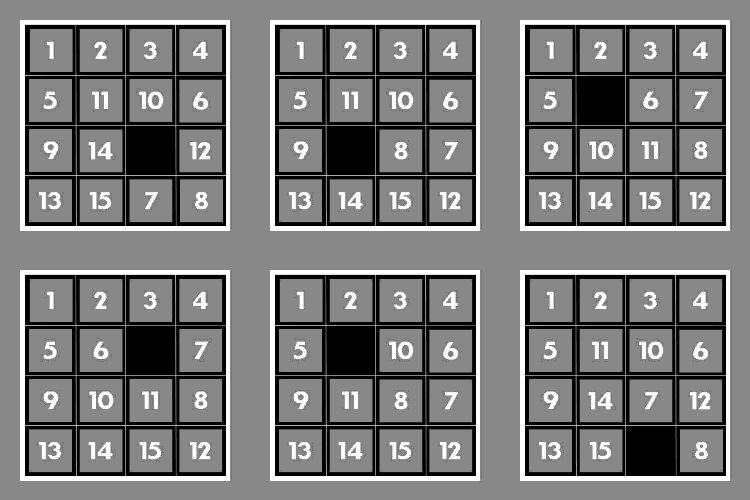 Don’t try to put the tiles in their final spot in the grid, rather try to string them together. For instance, if the 4 is down in the lower left corner, don’t try to put it in the upper right corner where it “belongs.” Rather, put it between the 3 and the 5 wherever they are. Think of the puzzle as a snake that’s slithering around inside that 4×4 grid. Once several pieces are strung together then they can be snaked around, up or down, into the final configuration. The more sections of the snake you can string together the better.
But remember, having say, 1-2-3-4, left to right on the second or fourth row is really backwards. When you snake them up to the top row, it’ll be 4-3-2-1. The thing to do is snake it down to the third row, then up to the first row. Just keep that train intact!
Also, we all know that it’s fairly easy to get most of the tiles in the proper order. It’s always those last couple that are so tough. So go ahead and put in the top row, 1-4, and then leave it alone. Now you can concentrate on the lower three rows.
2. Get the Picture
Of course, not all slider puzzles have a 4×4 grid, and not all are numbered. The popular thing of late is to have pieces of a picture, not a group of numbers. The size of the grid really makes no difference. As for the picture pieces, the first and most important thing to do there is identity which pieces do fit next to each other. It’s frustrating enough to get the pieces in the right order, but if you don’t know exactly where each piece fits, you’re really going around in circles. Sure, you’ll probably stumble upon the correct order eventually, but plan for a lunch and dinner break if this is your method. However, though picture tiles are admittedly more challenging than the numbered tiles, the solution is the same.
Usually, you do know what the completed picture looks like. You should then spend the time memorizing exactly which piece is which. Sometimes though, those sneaky game designers don’t even let you know what you’re assembling. You have to find out what the image is elsewhere in the game. And sometimes they just want you to sweat it out and discover what the heck it is you’re assembling the hard way. In this case, of course, time-honored jigsaw puzzle theory applies. Get to know what the sections of the picture are by organizing small groups by mating their sides. Usually, you don’t have to actually put the whole thing together to figure out where all the pieces fit.
3. Join the Circuits
Now we’re down to the nitty gritty. We’ve got most of the numbers (or picture pieces) snaked together, we’ve got the top row in, and probably the second row. But the bottom two rows still read something like 9-11-12-10 and 13-14-15. Now we’ve come to the theory of “circuits” and “exchange points.”
Obviously, you can rotate any three tiles around in a 2×2 space forever without ever changing their order. However, when you rotate a circuit of, 2×3, or 2×4, or 3×3 or 3×4 or 4×4, you open up exchange points in the middle. However, you cannot exchange any two tiles in the circuit — only the ones that fall either above or below the open space as they cycle around.
This is that point where the whiz kid mathematician needs to explain what’s going on. Practically speaking, though, just remember that if you can’t insert the tile where you want to on any given circuit, you’re going to have to try another circuit, or, most likely, move it somewhere out of the circuit so that it can be in position for when the open space comes around. It’s all a bit like playing musical chairs. The advantage of moving tiles around in these circuits and only “exchanging” one at a time, is that it allows you to keep most of your previous hard work intact. Once the tile is inserted in its new spot, the circuit can be rewound to its original state.
Okay, it’s all getting frustrating and confusing again. The trick is to try to keep as much of the snake intact as you move that last out-of-place tile around until it can finally slip into its proper place. In the examples from above, the 9-11-12-10 and 13-14-15 bottom two rows is a piece of cake. The 10 will easily slip into the open space between the 9 and 11 when you rotate the five tiles around the bottom 2×4 (or 2×3) circuit.
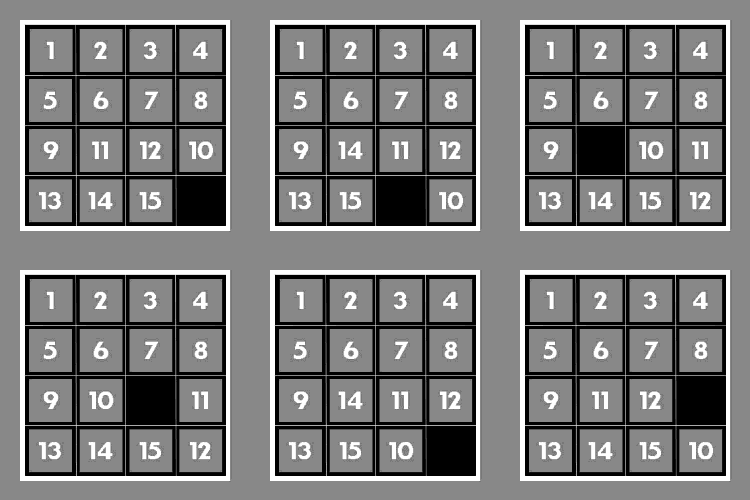 However, a 9-11-10-12 and 13-14-15 configuration is much tougher. The 10 and 11 are right next to each other. You have to move the 10 up into the second row. Of course, this means you have to exchange it with one of the numbers already occupying the second row. Well, this is the tricky part. You have to work the circuits so that the tiles you’re trying to move all find their right exchange points. Just remember, the biggest trouble is when the two out of place tiles are right next to each other. That’s when you have to start the merry-go-round, migrating the out-of-place tile from one circuit to another until it ends up in a circuit that will allow it to slip into its correct spot.
By the way, you should never end up with all the pieces in place except for two adjoining transposed tiles. This, in fact, is the situation Sam Loyd set up with his original “challenge.” As he well knew, it is impossible to “solve” the puzzle from this configuration.
Sorry, there is no magic bullet for solving slider puzzles. On the other hand, there’s no need to rely entirely on trial and error. It should be fairly easy to get to the point where you have only to place that last tricky out-of-place tile. You don’t have to tear up all your work to do it. Keep the tiles in their proper order as much as possible — keep the train chugging — while you maneuver that last tile around the circuits until it gets to a spot where it can drop into place.
It’s said that when Sam Loyd produced his first Fifteen puzzles in the 1870’s it created a worldwide craze. Train conductors missed stations because they were fiddling with the little box of tiles. Amazingly, almost a hundred years after Loyd’s death his infernal little device is still causing all kinds of people all kinds of headaches. Something tells me nothing could have made old Sam happier. Or the rest of us so miserable.