Death Gate
|
Death Gate Developer/Publisher: Legend Entertainment By Ray Ivey 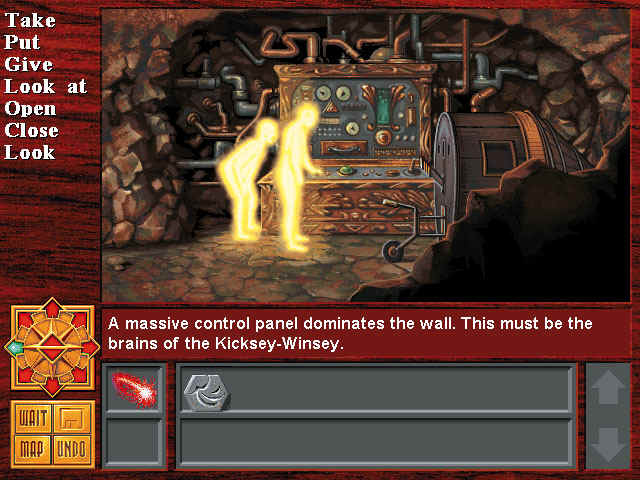 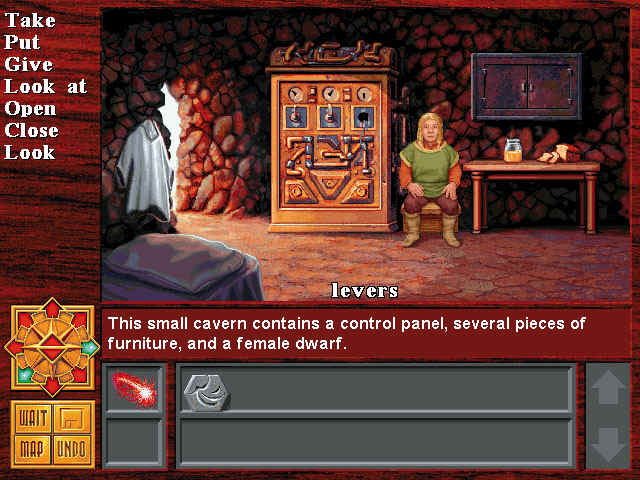 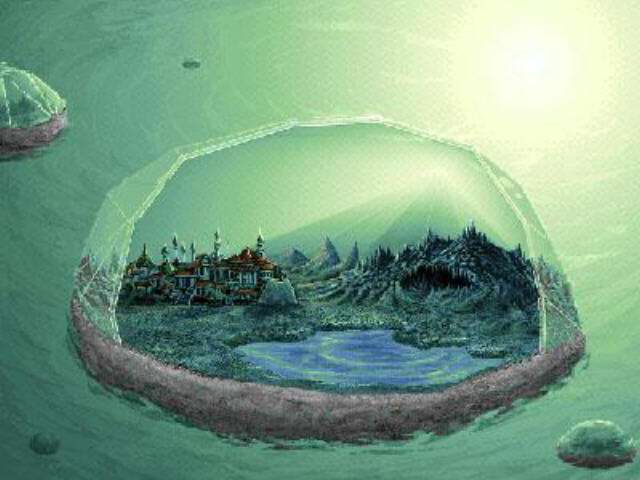 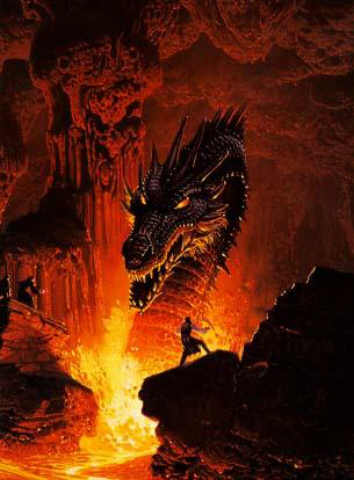 |
I never played Dungeons and Dragons. I never read a book by Stephen Donaldson or Terry Brooks. I’ve barely read Tolkien. I’m not a magic spells, wizard, and dragon sort of guy. I don’t know a sylph from Shinola. I certainly never read the Death Gate series of novels by Margaret Weis Tracy Hickman.
So I guess I’ve got some explaining to do. Why did I enjoy Legend Entertainment’s Death Gate so very, very much?
I guess it’s because this 1994 game is just so very, very well-built.
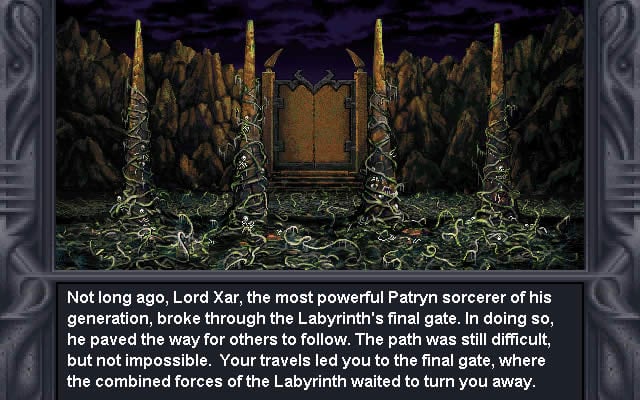
This story is truly epic. You play Haplo, a young member of a race called Patryns. The Patryns are but one race of many “mensch,” or sentient races, in a larger universe of worlds that were sundered into several different worlds thousands of years ago. At the beginning of the story, Haplo has just escaped a massive Labyrinth that has held your people prisoner for many years. You are sent on a mission that will take you to all of the other worlds in search of the tools to reform them once again into a unified whole. The “Death Gate” of the title refers to a portal your character uses to travel from world to world.
The game is based on several of the Death Gate novels, and it shows: this is a long, rich, and varied game. It’s easily three times longer than Legend’s more famous game, Shannara. The quest takes you to worlds of fire, air, stone, and water. Each world has its own history, quests, politics, and complications. In fact, each one could be a game in itself!
Death Gate is also presented in the exact same format as Shannara. Its interface is reminiscent of older DOS games, with commands created with inventory items, verbs, magic spells, and even other characters. Navigation is accomplished with a very efficient onscreen compass rose. The overall user interface is fluid, efficient, and user-friendly and gets an A.
Graphically, Death Gate certainly could seem primitive to a player in 2000. It consists of lovely hand-drawn backgrounds and characters with minimal animation. The art is fine, however, and the many characters are beautifully rendered. It’s true, however, that much of the action of the game is read, rather than seen, which I assume was a budgetary issue. Here’s what I mean: you might be in a situation in which you shoot a magic arrow at a monster. You then see written narration on the screen to the effect, “The monster screams in agony and writhes around, spinning in circles until it collapses on the ground and fades into the forest as the snowstorm begins.” Now, of course it would be nice to see all of this, but from a narrative point of view, it still works just fine. Graphics get an A-.
I want to talk about gameplay next, but it’s actually difficult to talk about gameplay in Death Gate without also taking about storytelling. In this game the two are completely intertwined, which is the game’s greatest strength. As I’ve said, the story is huge, with subplots galore, and each subplot has very entertaining stories to learn and puzzles to solve. Many of these puzzles involve using magic spells.
Now, before you roll your eyes up in your head, please remember that Ray is not a magic spells guy either! But the subject is just handled beautifully in this game. As the story progresses, you learn more and more spells, and these spells become just another set of tools at your disposal for solving the challenges your character faces. Your list of spells include things like Possession, Transportation, Resurrection, Swap, and Self-Immolation (which, yes, actually comes in handy at one point!).
For all these virtues, plot and gameplay obviously get a big fat A.
As in Shannara, from time to time in the story of Death Gate you have one or more companions. The most interesting one is a dog, who becomes one of your most important allies in the game. Many problems can only be solved by temporarily possessing this crusading canine. The cleverest puzzle in the game involves this sticky problem: how do you choose a bottle filled with liquid of a particular color when you are a dog with only black-and-white vision?
For its sheer number, variety, and cleverness of puzzles, puzzles get a resounding A.
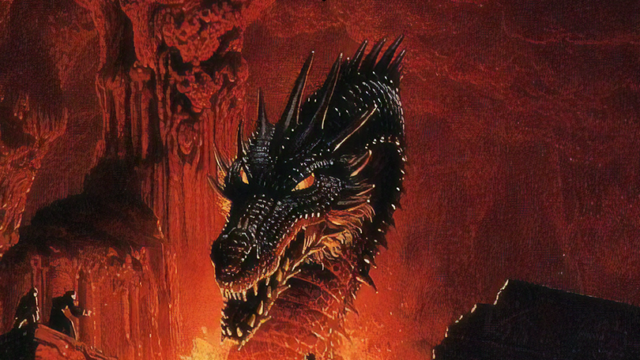
With all of those characters, there’s of course a ton of voice acting, and I’m happy to report that it’s uniformly excellent. Yes, a few times the angry dragon overdoes it a bit, but most of the work is terrific. There’s a hilarious old wizard who’s constantly cracking anachronistic jokes who is particularly entertaining. Voice acting gets an A.
Death Gate drew me into its story in a much more compelling way than I would have predicted. It strikes me as the kind of story Fable was attempting to be, and failing so miserably. In fact, the story of Fable is so very similar to that of Death Gate that it makes me a bit suspicious …
The game begins and ends with lovely 3D animated sequences. I truly wish someone would remake this game so that the entire game could be done in that format, so that the player could actually see everything transpire that the narration describes. I’d love to see this game done in the format of The Feeble Files or Discworld Noir.
This game didn’t sell very well, and I can’t help thinking its title is partially to blame. Sure, there’s the name recognition, if you’re a fan of the novels. But the Death Gate novels weren’t nearly as famous as the Shannara novels, and for those of us who weren’t familiar with them, I think the title is misleading, yet another title (like Circle of Blood) that makes a fine adventure game sound as if it belongs in another genre.
This can’t be an easy title to find, but trust your Uncle Ray, it’s worth the hunt. Death Gate will provide you many hours of classic adventuring.
P.S. Like Shannara, Death Gate is a DOS game that installs beautifully in Windows.
Final Grade: A
System Requirements: 386/33
Graphics 320 × 200 × 256
Disk space 4 MB (5 MB maximum)