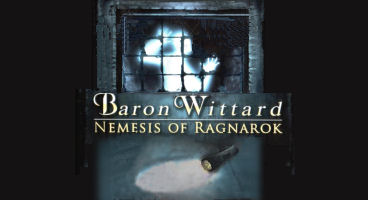
Baron Wittard Nemesis of Ragnarok
|
Articles
‘Baron Wittard is a game that can be creepy, fascinating and intimidating all at the same time’ so says a beta tester of the game. As development now reaches its final stages, I am at last able to sit back to play the game and to see it through a gamer’s eyes, as opposed to a developer’s eyes. In so doing, I think there is much truth in what that beta tester said about the game. The game can be creepy, fascinating, and intimidating. Creepy because the game requires the player to explore dark and foreboding places that have an undertone of menace throughout; places no person has visited or dared to visit for years. These range from long and claustrophobic sewer tunnels to damp and abandoned secret passageways. It can be a fascinating game because the story centres both on an eccentric and off-beat architect that built a giant maze of a city out of a fear about impending catastrophe, and on the malevolent and electrical entity that now inhabits the ruins of that city. It is also likely to be intimidating because the game features puzzles; lots and lots of puzzles. Some are straightforward and simple in comparison to some others that are complex and detailed and which are likely to keep the veteran puzzle-lover occupied. In recent weeks, I have been particularly impressed by the volume of email I have received from gamers interested in the Baron Wittard story; gamers wanting to know more about the game. Who is Baron Wittard? How large is his city? And will there be dangerous encounters with evil creatures? I would like to answer all of these story related questions in this part of the development diary. Subsequent parts will focus on puzzles and exportation; two other key ingredients of this game. Crafting the Story We (Marlies and I) were from the outset of development inspired by other genre classics, such as the Myst and Shivers series. We not only loved each of these games as complete entities, but we also loved their style. And it was that style that we wanted to import into Baron Wittard. I think there are two key ingredients or rules that must be obeyed by any adventure game if it is to belong successfully to the style found in Myst and Shivers. In developing Baron Wittard, and especially in crafting its story, we made sure as developers that we took notice of those rules. Those two rules are the non-linear rule and the solitary-exploration rule. The Non-linear rule states that the story should not get in the way of the gamer. It should not put limitations on the locations that the gamer can explore at any one time. We observed that rule stringently in developing Baron Wittard, by making sure that no place in the game is inaccessible to the gamer simply because it would have been inconvenient to the story. If the player cannot enter a room, it might be because the door leading there is locked, or because it is accessible only via a secret passageway that is yet to be discovered. The gamer could enter that room if they found the key, or if they found the entrance to the secret passageway, but the location would certainly not be locked because the story requires that is must be until a certain time. The second rule is the solitary exploration rule, and this states that character interaction, such as conversations with other characters, does not play a key role in the game. There are NPCS (Non Player Characters) in Baron Wittard, certainly. There is Baron Wittard himself, and there is Kate who is a magazine editor, and there is an evil presence too. But conversations with these characters are intentionally kept to a minimum, both to heighten the dramatic effect of those interactions when they do occur, and to allow the player more time for exploration, to uncover the mystery of exactly what terrible thing lurks at this desolate and isolated city and how it simply cannot be ignored. Taking the Story Further When creating the story for this game, we had to keep in mind these two key rules, and to create a story that was compatible with them both. It is only during the latter half of the testing phase that I am now able to appreciate fully how we have succeeded in creating such a story, and I am also pleased to hear that many testers agree with me in reaching that conclusion. The story centres on three important elements: Baron Wittard, The ‘Presence’, and The Utopia. Baron Wittard was, on the surface, a cosy English gentleman and architect who enjoyed interesting conversation with friends by the fireside on a winter evening. But beneath that veneer was a bookish man with a secret, a man preoccupied with legends, and specifically with Viking legends surrounding the great event of Ragnarok. I first came across the term ‘Ragnarok’ while watching an old Sylvester McCoy episode of Doctor Who in which the doctor must prevent the Gods of Ragnarok from destroying a ‘Psychic Circus’. I later came to realise long after watching the show that ‘Ragnarok’ was not just a term invented by the programme writers simply because they thought it sounded stylish and fun, but that it was really a word from Norse mythology. ‘Ragnarok’ is a term used to describe an event in the future that is the end of the world; a time at which Gods come to Earth and do battle. It is this event that played on Wittard’s mind and imagination. He knew something about it, something terrible. He took that secret with him to the grave shortly after building his great city, the Utopia. And now the player is left to explore the remains of that vast city. In exploring that place, they will need to uncover what it was that Baron Wittard knew or did before his death, and also his reasons for building his great city at all. And perhaps more importantly, the player must discover how all of this mystery relates to them, the main character. One of the first things that a gamer is likely to notice when they play Baron Wittard and start to explore the surroundings is the sound and experience of whooshes and electrical disturbances. This is because the Utopia is a city inhabited by a supernatural and evil entity (a presence) with electrical affiliations. Bringing that creature to life in the game was a real developmental challenge for me. It consisted in a balancing act. On the one hand, in a solitary exploration game, it is important not to push the story too much into the gamer’s face, because a lot of the game is about their exploration. But on the other it is important to bring that world and story to life. I think that we have struck a solid and interesting balance in Baron Wittard regarding the delivery of the story. As the player explores further, more and more of the story is unravelled and pieced together. This story and its unfolding is also complemented with a varied and comprehensive sound track. Each location in the Utopia has its own unique sound track used to convey an emotion, and theme, and a set of associated events. Step into one room and there will be signs and signals of something inhabiting that place, or something waiting to happen. Creaking floorboards, distant movement, and menacing incidental music are used frequently. All of them a prelude to an event. So, to answer the three questions at the beginning of this diary: Who is Baron Wittard? How large is his city? And will there be dangerous encounters with evil creatures? I will say: Baron Wittard was a fascinating and multi-dimensional architect who built a vast city with plenty to see and do. But unfortunately, Baron Wittard died and left behind him a city that time forgot, forgotten by all except the evil thing which inhabits that city. There will be encounters with dangerous creatures, and furthermore, there will need to be momentous choices made. Thank you for reading this first entry in the developer diary. It has been a pleasure discussing development with you and in parts 2 and 3 I hope to be discussing puzzles and exploration respectively. Please stay tuned.
|