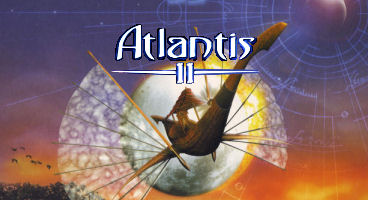
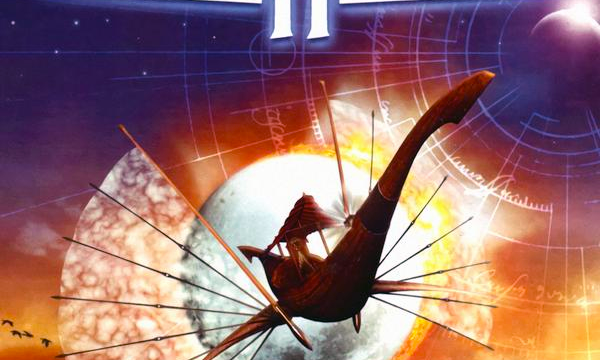
Atlantis II
|
Atlantis II Developer/Publisher: Cryo Interactive By Tom Houston 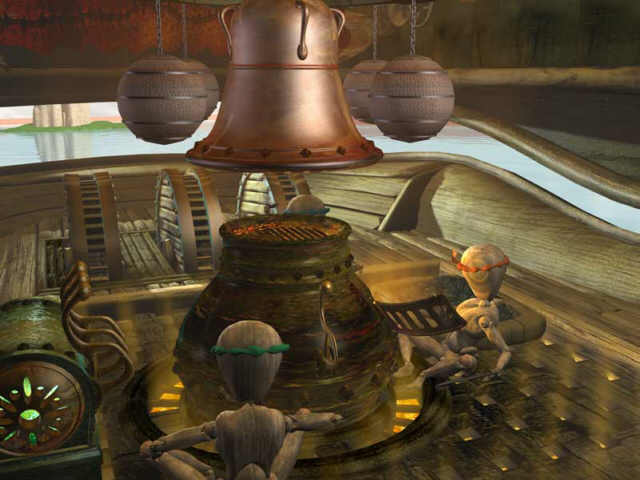  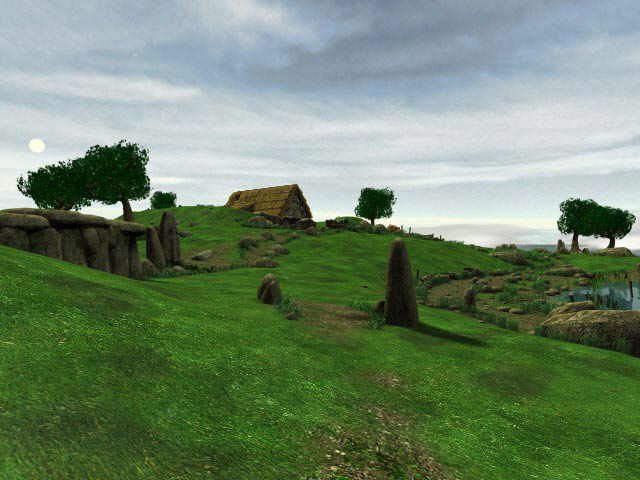 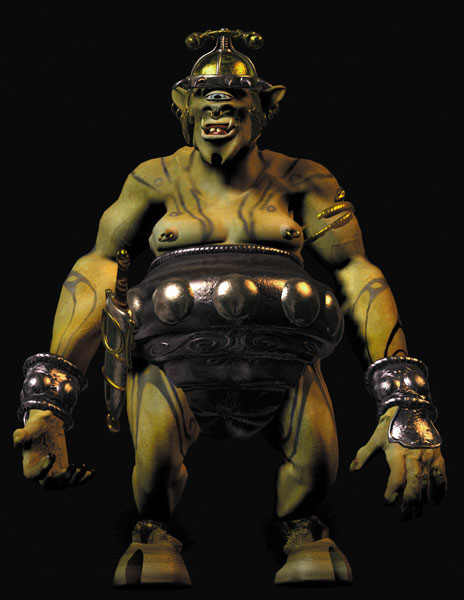 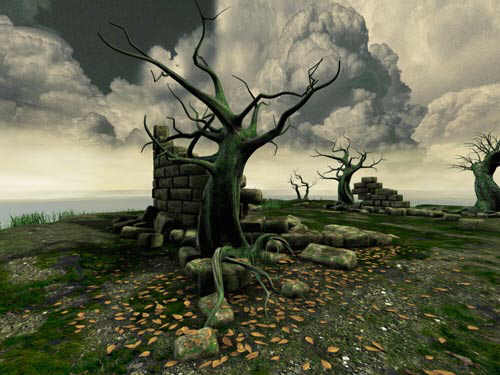 |
As you trudge up the snow-covered mountainside, somewhere in Tibet, you have little sense of the mysterious mission that awaits you. If only you knew that, if successful in accomplishing the arduous tasks that lie before you, you will not only restore the balance of order to the world but find a very unexpected kind of personal peace and pleasure.
But for the moment, you have been “summoned” to meet with an old Shaman, who sits in an old Atlantean airship, waiting for your arrival. You are Ten, a descendent of Seth, the original hero of Atlantis: The Lost Tales (the first Atlantis adventure game from Cryo). What happens next is that the old Shaman will explain to you what has transpired in the centuries that have passed since the time of Seth and the halcyon days of the Atlantean culture under the rule of Queen Rhea and how your destiny is linked to the past.
It seems that the development of the civilization of Atlantis with its unique technologies and skills can be attributed to a power that came from outer space and was represented by “the Cube.” At some point in the distant past, the people divided the power of the Cube into two parts, one “the Light” and the other “the Dark.” Subsequently, a war between the two partisan camps resulted in the conquest of the Dark, which was then captured and locked away in a metal head. The people decided in keep the Dark and the Light separate. While the majority went to live on the island of Atlantis, a smaller group bearing the Light portion of the Cube settled in Shambhala.
Centuries later on Atlantis, Queen Rhea’s royal consort, Creon, did the unthinkable: he freed the Dark from its containment and unleashed the struggle between Light and Dark once again. It was at this juncture that Seth, the hero of Atlantis, took the Light within himself and vanquished the Dark once more. The people of Shambhala would have liked to have joined together the Light and the Dark halves of the Cube, but they were afraid that the Dark might overcome the Light, so they chose to keep the two halves separated. The people of Shambhala then became the keepers of the Dark, hiding it away, while the Light passed down from Seth through the generations until it now resided with Ten, who became the “silent” Bearer of the Light.
Now … the Super Nova of the Crab, a bright star that shines day and night, has appeared in the sky and has awakened the Light half of the power of the Cube. Has it awakened the Dark half also? Will the balance of order and chaos that was established hundreds of years ago be upset?
It is here that the old Shaman explains to Ten his destiny as the Bearer of the Light and teaches him about how to use triangular stones and the power of a crystal ball to embark on journeys that will take Ten on quests, filled with mysteries, enigmas, and revelations, which when accomplished will build a road to Shambhala and ultimately provide the opportunity for the Bearer of the Light, Ten, to confront and capture the Dark, which turns out to be a vastly different experience than you might suspect.
Thus, the journey and the story begins …
The Story’s the Thing
Once you have acquired the knowledge that the Shaman imparts to you and have located three triangular stones, along with the crystal ball, you are ready to embark on one of three journeys that you will need to take in order to ultimately reach Shambhala.
Along the way at each of three journey locations, you will uncover mysterious events from the past, which have links to the unusual happenings that are occurring around you. You will take on the identity of someone from the world and time period that you have journeyed to and meet interesting and sometimes bizarre characters and strange creatures that will either help you or hinder you in your quest to resolve the problems that are before you. For only by solving the puzzles that you are presented with can you restore order to the lands that you are visiting and ultimately capture the next triangular stone that will allow you to progress down the road to Shambhala.
The three worlds that you must travel to are:
- The Mayan World of the twin gods, Quetzalcoatl (the Feathered Serpent) and his brother, Tezcatlipoca (the Jaguar), where you become Tepec, a warrior, who sides with the reigning king, a follower of Quetzalcoatl. You discover that the king is very ill and is facing the prospect of being sacrificed to the God, Tezcatlipoca, because the king’s God, Quetzalcoatl, is “sleeping” and unable to provide the “chulel” or energy that is required to support the growth and harvesting of a good crop of corn, which is needed for food. If you don’t help or are unsuccessful in getting the “chulel” from Quetzalcoatl, then the king will die and the power will be taken over by Tezcatlipoca’s followers, who are basically evil-doers who believe in and depend on bloody sacrifices to satisfy their God, Tezcatlipoca. What follows is an exciting journey through the Mayan world that will take you inside the secret temples and out to the surrounding jungles in search of the Land of the Dead, Xibalba, where you will encounter strange creatures and challenging traps and puzzles, as you try to find Quetzalcoatl. If you are successful, the fourth stone on the road to Shambhala will be yours.
- The Ireland World, where as Brother Felim, a monk, you are confronted by your superior, Brother Liam, who asks for your help in analyzing the strange affliction that has affected Finbar, another brother at this remote religious retreat location. As you search for answers to the predicament of Brother Finbar, you become involved in an unusual juxtaposition of past and present events that lead you to undertake side trips to a nearby island, where you encounter the strange character, Birdman, and to the “Sky World” inhabited by characters from the previous millennium (I knew I’d get to use that word again), all of whom have unusual connections to the present time. How do the happenings from a thousand years ago, which were affected by the influences and conduct of the Dolmen, Ailill, and the Goddess Aine become tied to the events that are occurring now? Many mysteries must be resolved for you to lay the fifth stone on the road to Shambhala.
- The China World, where as Wei Yulan, a government official who has been collating records for the imperial archives, you are unable to leave the Abode of the Purple Deposit, because its gate is being guarded by a strange Shadow. Because there are many other ghosts haunting the countryside, all of the exorcists are busy, and Wei Yulan is being given the task of exorcizing the Shadow. Wu Tao Shih, the Master of Directions at the Abode, has offered to guide you on a “magic path” leading to the Grand Master, Tan Yun, who has been gone from the Abode for 317 years and is thought to have attained immortality. If you are successful in finding Tan Yun, you may be able to convince him to teach you or give you the power to exorcize the Shadow. Your long and difficult journey from the Ceremonial Room to the Dragon’s Den and eventually to a search for the Mushroom of Immortality in Hell must be completed in order for you to return to the Abode, exorcize the Shadow, and retrieve the sixth and final stone needed for the journey to Shambhala.
Now that you have the six triangular stones that are needed to travel to Shambhala, you may think that your journey is nearly ended, but actually you still have a long way to go and many difficult trials and puzzles to solve. In fact, I found that the game became quite abstract at this point, and what had been a very logic-based game became somewhat illogical.
Suffice it to say that I do not deal effectively with abstract story-telling, so that I will admit to needing some assistance in getting through the rest of the story. The purpose and use of the markings on the crystal ball, the escape from the Lotus Flower, the gathering of articles from the places that had been previously visited in the three worlds, the underwater search for Atlantis, the encounter with the octopus, and the travel through celestial bodies all seemed very abstract to me, so I suffered through those parts of the story right up until the end.
The ending itself, however, was most enjoyable and somewhat of a surprise, so I’ll not say anything more, except that I think that you will appreciate the interesting conclusion to what, by this time, will have been an entertaining and very challenging series of arduous journeys.
On the whole, I thought that Atlantis II was better than the first Atlantis, and the story kept me involved and interested in the characters, except for the abstract parts near the end, which accounts for some deduction in my rating. The story receives an A-.
The Gameplay
When the game starts, the start-up screen appears, and you can select to play as one of up to five players that can be playing the game simultaneously. Embedded beneath the start up screen is the general menu, which contains three detailed sub-menus:
- Display options (subtitles, display resolution and the use of the Omni-3D features).
- Adjustment of the sound volumes (music, speech, and sound effects).
- Management of saving and loading games.
The game uses the familiar point-and-click interface, where you find hot spots identified by a change in the cursor icon, then use the left mouse button to move to another area, speak to a character, or pick up/manipulate an object. The movements of the mouse are used for rotations within the scenes in Omni-3D, which I found to be a very comfortable system for exploration. The move to icon (arrow) sometimes moves to the next location/scene instantaneously, and sometimes the movement is accomplished by walking to the next place in the same scene.
When an object is picked up or taken, one click of the right mouse button will open the inventory and place the object in it. To use an item from inventory, simply right-click to open the inventory screen and then left-click on the desired item to select it and to close the inventory screen. Very simple and convenient.
Dialogues with characters in the game are initiated by left-clicking on the character. The character then may speak directly to you or pictorial icons will appear that will suggest certain topics for discussion. Left-clicking on these icons will start the appropriate dialogue for that icon.
Regrettably, you will need to get used to disk swapping during the game play and you can only start the game with disk 1 in your drive, all of which can be a little annoying. The game comes on four disks, which load reasonably fast.
Overall, the game interface should be comfortable for any novice or experienced adventure gamer and all of the features seemed to function well with no problems or bugs, so I will give gameplay a rating of A.
The Graphics
This is a Cryo game, so you know that the graphics will be the strong point of the game presentation. In this case, the graphics for Atlantis II are simply stunning with beautiful, vibrant colors and the best use to date of the Omni-3D modeling system to provide gorgeous scenery and locations coupled with life-like 3D character presentations and magnificent animations.
The reconstruction of the Tibet, Mayan, Ireland, China, and Shambhala worlds, right down to the most minute detail, is always breathtaking and realistic. You are in for a real visual treat when you explore the scenes that make up the worlds that you will visit and travel through. As for the animations, there are so many beautiful representations to experience and remember that I had to think about my favorite for a few minutes, but I’ll select the exhilarating ride on the white horse across the water to the Birdman’s island and back again, which by the way, you get to do several times during the game.
The movements of the characters are reasonably good and seemed even better to me than what I had seen in the recent Cryo game, Aztec.
The new Cryo technology used for the synchronization of every character’s facial expression and speech, called Omni Sync, was excellent and perhaps among the best that you will experience in a typical adventure game.
The graphics are indeed the strength of any Cryo game, and Atlantis II shows that Cryo has continued to focus its efforts on improvement in this area and they continue to succeed, which makes it appropriate for me to give the graphics a score of A+.
The Music, Sounds, and Voice Acting
Sometimes, it may seem to be most appropriate that the best thing that you can say about the music is that it supported the evolvement of the story, without distracting your attention away from the enjoyment of the game play. The music compositions for Atlantis II always seemed appropriate and supportive of what was happening in the story and the environment (worlds and events) in which the characters were interacting. I was able to experience the music in a way that not only developed the proper moods and feelings for the interactions that were taking place in the story, but also enhanced the overall experience and enjoyment of the game.
In a very similar way, the sound effects were very good and provided just the right balance of sound and effects that were necessary to give me a more complete feeling of immersion in the game environments. For example, the realistic sounds of various animals, running water, and the celestial movements in the sky all contributed to the game’s presentation in a very positive manner.
The voice acting, which has not always been a strength of Cryo’s games, this time is excellent. Atlantis II seems to have use trained, English-speaking actors and actresses that were able to convey the right emotions at the right time and use English-language expressions that are appropriate for the English-speaking gamer.
The disappointment that I had experienced in this part of the gameplay in Aztec was not evident in Atlantis II, which was a very pleasant surprise, although not up to the extremely high standards set by Faust in this category, perhaps because Faust also involved Arxel Tribe, but for the reasons mentioned above, the music, sound effects and voice acting deserve an A.
The Puzzles
Simply put … Atlantis II has some of the best puzzles that I have ever experienced in an adventure game. Except for the puzzles that accompany those “abstract” portions of the story that I described earlier in this review, the vast majority of the puzzles require logical thinking to solve and are integrated nicely into the progression of the storyline.
However, because there is such a wide variety of the traditional puzzle types, even though they may be presented in some unusual formats, I’m certain that you are likely to encounter your least favorite puzzle type in this game. For instance, for you maze haters, there is the trek through the jungle paths in the Mayan world. Not to be left out, for you music puzzle types, there is the Birdman puzzle on the island in the Ireland world, and for you math freaks there are the Mayan number system puzzles.
In the category of unusual puzzles and among the most memorable for me are the Rainbow Bridge puzzle that provides you with access to the Mayan jungle (this one is a slider-type puzzle, but a really fun challenge) and the Spider Web puzzle, also in the Mayan jungle, where you will need to outwit big, bad “Mama Spider” (again, loads of fun) in order to obtain an important object.
In general, the puzzles are moderate to difficult, and you will not breeze through too many of them. But the challenge will always be rewarding both in your ability to sustain your progress in the game and in your enjoyment of the chance to apply your best thought processes and put some strain on the old gray matter.
If puzzles are an important reason why you play adventure games, then you will rejoice at the logical, thoughtful, and often complex puzzles that you will find throughout Atlantis II. I know that the puzzles were a highlight for me. The puzzles get a rating of A+.
My overall rating for Atlantis II is an A+.
As one who appreciates the commitment that Cryo has made to the proliferation of the adventure game genre and a believer that Cryo is making strong efforts and investments to continue to improve the development of their total adventure game package (story, interaction, graphics, music, sound, acting, and puzzle elements are all included), I am putting Atlantis II on my list of the five best adventure games of 1999, along with Faust, which I reviewed earlier.
This is a relatively long game in terms of the time that it will take to play, especially if you minimize your use of a walkthrough, but if you enjoy traveling to ancient civilizations and becoming immersed in an engrossing storyline, supported by excellent graphics and integrated, logical puzzles, then you will be both thrilled and challenged by the mysteries of Atlantis II.
System Requirements:
Pentium 200 MHz processor
32 MB RAM
8X CD-ROM drive
2 MB video card
65,000 colors
Soundblaster-compatible sound card
70 MB available on hard drive
DirectX 6.0 compatibility (supplied with game)