AGI: The Birth of the Graphic Adventure
AGI: The Birth of the Graphic Adventure
By Adam Rodman
 In ancient times (relative to gaming, anyway) primitive humans gathered around their PC Jrs., Commodore 64s, Apple ][s, and their ilk as they grunted nonsensical phrases to animated characters in graphic adventure games made by Sierra. What made these homo sapiens so happy? What were these adventure games like? How were they made? This self-proclaimed compu-anthropologist/archaeologist investigates this phenomenon, going back 16 years to a time when hostile machines ruled the planet and the wonder that is the modern adventure was being born …
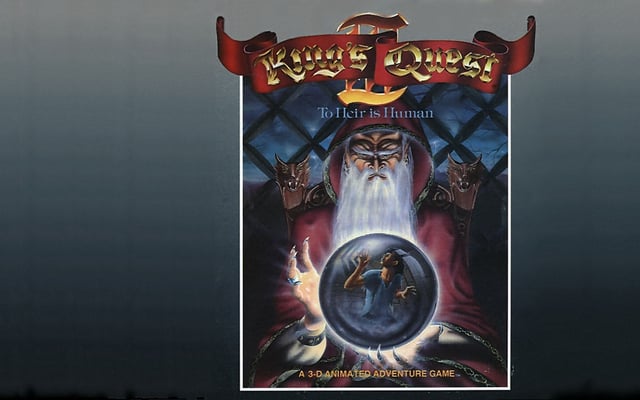
In July 1983, a small company known as Sierra On-Line released a game that would change the world. Kings Quest, it was called. Marketed as a “3-D Animated Adventure Game,” the engine driving this epic would be used to create 12 additional games. The engine was AGI. A clever acronym for “Adventure Game Interpreter,” it would survive for six years …
How does AGI work? It is (obviously) an interpreter. It loads instructions, graphics, backgrounds, and sounds into memory, where it executes commands to deal with player controls, graphics, text, etc. Each room in an AGI game included four types of resources: logics, or the room scripts, pictures, or the background images, views, or sprites and animations, and sounds, obviously sound effects. The logic for a room contains all dialogue, descriptions, controls, and essentially the meat and potatoes of the game. All of the four resources were compiled into VOL files (for the later games.)
The graphics in AGI were not complex–it was designed in the eighties. The interpreter supported 16-color graphics in a 160 x 200 resolution. However, they were displayed in a 320 x 200 resolution (2 x 1) possibly because of memory restrictions. The sound was also upper-Mesolithic, the IBM PC supporting one sound channel and other platforms supporting three music and one sound effects channel. Sierra originally built interpreters for the Apple 2, Amiga, Macintosh, Tandy/PC Jr., IBM PC, and Atari-ST. However, fans are working on new interpreters for Sun’s Ultra, IBM AIX, and Linux.
Like all things (life, computers, Michael Jackson), AGI has evolved over the years. The first version of AGI used CGA graphics and only ran on the IBM PC. The second version added 16-color graphics, and version three added support for compressed resources (VOL files.)
AGI lived a long and fruitful life, but as is inevitable, it slowly withered, died, and decayed. The last game by Sierra programmed fully in AGI was Man Hunter 2, released in 1989. But for addicts of this seemingly forgotten engine, worry not. There is a loyal fan base on the Internet striving to create homemade AGI games. The current count is over 20. Though the original code was similar to assembly language, Peter Kelly has programmed a nifty utility called AGI Studio that interprets the logics into easy-to-learn code similar to C++. To create a game, though, one will need more than simply AGI Studio. It cannot edit pictures, views, and sounds directly, so the programs PICEDIT and ROL2SND are recommended for the AGI programmer.
And thus ends the story of AGI. But AGI is only the tip of the iceberg, the lower Paleolithic of humanity, the … well, never mind. Tune in next week for the exciting next evolutionary step in adventure gaming … SCI.
Sierra Classics–AGI-Homepage of AGI Studio. Downloads of other utilities as well.
Thanks to Peter Kelly and Nat Budin for their interviews.