3D or Not 3D: That is the Question – Article
Articles
3D or Not 3D: That is the Question
Opinion Piece By Ben Bowen
 3D adventure gaming is somewhat a new and controversial subject. For me, it’s only recently that it’s become a viable medium and I’m often slightly taken aback by some of the vehemence of those within our community that rally against it. They often cite past 3D titles as being the main reason as why it would never work, a questionable move compounded by the fact that those games fail simply because they’re not great games, or suffered from the technology the developers were using back at that time. There’s also a pickiness associated with 3D titles that doesn’t transfer to 2D ones – simply put, most adventure gamers are OK settling for a mediocre (generalising maybe, but it’s an example) title like Midnight Nowhere because of its simple point-and-click mouse controls when a better game like Broken Sword 3 gets kicked in the shins for some relatively minor control problems and a couple of “Dragon’s Lair” interactive cutscenes which solve themselves… not that I’m agreeing with the fact that they’re there, as you can see below. But it’s a worthy point that many AG’ers seem to have something against 3D which I want to try to prove isn’t justified.
 Now, I personally don’t have a problem with action elements, though I can see some of the concerns. But the inclusion of them in 3D titles isn’t anything to do with the medium itself. What a lot of developers in the AG section who’ve moved to 3D seem to have a problem with is implementation. For me, a good 3D adventure could just be around the corner, if only they followed the dictum that Adventure Gamers don’t always want action and the fact that if they’re going to include it, it must be applicable from the start of the game. Advances in 3D action games of late have solved some of the old problems of moving our genre into the third dimension, through the development of useful camera systems and engines that can support the detailed backgrounds associated with graphical adventures. However, another thing that bears consideration the fact that in most action games, the rules are pretty much set in stone for you at the beginning. You KNOW the controls, you get to LEARN the interface and throughout the title, THAT DOESN’T CHANGE. This isn’t at a cost to the variety of gameplay, however – Call of Duty, for example, varies gameplay by giving you different objectives and tests your skills in a number of ways without changing the core elements.
 What’s stopping Adventure games from doing the same thing? I’m a firm believer that once you’ve set up a game, you have to stick to that course of action and rely on situational changes to challenge you. As far as I can see, Adventure gaming is the only genre where you seem to be expected to have more than one skill to hand due to non-linearity of gameplay. The majority rely on the brain, but a lot also rely on our sense of hearing and our reflexes in puzzles or sections which often come right out of the blue. An action gamer plays an action game for the action, for sure – but if we know from the start, like Deus Ex or Thief, that we’re expected to rely on more than that then the action gamer doesn’t mind. The skills become second nature. It’s just that we don’t suddenly like finding that we have to learn a new skill other than the ones we’ve been cultivating from the start a third of the way through the game – and this seems almost expected of AG’s and furthermore, it’s now become expected that it’s a requirement of 3D.
 But it’s not just the sudden implementation of an action element that we’re worried about – that’s something which happens in many 2D AG’s right up until the famous stealth/pyschic dog sequence in the recent Sherlock Holmes & The Case of the Silver Earring. The camera and the environment are issues too for the average JA+ forum poster. But here’s the thing – they’ don’t have to be! Schizm 2 proved that 3D can work great in a first person perspective, but suffered in other ways from the limitations of the engine and some level design that had you hanging on bits of scenery. But it’s worthy to note that it is the design at fault and not the medium! Broken Sword 3 had problems with the camera, a character relative control system and a few too many crates – but that again is the fault of the game design and nothing else. 3D games can have locked-off cameras too, but also provide a brilliant tool for developers which they’re not using to its full extent. 3D games can truly be movie like and also easy to use provided they have camera-relative control and used the medium sensibly. Not every film has continuously moving cameras or tracking shots on every scene. Through simple planning and storyboarding, or even hiring people from other industries to do that for them, an Adventure game could be more movie-like than ever before without it being obtrusive to the gameplay.
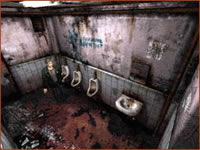 There’s also the claim that a move into 3D would also create problems with regards to pixel hunting. For me, the term “pixel hunting” has really blown out of proportion to the point it seems that some people can’t handle studying the screen carefully for more than five seconds. However, despite that, I can see where the concern lies if you have a detailed environment–but again, the same goes for 2D games like Sherlock. In 3D there are ways around this; a game like Silent Hill 2 solves it by having your avatar look at interactive areas which you can home in on. In first person, it is more of a problem – but I need to say, this has ALWAYS been a problem even in 2D adventures. Look at Darkfall 2, a great game for sure but suffers from some really unobvious hot spots because of the confined nature of the presented space. However, this is again a design issue and not the medium. If a space or camera shot is well designed enough to focus your attention on a section then it shouldn’t be a problem. There are many things that could be done, like sparkling objects (something I’m not fond of), less objects in the room or through developing the game to make the objective or item easier to spot. One idea could be a “focus” view for first person adventures that adjusts the camera field as you pass objects of importance. But I digress…
 To move on, another problem is that of engine. Wanted really seems to have suffered from the action sequences, but that is further compounded by the fact the engine wasn’t up to the task. Schizm 2 had some major optimisation and slowdown problems because the engine was processing too much – but it did a pretty damn good job in presenting us with a reasonably convincing world nonetheless. Admittedly, some of the better engines would cost developers a lot of money to utilise – but then, who’s tried? The sequel to Vampire: The Masquerade (an RPG title) had Valve offer their Source engine to the developers. I wonder if there are any inlets to this for AG developers, or if publishers have thought of investing in these technologies to create a game everyone would be interested in. Myst IV: Revelation had a ton of money spent on it. What if Ubisoft went the whole hog on a next-gen engine on the next game to produce something that looks great with full freedom of movement? Cyan did try something like this with Uru, but failed due to trying too hard… Despite calls from Beta testers during the games creation, the end result was clunky and poorly implemented. Again – to do with the design. Schizm 2 had already proved by then that you could use a firm, proven mouse-driven control system in a 3D adventure without a problem, but Cyan was trying to innovate – the problem being that the innovation didn’t really work.
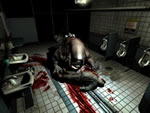 So, developers, use what’s already out there. Let’s take a look at the Source engine for a second – it’s not quite perfect, but it produces far more convincing humans than I’ve seen in a modern 2D/3D mixed adventure like The Moment Of Silence game WITHIN a convincing three-dimensional environment. The bonus being, as proven by the recent Counter Strike: Source benchmarks, it will run with lesser systems – I know one person who runs Counter Strike: Source on an integrated Geforce 2 32bit video card with no real issues. The same goes for ID Software’s Doom 3 engine. Both provide convincing environments and exceptional character modelling within a full 3D environment. Having seen the complexity of the rendered scenes of Half Life 2 through the widely available Bink videos, I marvel at the sequences where you actually take part in a convincing scenario such as the section where you arrive at the central city of the game. No action whatsoever, but just through watching it you feel you are taking part in something, a scenario. That’s kind of what I’d like to see and where most 3D adventure games so far haven’t gripped onto – and they’re usually well directed from the point of view of the gamer. The introduction of the complex in Doom 3 is also similar – you are taking part, yet as in other cutscenes you are a spectator. In Call of Duty and its expansion the most impressive, awesome segments are the player-controlled cutscenes, riding along with the Russian Troops as dive-bombing Stukas strafe a convoy in a convincing mix of 3D design and brilliant sound Even more stunningly, you feel like you’re still taking part without the need of action, with the use of sound in 3D audio a bonus if you’ve got access to it and only adding to the experience.
 Admittedly, games like HL2 and D3 do rely on eye candy, although it’s worth noting that Call of Duty does it all in an updated engine used by Quake 3 in 2000. Schizm 2 uses the same engine that was used by No-One-Lives-Forever 2, which has its fair share of graphical excellence and some good character models complete with lip synching. It also has some great scriptwork and a good eye for cutscenes and in-game comedy… so why aren’t there more AG’s taking this route save for the enteprising Detalion releases? And now we’re seeing a game like Psychonauts come a long and reaffirm my belief that a beautifully scripted, movie-like and above all exceptionally professionally-made cartoon animated game is possible. It may be a platform adventure, but it is worthy of note that Tim Schafer (also responsible for Full Throttle and Grim Fandango) has stated that the adventure elements and action elements work together as part of the core gameplay, touching on what I was saying earlier about implementation. Also, games like NOLF and from what I’ve seen of Psychonauts respect that despite these games being in 3D, they still work within the flat space of 2D narrative.
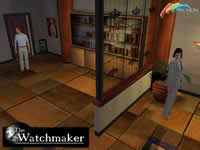 You see, another problem of 3D adventure games of late is over complication. As I previously touched upon, gamers don’t need constantly swinging 3rd person cameras in order to play a game. Too many times have I played 3D games where the camera is misused or poorly implemented, making the whole experience unpleasant and complicated – those of you who’ve played the incredibly bad The Watchmaker can attest to this. Developers don’t seem to want to respect basic 2D narrative laws, and are always eager to impress with complex camera moves which do nothing other than to confuse the viewer – it’s not just most 3D adventure do this as anyone who’s tried to make sense of the intro to Far Cry can attest. There’s also the scene layout – a game like Wanted proves problematic because cameras don’t hook up. This kind of goes hand in hand with the industry’s inability to comprehend that they’re creating a medium of entertainment comparable in basic structure to a 2D animation or television show.
 We don’t want to hear rubbish voice actors phoning in lines from a lame script, we want to hear professionals smoothly delivering a wondrously written piece created by someone who knows what they’re doing. Similarly, a 3D game DESPITE being in 3D must at all times adhere to the basic principles of filmmaking, something that developers evidently think is something they can handle when the proof shows that they can’t. Adventures also come into being possibly the MOST cinematic genre there is, through heavy use of cutscenes (something the Moment of Silence crew have utilised successfully from early videos) to a good portion of the genre being in third person. It shouldn’t be too much to ask of developers to at least make sure games aren’t confusing to watch and follow, and that if they are going to do something in 3D that they don’t overuse it… yet try looking for professionals other than 3D modellers and animators and the main design team on a lot of titles, and you can see that good use of direction and writing isn’t often respected.
Part of this can be associated with time pressures and publishers, but evidently nowadays they’re more concerned in pushing the games out quickly rather than giving us quality comparable to the delights found in a game like Grim Fandango. That’s why for me, personally, I’m looking forward to Tim Schafer’s Psychonauts, as all signs indicate he’s going to utilise the above and his past games show a respect for the nature of the screen.
 Surely it wouldn’t be too much to ask for the above points to be put to task in an adventure? For developers to create a rounded 3D experience relying on the innovations of other genres? For publishers to put their all into a movie-like gaming experience that didn’t necessarily rely on computer-controlled cutscenes, with the gamer taking a part in it without feeling stressed? For the basic narratives structures, developed over the past hundred years, to be fully respected and the requisite professionals hired from outside the games industry to impart their knowledge in order to provide for a smoother experience for the player? Fahrenheit looks like it’ll try to achieve this, but I hear so many negatives about it from the general community it looks like it could be cursed before it’s released. Admittedly, the idea of having specific action “sections” away from the core game doesn’t sit well with me either, but as long as the implementation is beneficial to the gameplay then I have hope. It’s one of the few titles to have the balls to call itself an adventure in this time when our genre is considered dying And although some people might take the early word as unfavourable, one thing’s for sure: it’ll bring more people to the fold if it’s a successful game. Then they might discover other exciting titles and similarly themed titles like Still Life, and thus the ball starts rolling and people begin to discover old titles, eventually generating more demand…
Only time will tell on that one, but what I’m trying to push forward here is that a truly wondrous 3D adventure IS possible. It’s also perfectly viable to stand side to side with 2D and NOT be detrimental to 2D adventure gaming in any way. The movie industry seems to think 2D animation is dead and that 3D rules all, although films like Silvain Chomet’s “The Triplets of Belleville” and Miyakazi’s output, plus films like “Ghost In The Shell 2” PROVE undeniably that 2D isn’t. Personally, despite what this article might seem to indicate, I feel that 2D adventure gaming can stand side by side with great 3D titles and that 3D should be given every bit a chance to provide classic games as 2D has. There’s simply far too much nit-picking going on and defense of mediocre titles in 2D, without respecting the fact that 2D has its clunkers and 3D has yet to really prove itself…
 So, I can hear the nay-sayers already screeching away on the forums. The above is all well and good, but what can 3D provide that 2D doesn’t? Well, for one fully immersive environments, with the added bonus directional audio within a 3D space. Imagine entering a church in a 3D adventure and instead of being presented a flat space as in The Longest Journey, being able to stare up at the columns and stained glass windows and get closer to study the details. Say what you want, but people enjoy being immersed in games – they want to escape into the environment and 3D offers complete choice in what you look at. Some might say this in itself could cause more problems – well, if the game is badly designed then naturally it would. But if moves were made to make things obvious to the gamer, slight nudges like you get in 3D action games where issues like finding objectives and objects have already been touched upon, then it wouldn’t be an issue. A game with a crime scene could have a number of evident clues to pick up and check out. Find the clues for yourself through checking the objects and rotating them around. Environments like cities could have Mafia-style AI citizens walking past, for as long as your objectives are clear within a game it wouldn’t be an issue. Rather than grainy FMV cutscenes they could be handled in-engine, allowing for smoother transitions between environments and more fluid direction. I’m sure there are many, many things that could be innovate in 3D Adventure games, but this article is more to do with alleviating fears and trying to get people to think about ways around problems, not thinking of ways as to how 3D could cause them.
 So, when you hear the next title of your favourite series is in 3D, don’t despair. It might turn into a Leisure Suit Larry: Magna Cum Laude, but who knows? Perhaps an intelligent developer would read this article, visit the forums and gather your opinions in order to make one the best they can. And if they don’t get it just right the first time, there’s always the next time – and there’s also the chance that this is already happening. 3D adventure gaming, whether some of the community like it or not, is on it’s way and it’ll be far better to support positive decisions rather than come down hard and be negative as soon as something out of place is mentioned. This is only detriment to development – after all, bad games don’t sell nor have legs. Let’s support 3D equally and steer people, not put them off of doing it, and one day, who knows? You could be playing the equivalent of the best LucasArts had to offer, only within the confines of the best that 3D action games have to offer. And possibly having fun to boot.