Sentinel: Descendants in Time Review
|
Review Sentinel: Descendants in Time
Review by Robert Washburne |
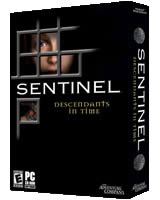
Introduction
If you have been reading Adventure Game reviews for any length of time, then you have come across a reviewer saying that such-and-such a game is a “Myst clone.” This is inevitable as Myst was a huge success and set a new standard in the industry.
The influence of Myst on Sentinel is obvious and the comparison unavoidable, but Sentinel is much more than a clone. The folks at Detalion have taken those things which made Myst a success, refined them and done the job even better. They have out Mysted Myst.
Sentinel is a Triple Threat – it has a great story, enjoyable puzzles and gorgeous graphics. And it balances all three so that you are left wanting more of everything. It is as if Maciek of Detalion ignored the fan sites, the forums and the marketing droids and just did what was right.
But enough gushing. Let us take a close look at why I loved this game and why I suspect the average adventure gamer will love it as well.
Story
From the web site:
“The Tastan civilization succumbed to extinction many years ago; their only legacy being the mysterious Tastan Caverns. Some believe the caverns hold an invaluable treasure, while others say great wealth is attained through the knowledge and technology left behind by this advanced race.
“Take on the role of Beni and search for the truth as you enter the Caverns on a dangerous quest for riches.
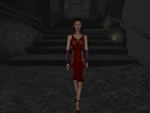
“As you begin your strange and perilous journey, a female sentinel, a holographic image with advanced A.I., positioned there by the ancient Tastans to guard their sacred caverns, awakens. She appears throughout your quest with a sometimes benign purpose, but other times with calculated intentions. You will soon realize that behind the mask of illusions, the sentinel is much more than she appears to be – her dark purpose will threaten your very existence.”
When I first read that Detalion was using Terry Dowling, the popular Australian Sci-Fi author, to write the story for Sentinel as they had for Schizm, I had my reservations. Schizm basically dropped you onto an alien world with no clue as to what happened, had you solve a bunch of puzzles and finally told you at the end what was going on. There was no story, no plot advancement – nothing – during the actual game. Looking back, I can see where Schizm‘s story had potential, but it felt like an afterthought just tacked on at the end – a total waste of Mr. Dowling’s talents. Would Sentinel be a repeat performance? (22-DEC-2004 Note: I have been told that one reason for my experiance with Schizm is that I played the CD version which had about 40% of the storyline removed. The DVD version included many FMV sequenses which provided background to what was hapening. So be sure to get the DVD version if you want to play Schizm.)
Thankfully, no. They did it right this time. The “A.I.” confronts you and converses with you on a very regular basis throughout the whole game. Like a good detective story, you are constantly fed new clues and presented with new trains of thought. I felt like I was continuously on the edge of a breakthrough. If only I could speak with the A.I. one more time… but it only got deeper and the stakes got higher.
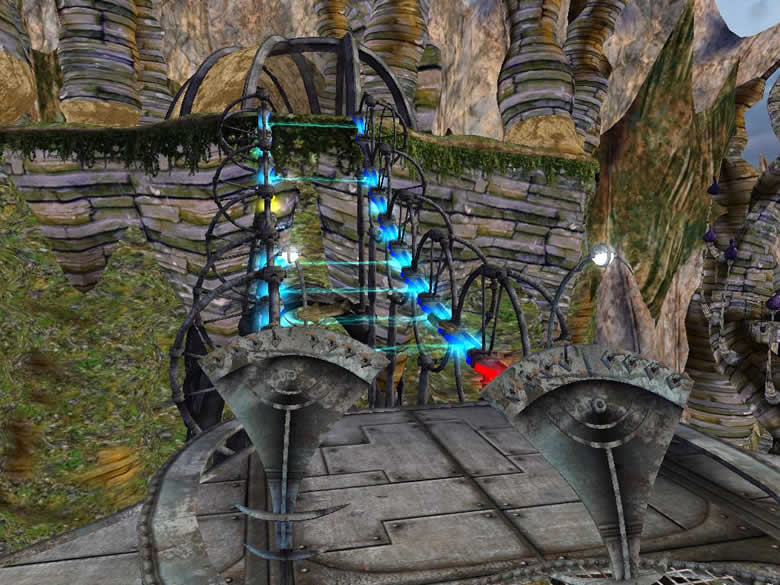
My only complaint was that you and I are not part of it. The story is between Beni and the A.I. You and I are little more than voyeurs whose only job is to walk Beni through each Realm and solve the puzzles. But then, the same could be said of any good novel.
The story was gripping and held me captive for the entire game. The concepts were intriguing and had me thinking for days later. And while the immediate conflicts are resolved, there is much more of the story to be told. I want the sequel, NOW!
This was truly a class “A” effort.
Navigation

Detalion used the same Jupiter engine which they used in Schizm II (aka Mysterious Journey II). It is a full 3D environment and you can travel to any pixel you wish. Navigation was effortless with just the mouse. The space-bar allowed you to jump a couple of game inches, but it was never needed in the game. No action sequences here.
The cursor is a tiny dot in the center of the screen. This is fine as the only time it is needed is when it is on a hotspot, and then it grows a ring around itself becoming large enough to be noticeable. And since the hotspots are only found with puzzles, I never had trouble finding them.

There is no danger of falling off cliffs. If you shouldn’t go somewhere, then you aren’t allowed to. This was sometimes frustrating as there were places I would liked to have explored (aren’t there always), but it was a fair trade for not having to worry about perfect steering.
I had only two minor criticisms with the navigation. First, the mouse was a bit too sensitive for me. I had it on the lowest setting, but I still felt like I was swinging wildly. I eventually got used to it, but it would have been nice if the game were kinder to the old folks out here.
Second, you needed the keyboard to move backwards. It would have been nice if the third mouse button or two button chord had been mapped to backup.
But overall, the engine did its job without getting in the way. A good solid “B”.
Puzzles
The puzzles in Sentinel are some of the most enjoyable I have encountered in a long time. They are well thought out and logical. The clues to their purpose and solution are near at hand. They were meant to solved by the average gamer.
They were all of the Logical variety and could be rated as Easy to Medium in difficulty. It usually took me about ten minutes to figure out how to solve each puzzle, although it sometimes took over an hour to implement my strategy. This was perfect for my temperament where I want to enjoy the puzzle, not make it a career. If you are the type who likes to spend hours deciphering obtuse clues, then this is probably not the game for you. Schizm or Myst IV would be more up your alley.
There are several audio puzzles in the game, but they were done right. Instead of having to tell the difference between a C-Sharp and an E-Flat, you must be able to hear the difference between a saxophone and a fog horn. No matter how tone deaf you are, you should have no problem with these puzzles. Kudos to Detalion for doing it right.
There is also a built-in hint system. If you turn it on then a single line of text appears at the top of the screen when you approach a puzzle. This text explains the purpose of the puzzle and might say, for example, “Make all the lights come on at once.”
Between the logical nature of the puzzles and the occasional nudge from the hint system, I found that I never had to resort to a walkthrough. This is rare for me and a testament to the thought put into the game.
Can I find anything to criticize? Well… there were a couple of puzzles which were based on color and would have been difficult for people with color blindness or cheap monitors. Also, I am still having trouble seeing how the puzzles connected to the story. Are they intended to be traps? Then why aren’t they deadly? Are they intended to test the character of the intruder? Then why do they only test the player’s ability to solve logic puzzles?
But they were wonderful puzzles that left me wanting more. So, for me, they deserve an “A-”.
Graphics
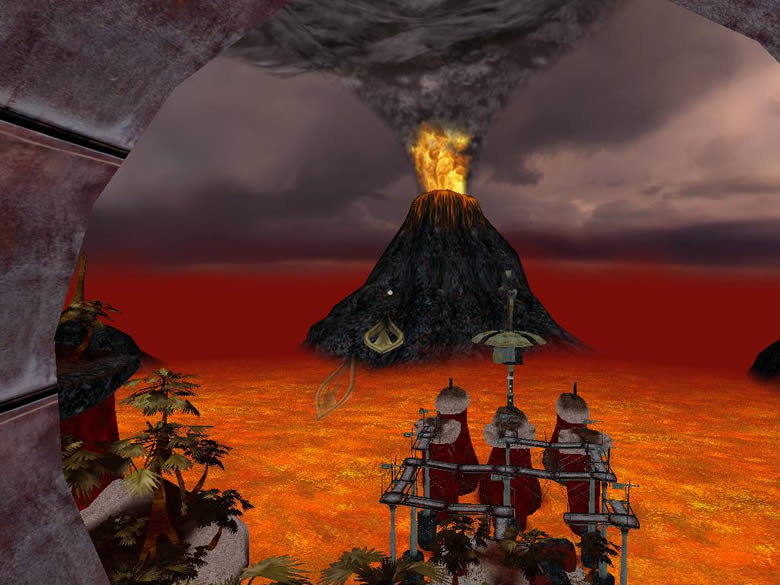
Graphics were right up there with the quality you have come to expect from Detalion and The Adventure Company.
I was concerned that using a 3D engine would compromise the graphics quality, but I needn’t have feared. The graphics were beautiful without any hint of blockiness anywhere.
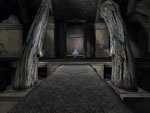
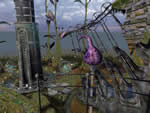
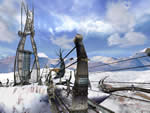
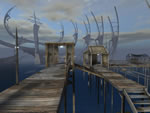
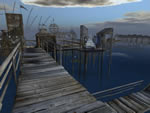
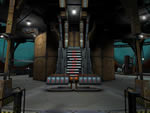
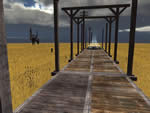
Take a look at the screen shots. The environments are wonderfully varied and captured. It is snowing in the winter world and it feels cold. Magma bubbles and spurts in the volcano world and it feels hot. Smoke and fire billow majestically. At times the worlds feel small, almost like a shadowbox of the real thing. But even that is intended – the A.I. tells us that all it could save were snapshots of the worlds it loved.
Sentinel may not have the artistry of Syberia nor the environmental complexity of Myst IV, but it nailed the technology it was using. I give graphics an “A-.”
Sound
The sound effect were all that would be expected. Nothing spectacular, but nothing disappointing.
The background “music” was very nice and set the mood. I say quote-music because there was no real melody to it. It was more of a series of chordal progressions. Very nice and pleasant, but nothing you will hum in the shower later.
The voice acting was very good. It is apparent the the actors knew what situations they were in (they aren’t always told) and the characterizations were always appropriate. My only frustration was Beni who was portrayed as a late teenager. His conversations were usually sophomoric. That was appropriate for him, but I would have said things much differently. But, as I mentioned above, this is Beni’s story. Not yours.
Sound gets a solid “B+.”
Playability
I cringe whenever I see a game advertised as “non-linear.” This is supposed to be a good thing, but usually ends up meaning “Good luck figuring out what to do next.” Fortunately, this is not a problem with Sentinel.
There are seven Realms to visit. Up to three are available at any time and it does not matter what order you do them in. You may also jump back and forth and do several at the same time. But there is no question of what needs to be done within any of the Realms. You explore, listen to the A.I., and solve the puzzles you run across. Solving the puzzles opens the way to new areas.
Completing a Realm opens another Realm up for exploration until all are finished.
Also, you may notice some mysterious arrows in the screen shots. These appear as you get close to a puzzle and point to it. So you always have a clue as to where the important stuff is.
I found that I always had something fun to do and was never frustrated.
Conclusion
I liked this game.
There was always something new to see, a fun puzzle to solve or another comment from the A.I. to mull over. I never felt frustration or the need to “get it over with.” I want more.
The overall balance of the game and its total playability puts it in “A” territory. Unfortunately, it falls just short of being a classic. What does it lack? Puzzles which fit the story. The puzzles are great and the story is great, but the two have nothing to do with each other. Is the A.I. trying to weed out greedy people? Then we should have a test which a greedy person would fail but a generous person would pass.
Come on, Maciek. You and the team at Detalion have proven that you can create a superior game. Now prove that it wasn’t an accident and that you can do it again. And then take that next step and give us a classic!


Final Grade: A-
(find out more about our grading system)
System Requirements:
- Windows® 98SE/ME/2000/XP
- 800 MHz Pentium® III (or Higher 1.6 GHz recommended)
- 128MB RAM (256 MB recommended for XP)
- 64 MB 3D Video Card 128 MB recommended)
- DirectX 8.1
- Mouse and Keyboard