Fable Review — Part 3
|
Review Fable
Review by Ray Ivey |
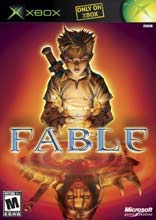 |
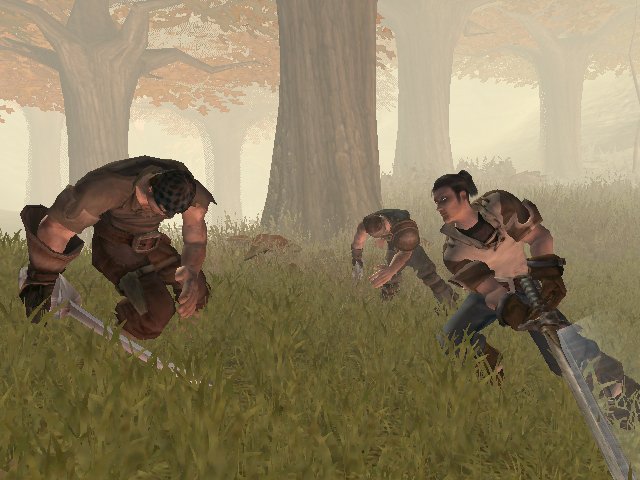
Here is a game that is tricky to review because it really suffers from the mountain of hype designer Peter Molyneaux has created over the last several years.
Formerly called Project Ego, this is a project that attendees to the last several E3 conventions have been following closely. Molyneaux, the legendary designer behind Populous and Black & White, is nothing if not a good salesman. He made more promises about this game than a politician on a stump speech. And we all know what happens to most campaign promises . . .
I think it’s a shame how much Molyneaux overdoes it. He’s already wildly respected in the industry, and any game he creates is going to get a lot of attention. His hyperbolic promises actually hurt his games by creating expectations he can’t fulfill. I hope that for his next projects, B.C., Black & White 2 and The Movies, he does the games a favor and eases up on the hype machine. [oops, looks like B.C. might be cancelled, yikes!]
So let’s get to the actual game, Fable. The bad news is that no, it doesn’t live up to its impossible hype. The good news is that it’s a pretty dandy game that will keep you very entertained . . . for about a weekend.
Fable is a role-playing game with strong action/adventure elements. The game begins with your character, a young boy, living a quiet, pastoral existence with his family in a very generic fantasy world called Albion. Quicker than you can say, “Evil forces that only you can stop burst in and rip your world apart,” uh, evil forces that only you can stop burst in and rip your world apart. Your village and your family are destroyed in front of your very eyes. And on your big sister’s birthday, bummer!
You’re rescued by a mysterious wizard (is there any other kind?) and whisked off to a place called The Heroes Guild, sort of an orphanage for would-be RPG stars-in-training.
The game then very entertainingly uses your years (yes, years) at this academy to teach you the game’s three major skill sets: melee combat, ranged combat and magic. Once your training is completed, you’re sent out into the world to become a hero.
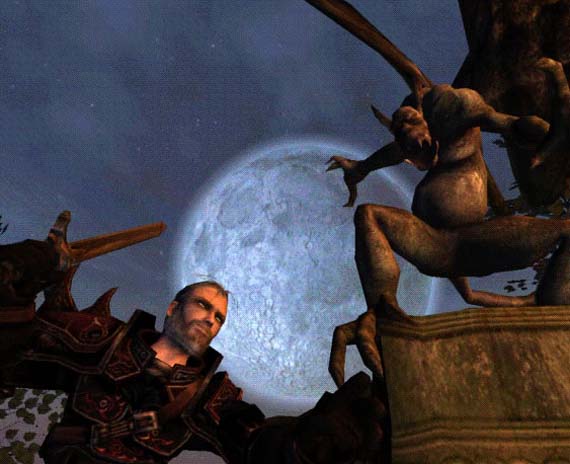
So far, so good. At this point, your character begins to have a lot of choices. There are required quests and optional quests. Plus there are many other entertaining activities you can spend your time doing, creating an evil or good character in the process.
The good/evil thing is at the center of the afore-mentioned hype. The television commercial for the game promises, “For every choice, a consequence.” That’s a pretty big promise! Alas, as Brick says at the end of Tennessee Williams Cat on a Hot Tin Roof, “Wouldn’t it be pretty if that were true?”
On the positive side, the good/evil and other character development opportunities are fun. As you make good or evil choices, your physical appearance actually changes! This is very cool. Also, your physique changes, depending on whether you are a lithe archer, bruising brawler or effete magic user. This is also cool.
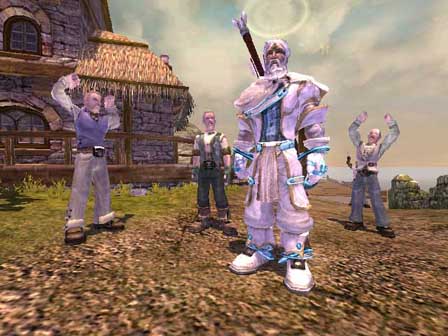
You can also have an actual personal life in and around the various villages you visit. You can have a romance, even get married and buy a house. You can furnish the house and sell it, or rent it out to gain extra income. You can go fishing and digging for treasure. You can enter local fight clubs (no talking about fight club!). You can negotiate with various demon doors to try to get the treasures hidden behind them.
At first, these sandbox activities are fun. It’s entertaining to try different haircuts and tattoos to adjust your levels of “attractiveness” and “scariness” (both of which are measured by the game). It’s fun to see your fame increase and have strangers applaud you wherever you go.
Unfortunately, the problem with all of these entertaining diversions is that, despite the promises by Molyneaux, they ultimately have no impact on the game whatsoever. The quests do not change, and neither does the story. This turns all of the personality engineering in the game into just window dressing tacked on from a game like The Sims.
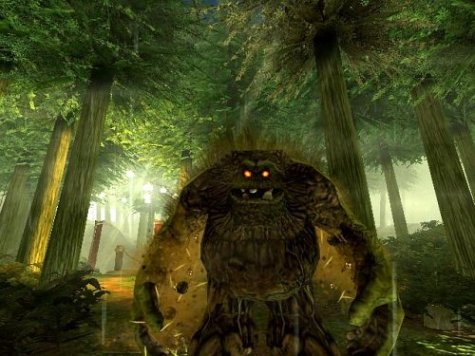
Another much-hyped feature of the game is that your character actually ages. By the end of the game my boy was in his mid-50s. While that’s pretty cool, it’s awkwardly illogical in the context of the gameworld. Not only do the game’s events feel like they just take a few days, but no one else except your family members seem to age. Not spouses, not other player characters, not villains. It’s like you alone are infected with that weird TV-movie disease that speeds up the aging process.
Worse, the much-ballyhooed morality system turns out to be meaningless. The “good” and “evil” points you get for various deeds are hopelessly out of balance. Murder your spouse out behind the house? Slap on the moral wrist. Steal from the wrong barrel? Big fat fine and lost of reputation!
Now, I understand it’s easy for me, not a game developer, to demand that the designers create a branching storyline that responds to the morality and other personal choices of the player character. But hey, I didn’t make all the promises about the game, Molyneaux, you did! Plus, if any RPG was ever short enough to be able to fit in a couple of plot branches, it’s Fable (more on that below).
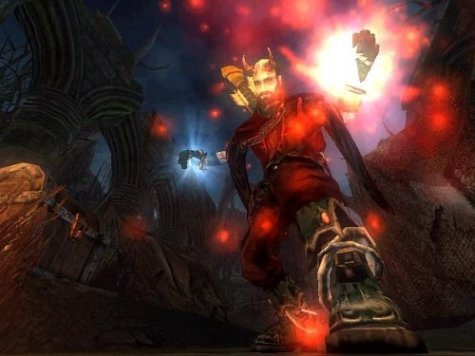
However, there is one element to the personal life of the character that I must comment further on. It’s regarding the romantic possibilities facing the player’s character. Only certain non-player characters are susceptible to the hero’s charms (indicated by a floating heart over their heads). What astounded me in Fable is that the designers were modern enough to include several male characters as possible mates. So, if the player desires, he can actually get married to a man. And yes, you can enjoy connubial bliss with your mate, regardless of the gender. You can also walk around town in drag if that’s your thing. The game even keeps track of your sexuality in your personality profile!
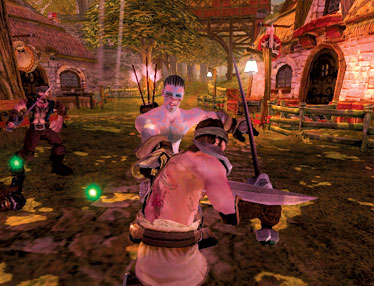
But let’s get to the meat of the game: questing and combat. The quests are quite fun and the combat system works pretty well. There are three classes of skills you can choose from, Strength (melee abilities, physical strength, endurance and health), Skill (ranged combat, agility, and stealth) and Will (magic abilities). As you defeat enemies and fulfill quests, you can use your experience points to develop your character along any combination of these three general areas. My general taste in an RPG is to create high-level “pure” characters, but Fable rewards being a generalist. This is because the higher skill levels come at an increasingly staggering experience cost. Still, if you master the basics of combat, especially the mechanic by which you can use “flourish” moves to greatly multiply your experience rewards, you can accumulate all of the experience you’ll need to create whatever type of character you are interested in.
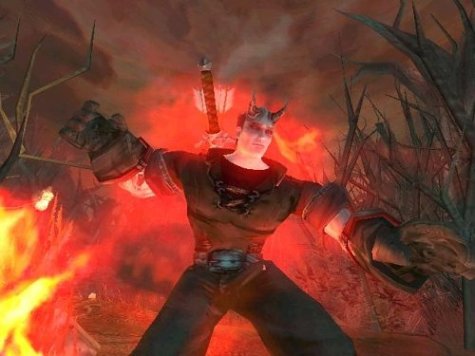
Melee combat is simple to master but complicated enough to chew on and provide a fun challenge. Ranged combat is of limited use (since enemies approach you so quickly) but it’s well-done as well, complete with zooming and gruesome decapitation moves. Magic is fun to use, and the interface lets you assign three spells to quick keys. Three may not sound like many, but it’s pretty generous in the world of RPGs.
The quests are well-documented and the mini-map does a very good job of keeping you on track, geographically. A series of magic portals also eliminates the need for involuntary cross-country backtracking – though sometimes you’ll, of course, choose to simply go wandering around, looking for trouble, hidden items and more experience.
In general the presentation is quite good. The graphics are beautiful, with a rich, cartoony-fantasy look and great spell effects.
The music, especially the opening theme by Danny Elfman, is spectacular.
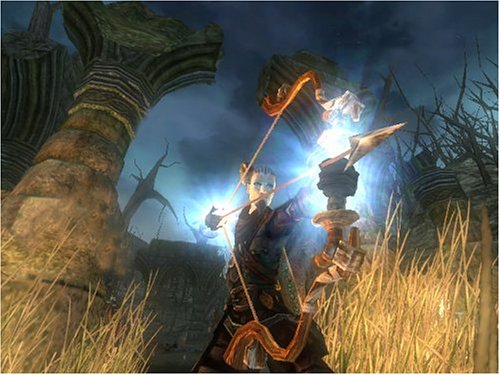
The look, the presentation and the score all contribute to giving the game an epic atmosphere that it, unfortunately, doesn’t really earn. The game is extremely easy (something I RARELY complain about), and the game is just too damn short.
Now, I don’t generally complain about short games. As a reviewer, I’m always needing to get to the next game, so for me short can be good. And I’m not a fan of the mind-numbing length of, say, Japanese RPGs, especially since their length is generally artificially extended by the use of endless tedious random encounter battles. Plus, I would be more sympathetic to Fable’s anemic length if there really was incentive, through the good and evil mechanic, to replay the game. Unfortunately, there isn’t. Since, as mentioned before, your personal and moral choices have absolutely no impact on the game in any real way, there’s no impulse to replay the game and “see what happens” if you create a different kind of character.
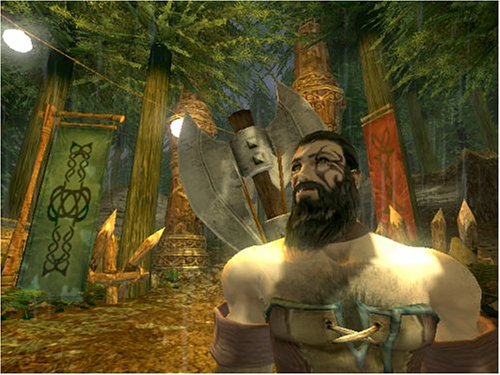
To say this game is short is too kind. I think the credits are longer than the game. I think the endless loading screens at Lionhead Studios are longer than this game. Now, every RPG doesn’t have to be as long as, say, Might and Magic VI, Lands of Lore, Anvil of Dawn, Wizardry 8 or Morrowind, but even moderate-length RPGs like Arx Fatalis, Diablo II, Divine Divinity or the Gothic series are lengthy and meaty enough that you leave the game feeling as if you have just been through an epic experience. Compared to those games, finishing Fable makes you feel like you’ve just spent a three-day weekend at a hero dude ranch.
This is a shame, because there’s a lot that’s good going on in Fable. And I do recommend it to all XBox owners. It’s a stylish, great-looking, entertaining adventure. But it’s not a seven-course meal; it’s a miniature chocolate éclair.
Final Grade: B
(find out more about our grading system)
System Requirements: An Xbox, Controller, and Television
This review is copyright Ray Ivey and Just Adventure and may not be republished elsewhere without the express written consent of the author. Republication of said review must also contain a link back to Just Adventure.