KGB Review
|
Review KGB
Review by Michal Necasek |
 |
KGB was the acronym of famous (or rather infamous) Komitet Gosudarstvyennoy Bezopasnosti, or Committee of State Security. In other words, Russian intelligence agency. In most games you’d play the dashing CIA agent, intent on fighting godless commies and your adversaries would be KGB agents.
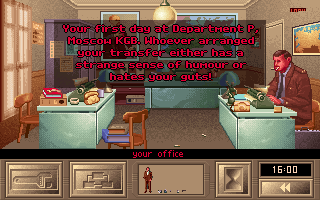
Not so in KGB. You play a dashing KGB operative, Maksim Rukov. But it is 1991 and the times have changed. the Eastern Bloc is largely gone, the Soviet Union is crumbling and the power of the Party is no longer absolute. Perestroika and Glasnost are in full swing… and instead of fighting imperialist and/or zionist swine, you are assigned to Department P of Moscow KGB and investigate internal corruption within KGB itself. And who knows, CIA agents might actually be your friends, not enemies.
First I must mention one feature of the game that truly impressed me – the writing style. The authors must have had a consultant with very good knowledge of Soviet life. I had the misfortune to be born in a communist country and I must say that the phraseology was spot on in all its awfulness. The talk about the Party, soviet achievements, the “sword and shield” of the state (yes, that was KGB) – it was so absurd as to be funny. As long as you did not have to live in it.
But let’s start at the beginning. Your first task in KGB is to investigate the murder of a certain Mr. (or is that ‘comrade’?) Golitsin, ex-KGB operative who decided to leave the warm bosom of the agency and set up his own business as a private detective, and action that smacks of individualism, free-marketeerism and several other -isms.
But now comrade Golitsin is dead, shot by an unknown assailant. So much for free enterprise. Your investigation of his office will reveal that he was on the track of a Moscow mafia gang which may have been run by and employed other ex-KGB agents (who apparently decided to venture into the stormy waters of the even more free enterprise).
The gang is apparently producing snuff videos – recordings of torture, mutilation and killings. Live recordings. I should say that KGB is definitely not for the squeamish players. There are no graphic depictions of violence, but even some of the textual descriptions are enough to turn one’s stomach. The snuff videos are apparently somehow being smuggled out of the country and most likely exchanged for some other contraband.
The plot soon thickens – a number of gangs, KGB factions, CIA agents are involved and there seem to be some major conspiracies going on. In fact towards the end I was almost unable to follow the action, simply because of the sheer number of characters, factions, motives and objectives. You will unravel the mystery if you are lucky – and if you play your cards right.
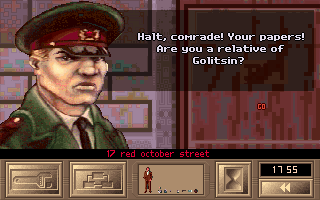
It should be obvious that all this is a very dangerous business. And indeed, failure or death lurk at every corner. Besides the danger of being killed, if you fail in your investigation (and that is very easy), you will be sent to some remote part of the Soviet Union and given plenty of time to contemplate your failure.
The puzzles per se are not that difficult in KGB. One or two ciphers, interrogations and classic inventory puzzles. Where the difficulty comes is the timing. While KGB is not a real time game, time does flow within the game and it is very important. You have to be in the right place at the right time. What’s worse, the order of your actions is of extreme import. If you for instance interrogate someone too early, you may miss vital clues. But if you come back later, the people won’t talk to you. Dead ends galore.
This leads to some serious amount of backtracking – which I did not consider very fun at all. You will often discover that you failed to do something earlier and will have to replay a part of the game. Sometimes it’s easy – if you die or otherwise fatally fail, you will be allowed to take a step back which usually (but not always) lets you try some more fruitful approach. But you will still often be forced to reload an earlier game and possibly replay long segments.
This is made more difficult by the fact that there are only four save game slots. This is not as bad as it sounds, but it does mean that you have to be careful with “save early, save often” because you might not be able to return to a “good” save after you’ve run into a dead end. The game is split into four independent chapters, but two of them are quite long and if you are unlucky, you might have to restart the entire chapter (there’s an option to do that).
Let’s examine the technicalities now. The game was released in 1992 and that obviously shows. Graphics are VGA 320×200, 256 colors. Not exactly impressive but not really that awful to look at. There is very little animation, most screens are completely static. Of course the game fit on a few floppies, it’s from the pre-CD-ROM era.
Music is Ad Lib style, again not exactly bad but certainly not up to today’s standards. Pleasant enough to listen to though. There is no digitized sound so I can’t say how awful the voice acting was.
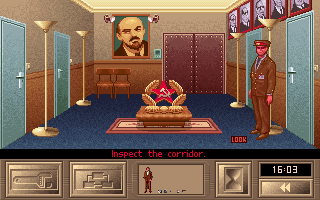
The interface is slightly unusual. It is fully mouse controlled and right click pops up an action menu. The default is “smart pointer” which will select the most appropriate action when you hover over an object. At several points in the game you will have to manually select other actions though, for instance when you need to hide or move dead bodies out of sight. The inventory screen is separate and you can investigate and manipulate inventory objects to your heart’s content there. Most of them are not really useful anyway. There’s also a map but I did not find it all that useful.
An important element of the gameplay are the dialogues, and unlike many (or most) other games they are parts of the puzzle in KGB. What and how you ask people matters. You may not always have enough time to exhaust all dialogue options so you must choose the questions carefully. And if you say the wrong thing, you may miss vital clues or worse. Much worse. It is amazing what KGB agents or mobsters will do when they’re upset.
KGB in my opinion manages to recreate the atmosphere of the crumbling Soviet empire quite well. Not that that’s a very pretty picture, but it is certainly interesting. The conspiracy plot is rather complex, perhaps even a little too complex. The almost constant need for backtracking is a definite negative in my mind. It makes the game much more difficult, which is okay, but also less fun by forcing you to repeatedly play parts of the game, which is not. My final grade is a C+.
Final Grade: C+
System Requirements:
- 386/20
- DOS
- 500 K Memory
- CDROM
- Adlib
- Soundblaster compatible