The Haunted Mansion Review
|
Review
Review by Randy Sluganski |
|
It is inevitable that some gems get buried during the holiday glut of games and The Haunted Mansion is the perfect example. A thoughtful, well-balanced and simply fun game that would be an instant favorite of any adventure gamer was doomed by two misperceptions: first that it is a children’s game and second that it based on the Eddie Murphy movie of the same name that received scathing reviews. It is neither and is instead actually centered around the ghostly scenarios featured in the Disneyland/World attraction. But that is the chance you take when you tie your product to a movie license; no matter how good (or bad) the game, its success is too often linked to the fortunes of its movie counterpart.
Probably the best examples to illustrate this point would be Enter the Matrix and Finding Nemo, both of which enjoyed phenomenal sales. Enter the Matrix, a game almost universally panned, sold incredibly well early, but once the movie died in the theatres, so too did game sales. Finding Nemo, an above average game based on a great movie, continues to sell well. The Haunted Mansion, despite being the better of the three games, was never able to scare-up the sales figures of the other two thanks in a large part to lukewarm movie reviews and a substantial drop-off in ticket sales in the face of competition from other holiday releases.
If Hubert Chadot’s classic Alone in the Dark were to be remade, it would look a lot like The Haunted Mansion. While The Haunted Mansion can not be classified as a children’s game, it does have a genial, yet spooky feel about it and is easily accessible by both novice and veteran gamers.
The basic premise is simple – enter a room and turn on the light. Once the lights are on, you then search objects in the room to release trapped souls. The twist here is that the goal – releasing the trapped souls – is a breeze, but actually locating and flipping the light switch, well, this is where the game becomes complicated – and fun.
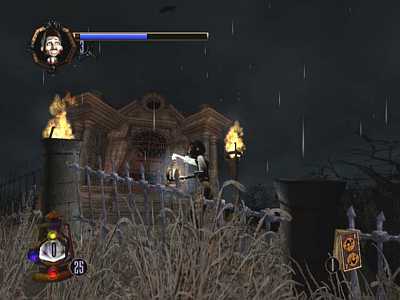
The setting is post Civil War Louisiana as one Zeke Holloway appears at the mansion in response to an advertisement for an assistant caretaker. He soon finds himself embroiled in a mission to free the mansion from the grasp of Atticus Thorn, an evil spirit who has imprisoned tortured souls throughout the mansion. Armed with only a Sacred Lantern known as the Beacon of Souls – which will seem very familiar to Zork aficionados – you must then use the lantern to both capture trapped souls and to shoot beams that can destroy enemies.
Each room is actually a themed puzzle. For example, the Game Room puts a shrunken Zeke on a billiard table where he must avoid the cue ball while at the same time placing himself at danger in front of the pool table holes so that the numbered balls can eliminate ghosts guarding the holes. In the Conservatory you must figure out how to play musical instruments so that they will build a path to the light switch and in the Trophy Room you have to light candles by avoiding fireballs. The topper is that many of the rooms, once successfully completed, then feature a delightful ghostly scenario direct from the amusement park attraction.
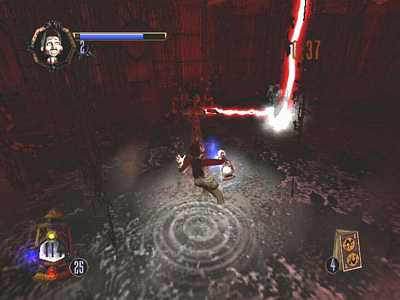
I’m not sure if console games are considered to have special effects, but if they are then the Maid’s Room would win an award as you are surrounded by walls that move according to your movement. I actually replayed this room a few times just to see if I could figure out how my moves were affecting the constantly shifting walls.
There may be portions of the game that the younger gamer may find disturbing and there is even one incident that made me jump the first time it occurred, and then laugh afterwards, much like the dogs crashing through the window in the original Resident Evil, but this game is spooky in a fun way. The trapped spirits can be located anywhere – in bookcases, tombstones, cupboards, etc. – and their location is easily identified as the object they are hidden in will shake crazily when you are near. The wonderfully creepy sound effects could have been pulled from one of those cds heard during Halloween.
The ‘action’ sequences mostly consist of firing beams from the Sacred Lantern to destroy spiders and some modest apparitions. As your search progress, Zeke can find death certificates that, once they are presented to the proper ghost, will increase the potency of your lantern. An automatic lock-on targeting system makes ‘combat’ a breeze. Though you can ‘die’ during gameplay, it is easy enough to collect fortune cards that provide extra lives and I was actually able to finish the entire game without ever using one of my continues.
If there is a downside to The Haunted Mansion it is, once again, that idiotic console mentality that insists on end bosses. Yet, as we have been discovering, it is not always the developers who insert these ‘action sequences’ but rather Sony who insists that all games must have some sort of action or arcade sequence in them lest they be thought of as *gasp* pure adventure. In fact, the endgame battle with Atticus is a prime example of what is usually wrong with ‘adventure/puzzle’ games on consoles: after using your wits to progress through most of the rooms, you must then rely on a quick trigger finger and impeccable aim to finish off the end boss. Blah.
It is difficult to believe that High Voltage, the talented Haunted Mansion development team, are now working on Leisure Suit Larry: Magna Cum Laude – which press releases have stated will mirror the vulgar humor of teen movies American Pie and Something About Mary and which promises to be the complete opposite of this game based on a famous Disney ride. But I have much higher hopes for Leisure Suit Larry now that I’ve played The Haunted Mansion.
Final Grade: B+