Jack the Ripper New York 1901 Review
|
Review Jack The Ripper: New York 1901
Review by Ray Ivey |
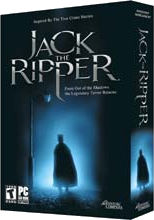 |
First of all, I can’t tell you whether this game is called New York 1901: Jack the Ripper or Jack the Ripper: New York 1901, because the two title screens for the game are inconsistent. Let’s just stick with Jack for the purposes of this review.
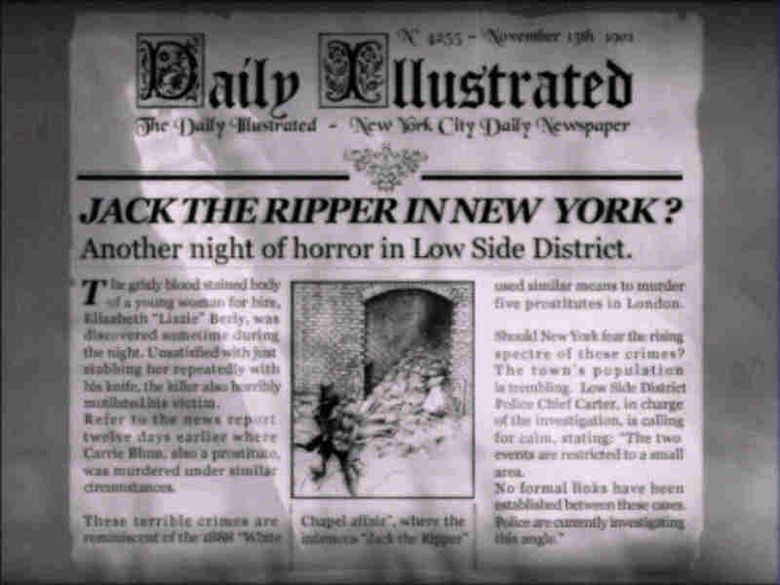
Anyway, Jack feels very much like a follow-up to Microïds’ 2003 adventure, Post Mortem, though it was developed by the studio that brought us the two Cameron Files games. And like all of the above-mentioned games, Jack is a mixed blessing.
A murder mystery is one of the best types of stories for a graphic adventure to tell. The premise of Jack is rock-solid. A young reporter on a New York newspaper in 1901 thinks he may be on the trail of a returned Jack the Ripper, who’s now stalking the streets of New York thirteen years after the unsolved Whitechapel murders in London.
This premise leads to by far the game’s best feature: its story. The reporter has very little to go on at first, aside from a crime report from the Police Chief and a couple of people to interview.
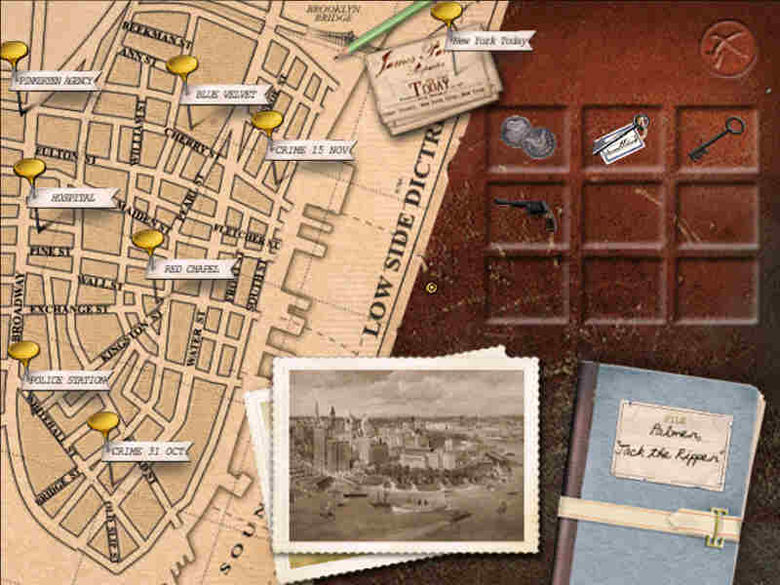
As in other mystery adventures, navigation is accomplished through a map of Lower Manhattan (inexplicably called “The Lowside District” in the game). As new witnesses give you additional inventory items that point to new locations, you can use these items to activate new places on the map to visit.
Once your reporter has the great idea to use the services of Pinkerton Detective Agency (inexplicably misspelled in the game as “Pinkerten”), the story kicks up, if not into high gear, at least out of neutral. A light board at Pinkerton’s allows you to compare two important pieces of information that reveal a chilling truth (which I won’t reveal here).
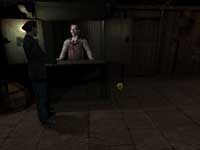
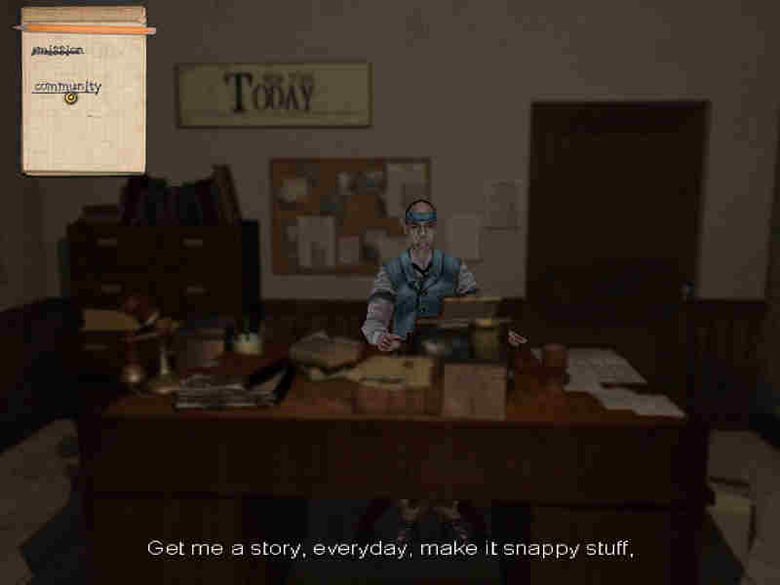
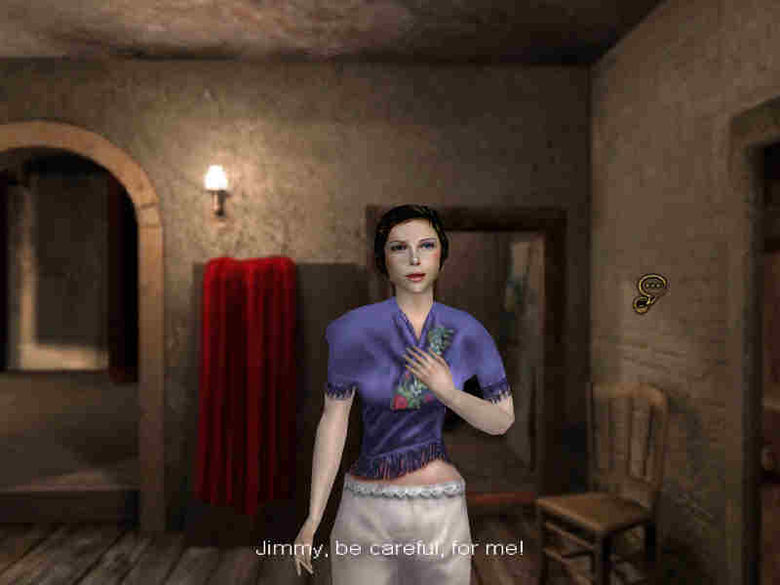
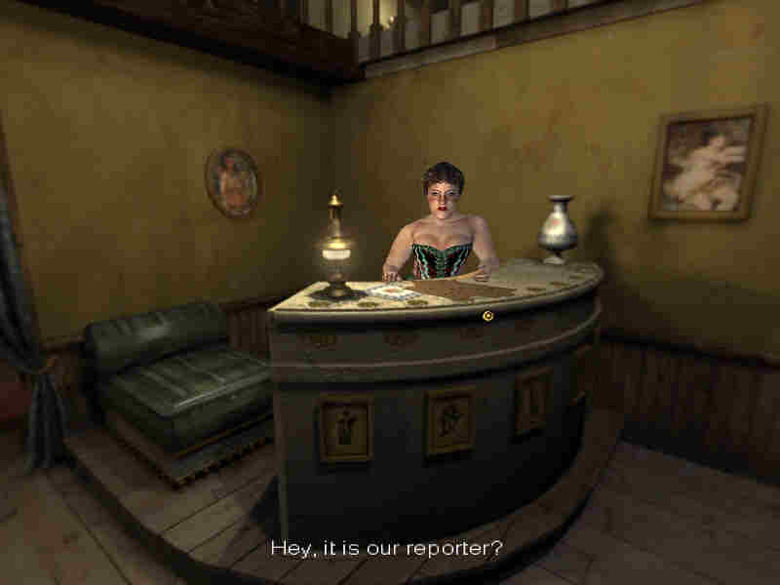
The game is extremely thin in the puzzle department. Most of the gameplay consists of repeatedly visiting locations, speaking to characters, and gradually opening up the story. You spend a lot of time talking to the same small group of characters, so it’s a good thing that character models aren’t bad, and some (though not all) of the voice acting is reasonably good.
The game takes place over a series of days, each of which have two parts: After gathering new information for the next day’s story, the player can click on a typewriter to trigger the end of the working day and the typing of the story. Then there’s a nocturnal episode, which eventually ends with some variation of a moon graphic.
Two of these nighttime episodes, which take place in different parts of the bowels of a creepy hospital, are very scary and atmospheric. The second one, particularly, reminded me of the only good sequence in 2001’s Necronomicon (remember the underground lab?). Creepy. There are also a couple of stealthy objectives (spying on a suspect artist and attempting to get a photo of Jack himself) which are also entertaining.
What puzzles there are in the game are very organic to the story and surroundings, and I give the developers credit for that. Organic puzzles are not easy!
The story also develops a couple of very good red herring suspects.
The graphics, while fairly low-resolution and unimpressive technically, nevertheless do a good job of suggesting the back alleys of Lower Manhattan at the turn of the century. The character models seem to have an extra gloss on them, which makes them stand out from the scenery in a pretty unnatural way. This could be seen as a good thing or a bad thing, I guess, depending on your taste. The artists also have a good time with the various moon graphics that end the nocturnal episodes. One particularly good one morphs the moon into a sort of astral beating heart.
The game is in first person point-and-click format with 360 degree scrolling. Overall the presentation of the game will be quite familiar to anyone who has been playing French adventure games for the last few years.
I want to make a special mention of the music in this game. The fact that one of the main characters is a music hall singer provides one of the best pleasures in Jack. Several times you can take a break from your sleuthing and listen to some very well-performed songs (even better, the songs are performed by a major character!). Yan Volsy wrote the game’s effective score, and provided the music for the songs that don’t use traditional melodies. Djazia Satour does a beautiful job with the singing.
Okay, so we have a killer who may be Jack the Ripper stalking the streets of New York in 1901. So what’s not to like?
There’s a Buddhist saying, “Before enlightment, you chop wood and carry water. After enlightenment, you chop wood and carry water.” One of the points of this saying is that small things matter The problem with Jack is that when you play it, it feels like not enough small things mattered to the developers. There’s the inconsistency in the game’s very title. There’s the odd misspellings like “Pinkerten” and awkward translations like using the word “chronicle” when the far more appropriate choice would have been simply “story.” (I have trouble picturing even turn-of-the-last-century hard-boiled New York newspaper editors yelling at their reporters to hurry up and finish their “chronicles.”) There’s that neighborhood name, “The Lowside District.” There’s no such district in New York, and there wasn’t one in 1901 – and since the game was using real locations and street names, why not use real neighborhood names? And there’s the problem with The World Series, which figures prominently in the plot. Trouble is, the World Series didn’t exist in 1901.
More irritating is the fact that it can be very difficult sometimes to get the chapters to “close.” You find yourself trudging over and over through locations you’ve seen a dozen times, trying with increasing frustration to get that damn moon graphic to appear, signaling the fact that you’ve closed the chapter. This strikes me as just sloppy programming.
Even weirder, there’s this inexplicable attempt by the developers to link the Jack the Ripper character with Edgar Allen Poe’s “Raven.” At various crime scenes, your character sees an ominous raven and has a series of inscrutable hallucinations (which never add up to anyting). At the end of the game the villain even quotes Poe’s famous poem. Uh,why? Poe never wrote about Jack the Ripper. He’s not associated with him in any way I have ever heard of. It would be one thing if the game had created an interesting fictional link between the two. Remember in Gabriel Knight 2, in which Jane Jensen brazenly dreamed up a relationship between Mad King Ludwig and Richard Wagner, resulting in an insane lost werewolf opera? This game doesn’t bother to do any of that dramaturgical heavy lifting. It just throws this silly raven at you, and the results are, well, puzzling.
Finally, the worst news is that, by the end of the game, the creators of Jack the Ripper betray their game’s best feature: its story. The game’s conclusion is a utter boondoggle, meaning all of the information you’ve so painstakingly gathered means absolutely nothing. It’s a serious disappointment after following an otherwise compelling, if somewhat shakily told, story.
Final Grade: C+
System Requirements:
- System Requirements: Windows® 95/98/2000/ME/XP
- Pentium® III 500MHz (Pentium® IV 800MHz Recommended)
- 64MB Ram (128 MB Recommended)
- 16 MB Direct3D® Compatible Video Card (32 MB Recommended)
- DirectX®7 Compatible Sound Card
This review is copyright Ray Ivey and Just Adventure and may not be republished elsewhere without the express written consent of the author. Republication of said review must also contain a link back to Just Adventure.