Beyond Good and Evil Review
|
Review Beyond Good & Evil
Review by Ray Ivey |
 |
There are so many terrific things in Beyond Good and Evil that its difficult to know where to begin.
The Beauty Part

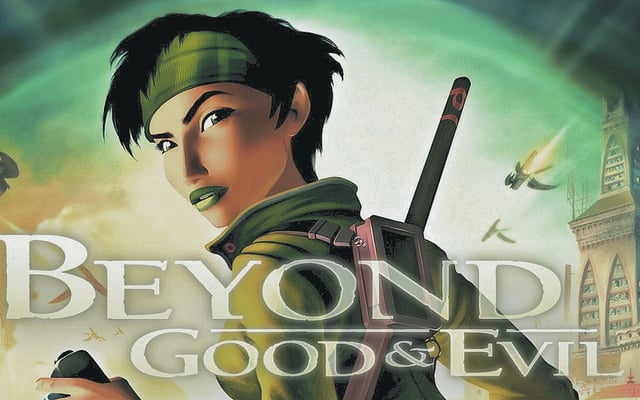
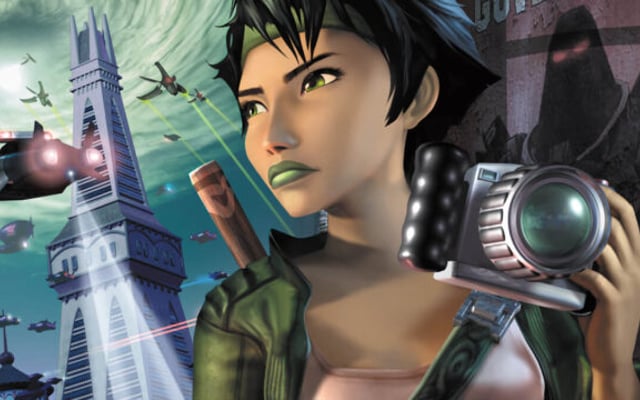
Firstly, this is a seriously good-looking game. From the opening cut scenes to the multiple environments, the gorgeous palette of this game pours over you. Full of luxuriant greens and blues, it creates a world you want to spend time in and just look around. You spend a lot of time on the water, and the water is technically stunning as well as beautiful. The lead character, Jade, is gorgeous, and not in an obvious, Lara Croft way.
Mongrelization of the Game Species!
I have long been a fan of hybrid games. I think its risky and creative to throw elements from different genres into the same game, and when brave designers do it, the results can sometimes be wonderful. The original System Shock, Outcast, Thief, Anachronox and Deus Ex are all hybrids that are among my favorite games.
One of the dangerous things about a hybrid is that its a bit hard to describe in a simple sentence, something which is rarely true with pure genre games. Heres a couple of examples of pure-genre games.
Half-Life: First person shooter involving hostile aliens invading from another dimension.
Baldurs Gate: Isometric, third-person role-playing game based on the Dungeons and Dragons Forgotten Realms campaign.
Okay, lets try to describe a hybrid as easily:
System Shock: Well, its sort of a first-person action game except that theres a whole lot of story like an adventure game and also fairly strong role-playing elements because you get such freedom in how to equip your character, and theres even some jumping puzzles like a platform game, and dont forget the arcade-like cyberspace sequences.
Thats whats cool about a good hybrid. If the combination is successful, you find your self telling your gaming friends, Uh, you just have to play it to get it.
Beyond Good and Evil joins that august list of hybrids in which the designers went out on a limb and the limb didnt break.
The simplest way to describe this game is that its a sort of Zelda-like action/adventure. But that wouldnt tell the whole story. The game also has a Pokemon-like creature collection element (more on this later), object collection reminiscent of classic platform games, very fun racing elements (ditto), strong stealth elements, plus an overall feel thats very reminiscent of a pure adventure game. Ill talk about each of these elements.
Adventure. This game has a very strong story, one that would be at home in an exciting film or science fiction novel. It takes place on a watery, cosmopolitan planet thats under siege from hostile aliens. The rather repressive world government claims its fighting these enemies. Jade, the main character, is a photojournalist and foster mother to several orphans of these attacks. She gets drawn into a group of undercover revolutionaries who are exposing a horrifying web of lies and conspiracies that lie behind the governments party line. What struck me about the story, especially as I moved toward the end of the game, was its urgency and immediacy. The plot of many games simply serves as a backdrop for the gameplay. The story in Beyond Good and Evil is so good that it feels like the game was created in order to tell it.
Creature Collection. Jade is a photographer, and earns her money by taking photos of the wildlife she spies around her home planet. This is an ingenious game device that works beautifully. It also adds a strong degree of exploration to the game.
Object Collection. Just like in a million platform games, Jade needs to collect a certain kind of mystic, beautiful pearl. She is able to get pearls in several ways: by taking enough wildlife photos, by winning races, by defeating bosses, and by very thorough exploration of her environment. These pearls allow her to buy important upgrades to her equipment.
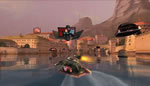
Racing. Usually my blood runs cold at the prospect of a racing component in a game. I dont play racing games and Im not good at it. But, the many racing levels in Beyond Good and Evil are entertaining, exciting, and most importantly, not vexingly difficult. Jades hovercraft is a very cool vehicle and its fun using it to solve the adventure.
Stealth. In much of the game Jade is sneaking into hostile and dangerous environments, and staying undetected is key. Jade can crouch to creep past enemies, and learn various tricks to foil the various guards and robots who block her path. Stealth is an element that can be very risky to add to a game, because a bad implementation of it makes for a very lame game. The designers have pulled it off beautifully here.
Zelda/Not Zelda. The best Zelda element used in Beyond Good and Evil is the idea of the Tricky Dungeon. Jade has to approach all of her physical environments as puzzles that must be solved. Sometimes she has a companion to help her, and sometimes shes alone. Theres even an Ico-like dynamic of having to slip through an area Jades companion cant follow, then clear out another path that he CAN follow. These puzzle elements are quite entertaining, and add to the games adventure feel.
Also adding to the adventure feel is that fact that, even though Jade is forever jumping over things, the game absolutely does not contain jumping puzzles. It uses a system more reminiscent of Broken Sword: The Sleeping Dragon than the typical action/adventure. If Jade can make a jump, you just move her to the edge, and she jumps. If she cant make it, she doesnt move. No frustrating, jump-to-your-death situations here.
And I havent even MENTIONED the air hockey, or the fact that you can subscribe to not one but two different electronic newspapers with opposing political points of view.
You might think that the net result of all of these gaming elements would be chaos. But the designers manage to pull it all together. What happens is that you truly begin to feel like Jade. You buy into her world and her situation, and it just all begins to feel very very real. Which is one of the nicest things that can happen in gaming.
Turtle Wax
So far Ive talked about the aesthetics and the game mechanics. Now Im going to talk about the third aspect of the game that pulls it all together and makes it a must-have, must-play game.
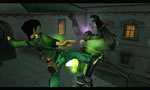
Im talking about polish. This is one of the most polished games Ive played since the two Ratchet & Clank games, and thats high praise indeed. Everything in the game feels well thought-out. The interface works like a charm, and the controls are easy to master. I played the XBox version, and even though the game has many different types of activities: exploring, fighting, flying, speed boating, minigames I always felt in control of what was happening.
The voiceover work and dialog writing are also superb. Jades two main companions through the game are a human-like pig and a breathtakingly gung-ho soldier. The soldiers resolute and square approach to his job is so strong that he unabashedly responds with a crisp Yes, sir!! to his female companion, Jade. The music is also extremely well done.
None of the disparate elements in this hybrid game feel out of place. Everything works to create a beautifully cohesive whole. Even though the story is fairly dark, the sense of fun that pervades the game reminded me a bit of that unsung masterpiece (and fellow hybrid) Anachronox.
The game has a slightly curious structure, in that its pretty short (I finished it in less than 20 hours), but the three major missions in it feel absolutely huge. The result is an epic feel without epic length.
Reviews should be balanced, so let me think of something bad to say about the game. Okay, I dont like the title very much. Its boring, generic, and tells you absolutely nothing about the game. So there.
The creative talent behind this game is Marcel Ancel, the guy behind the Rayman games. I cant wait to see what he and his team come up with next. This is one of those games that should be played by everyone. And its on every single platform out there, so theres no excuse to miss it. PLUS, its dropped dramatically in price recently. So what are you waiting for?
Final Grade: A+
System Requirements:
PC
- Operating System: Windows® 98SE/ME/2000/XP (only)
- Processor: 700 MHz Pentium® III, Celeron®, or AMD Athlon™ (1 GHz recommended)
- RAM: 64 MB minimum, 128 MB recommended (256 MB recommended for XP)
- Video Card: DirectX® 9-compatible 32 MB video card; specific cards supported:
- ATI® Radeon™ 9700 and Pro
- ATI Radeon 9000 and Pro
- GeForce™ 4 Ti 4600/Ti 4400/MX 460/MX 440
- GeForce3 and Ti500
- GeForce2 GTS/MX400/MX
- Sound Card: DirectX 9-compatible sound card
- DirectX Version: DirectX 9 (included on disc)
- CD-ROM: 4x CD-ROM or faster (not recommended for use with CD-RWs)
This review is copyright Ray Ivey and Just Adventure and may not be republished elsewhere without the express written consent of the author. Republication of said review must also contain a link back to Just Adventure.