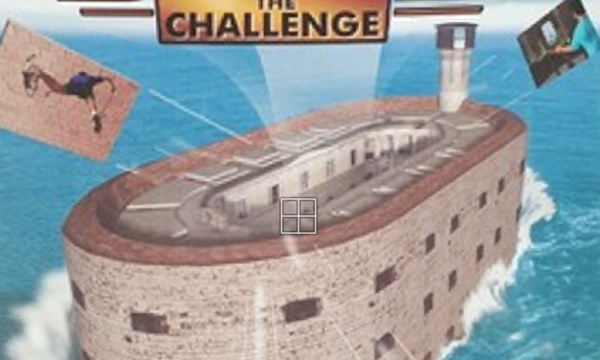
Fort Boyard: The Challenge Review
|
Review Fort Boyard: The Challenge
Review by Alexander Tait |
 |
Long before Post Mortem and Syberia, even before Amerzone and Road to India, Microids were making games. This flashback takes us back to AD 1995 for an interesting adventure-plus title. Combining adventure gaming with the French reality TV program Fort Boyard produced this time-based competition with word and eye-hand dexterity puzzles.
The game begins with what looks to be an old Chinese sage/wizard, with some of the worst voice acting and makeup ever seen, who wonders aloud about the quality of the next group of entrants to the challenge. The old man’s name is Father Fouras, so perhaps he isn’t Chinese after all! The old man harbors the Napoleonic treasure in the abandoned French Fort Boyard.
The game is controlled primarily with the mouse but the spacebar is used to escape the room before the timer runs out. When Father Fouras requests a certain word, use the keyboard letters to type it in. Only challengers that have demonstrated the skill to defeat the old man’s puzzles may claim the treasure. The game can be played by up to six players. Each puzzle is prefaced by a required skill, allowing a team of players to select the most skilled from the ranks. These skills are “Clever”, “Tough”, “Agile”, “Sharp”, “Strong”, and the dubious, “Captain”.
Puzzles are chosen randomly so no game plays exactly the same twice. By selecting puzzles carefully, it is possible to avoid the dexterity puzzles if they are tedious. The time penalty is only minor, thereby allowing choice of a more cerebral challenge. There are twenty different types of puzzles, which have different solutions each time so there is much room for replay. Some of the puzzles are word puzzles from Father Fouras, which are very hard to understand. He speaks very quickly and with the accent and sound quality a little muddy, it is a challenge to get them right.
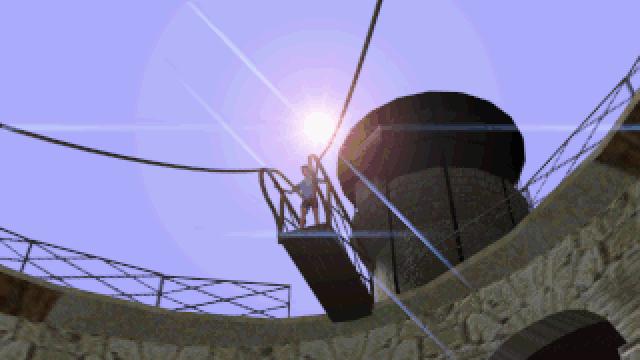
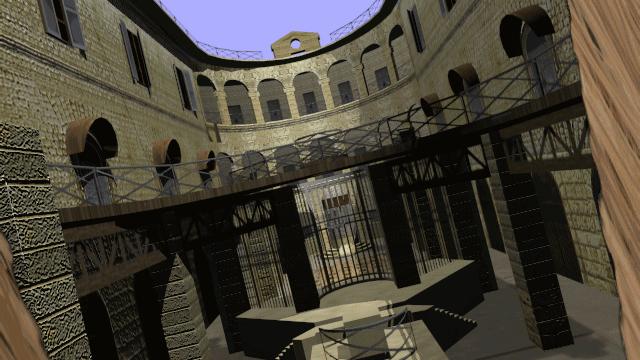
There are cutscenes from the TV program interspersed with rendered scenes that hold up quite well over the past eight years from its creation. Having watched a video of the TV show, I know the scenes are faithful to the show and represent a rendered real-life experience in nearly all aspects of the show.
Although the first part of the game (“The Trials”) is in real time, there is opportunity to save and more than ample time to complete enough tasks to collect the seven keys to progress to part two of the challenge. There is seventy-five minutes of actual game time in which to complete enough challenges to collect seven keys. Once all seven keys have been collected, there is the opportunity to free any team members who have been locked away as a result of failing to completing a challenge. Before panicking, kind reader, remember it is possible to bail out of any challenge by pushing the space bar. Take careful note of the hourglass as it counts down the remaining time and you need never worry about losing a team member into jail.
Should any team member end up in jail, the next stage of the game is the “Rat Game”. This is essentially a heads and tails guess about whether the rat will choose one colored exit over another. If you choose correctly (red or black), the team member is freed. Otherwise, they are held in for the remainder of the game.
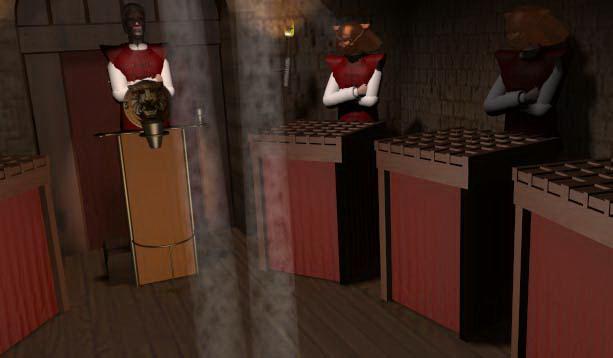
The part of the game that follows is the “Fortress Council” challenge. Each player must play a puzzle game against the Fortress Council to acquire twenty-five seconds to collect treasure from the Treasure House in the next challenge. The total time collected is added to three minutes and the team is returned to Father Fouras for further clues, which are earned by completed successive challenges (“The Adventure Stage”). Successive clues indicate a mystery word that is the key to the Treasure Room. When the team has collected enough clues to identify the mystery word, they are led to the final challenge.
On a giant letter board, using a combination of team members and cannonballs, the team must spell out the mystery word. When correct, the team is allowed access to the Treasure Room to collect money for the time earned earlier. This entails clicking on virtual players to collect treasure and then sending them to the exit repeatedly until time runs out, being certain not to allow them to be caught in the chamber. The total loot collected is totaled and a score is given.
The game is accompanied by a twelve page booklet. The readme is virtually useless for background information. Remember once upon a time, games had printed documentation, not just disk-based information. Instructions are obviously translated from the French and are confusing and lack detail. It mentions characters that are seen for only fractions of seconds in the game but gives limited background to allow insight to the events that have led to the challenge. should be in instruction manual.
The game is a DOS one but performed perfectly from within Windows 98SE without any glitches whatsoever.
I quite happily play this game against the computer but it can be played by up to six people which could make for an interesting evening with similar minded people. This game manages to avoid pitfalls in similar games (remember Survivor?) by making the puzzles challenging without losing a sense of fun. The clock is always counting down but time is so generous that everyone has a good chance of getting to the later parts of the game.
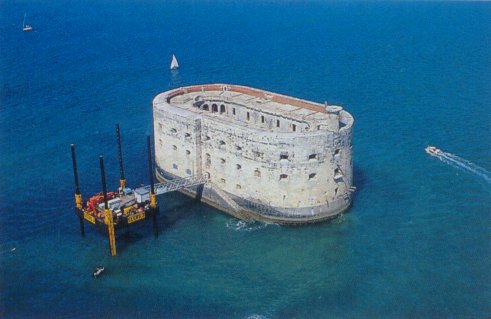
Fort Boyard is a pretty spectacular place-an abandoned Napoleonic fort on the coast of France near La Rochelle in the Charente-Maritime region. Watch the opening cutscenes just to marvel at the engineering feats that were required to achieve it. It must be quite breathtaking as contestants arrive for the real-life series. How Fort Boyard could have served a defensive purpose is unclear to me; but then again I am neither an architect nor a military strategist!
Other titles in this series include Fort Boyard: The Quest, which is an action-adventure title and Fort Boyard: The Legend, which is more of an adventure game. All three titles are listed as available on the Microids website and I hope to get hold of the adventure game soon. Fort Boyard: The Quest was quite enjoyable as a Tomb Raider clone with more cerebral puzzles but I gave up mid-game because there was no save feature. Others with more patience may fare well with this title. Despite this, the Fort Boyard franchise is one of considerable quality.
Although Fort Boyard: The Challenge is no Syberia or even a Road to India, the game continues to hold my interest for days at a time because of the adventure and puzzle elements. Most adventure gamers will find Fort Boyard: The Challenge an experience worth having. It deserves a B overall for anyone interested in a “not-quite” adventure game.
Final Grade: B
System Requirements (Good for reminiscing of the glory days!):
- 486 DX processor
- DOS/Windows 95
- 2X CD-ROM
- 4 MB free HD space
- 8 MB RAM
- 512 KB graphics card (VESA compatible)
- Soundblaster-compatible sound card
- Mouse
- Keyboard