Journey to the Center of the Earth Review
|
Review Journey to the Center of the Earth Frogwares Review by Karla Munger |
 Walkthrough |
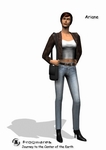
The year is 2005. Intrepid, ambitious photojournalist Ariane, on assignment in Iceland, falls through a crack in the Earth and engages in feats of derring-do beneath the surface, encountering colorful characters, traversing exotic territory, confronting prehistoric creatures, and uncovering a diabolical plot…
There you have a thumbnail sketch of Journey to the Center of the Earth, a new third person point-and-click adventure game from Frogwares that’s loosely based on the Jules Verne novel of the same name.
In the opening sequence, a helicopter carrying Ariane and her pilot sets down on an Icelandic volcano. Our heroine exits the helicopter only to see it destroyed by a rockslide few minutes later.
As our adventure begins, Ariane is unable to find the pilot. She sets off to seek help and ends up in a very dark cave, where she falls through an unseen crevasse and is knocked unconscious. When she comes to she finds herself lying on a beach, with a shaman standing over her. He tells her they are beneath the volcano. After a bit of expository dialog, he offers to help Ariane find a way back to the surface, but only if she will do something for him first…
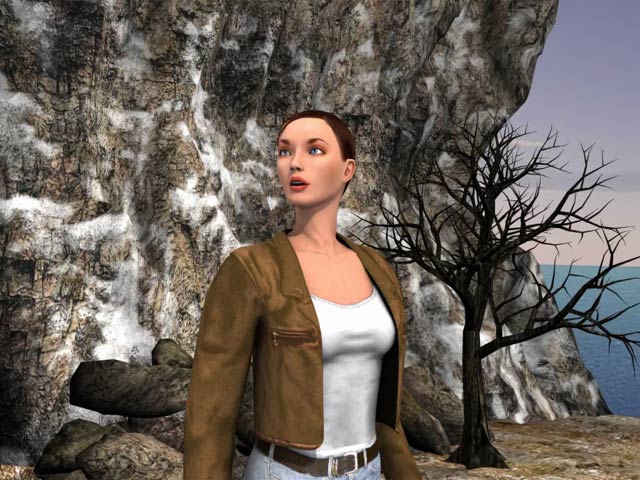
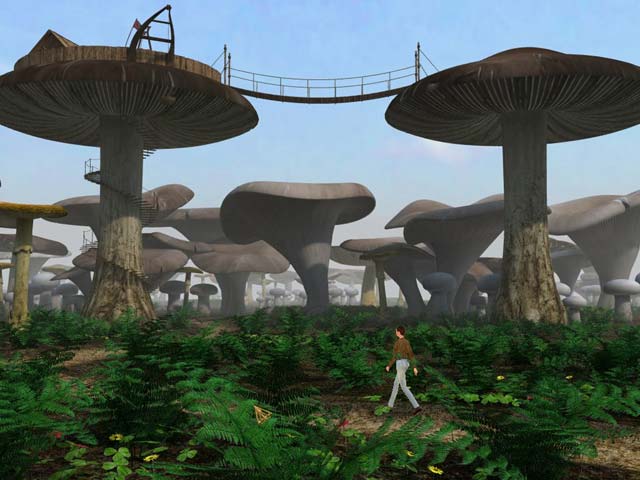
The balance of the story revolves around Ariane’s search for a path that will return her to the world above, and her pursuit of The Big Scoop That Will Make Her Famous. She covers quite a bit of territory and encounters a wide variety of characters. Her adventures take her to such places as an exotic forest of giant mushrooms, a savannah occupied by dinosaurs, and a multi-level diamond mine. She crosses a huge suspension bridge, pilots a submarine, and rides in a helium balloon that’s fashioned after a pterodactyl. Our heroine is a very busy young lady!
Meanwhile, a tense political situation is brewing on the surface. Ariane learns of this via news bulletins sent to a laptop computer she carries with her. I found the laptop to be a rather nifty story-advancing device, and Ariane puts it to a variety of uses.
In the world below, our heroine soon discovers that all is not as it appears. She embarks on an investigation that will take her to the subterranean world’s only city and lead her to a village inhabited by giants, some of whom possess mystical powers.
Will she get to the bottom of things? Will she identify any wrongdoers? Does she ever find a way back to the surface? Will she expose the underground world she’s discovered to those who live above it, or will she keep its existence to herself? The answers to these questions and more are revealed during Ariane’s sojourn through the strange and exotic lands of JTCE.
A particularly interesting aspect of the game is that it comes in two lengths, each with a different ending. One of the endings has a quite unexpected twist. I just love those!
The story itself is imaginative and held my interest throughout. The game boasts many unusual and captivating characters with whom Ariane interacts; NPCs are plentiful as well. Speaking parts are delivered in a variety of accents and dialects (although I do feel that some of the voice acting could have been better).
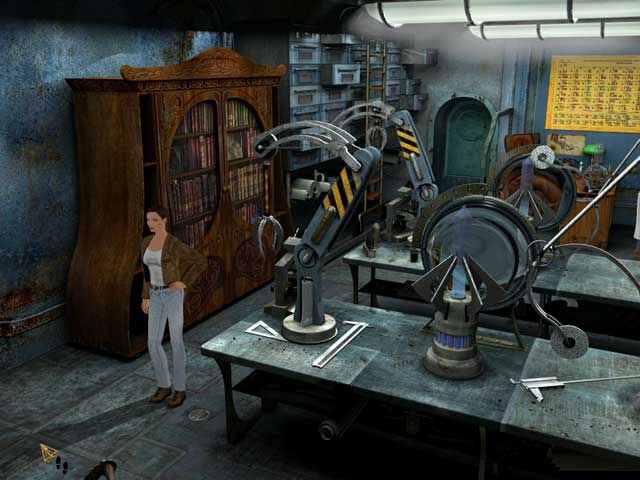
JTCE is an impressive-looking game. Its environments are creative and visually intriguing, making use of vivid colors and interesting overhead perspective shots. The music, performed by a philharmonic orchestra (called “Sneffels,” which is also the name of the game’s volcano!), is simply beautiful. Sound quality is also very good. Some of the ambient sounds — chirping birds and such — could have easily been coming from outside my window as I played the game.
In one particular sequence Ariane encounters a non-threatening baby dinosaur that follows her around like a puppy. It’s an adorable scene. I even spent a little extra time there and had Ariane simply run around the area while the little dinosaur scampered along behind her. It’s that cute! (All together now: Awwwwww!)
The game’s inventory is attractive and easy to use; it displays across the bottom of the screen and can be toggled on and off. It does, however, present one drawback. When left open, it can obscure items that are crucial to gameplay. (I realized this only after I’d become completely stuck a few times and had an epiphany of the forehead-smacking variety.)
JTCE serves up a veritable cornucopia of puzzles, ranging from fairly simple to rather excruciating (watch out for brain cramps). One particular puzzle left me completely baffled, but I did manage to solve it through trial and error. At least one puzzle has a random solution.
Several of the game’s puzzles are optional, as are some of Ariane’s actions. Although JTCE can be successfully completed without these optional items, they do add dimension to the story and enhance the immersive experience offered by the game.
But alas, no game is perfect, and I had my share of problems with JTCE.
None of the cut scenes would run smoothly for me (had they not been choppy, they would have been gorgeous). Although I’m currently unaware of any known problems related to the game, I suppose this could be attributable to my video card. Action within the game itself presented no such problem.
The game also had a tendency to freeze and crash. One of the puzzles was particularly adept at triggering crashes, although this didn’t happen consistently. While I’m sure that not everyone will experience this kind of instability, I do feel that mentioning it is warranted.
At times, I found Ariane a tad difficult to control. For instance, she wouldn’t always go where I wanted her to go; occasionally, several attempts were necessary in order to get her moving. At other times she would refuse to budge altogether, become stuck behind things, go sailing off the screen, overshoot her mark, and/or run into solid objects (sometimes passing right through them). Yet when viewed from the proper perspective, this kind of thing can actually be entertaining! (Yeah…I know…I’m not a well person…)
Now here’s something that’s not so entertaining. Ariane would sometimes end up in a position that would effectively block my view of items with which our heroine needs to interact. This would also render absent the icon that displays to indicate the presence of an item needing attention. It didn’t always happen in the same spots, but on more than one occasion it caused me to miss items that are essential to the completion of the game. Until I played JTCE a few times and basically knew where everything was, moving Ariane to the side and checking for hidden items became the order of the day.
Some of the game’s hotspots are quite small. Hitting them with precision can be tricky; they can also be fairly easy to miss. Additionally, there were times I was unable to see the icons used for navigation (footprints) and interaction (a hand) that display beside the pointer. The footprints, for example, could end up just off screen.
A certain structural aspect of the game was a source of frustration. If I had overlooked an essential item or action, I was sometimes able to continue the game well past the point of having missed it. By the time I reached a sticking point, it was almost impossible to discern which item or action was needed. This made for some time-consuming backtracking and replaying, which can become tedious after awhile.
Fortunately, JTCE allows unlimited saves. Until one is familiar with the game’s vagaries, I recommend saving it frequently.
This next thing is entirely personal. I found Ariane to be a tad fidgety when standing in one place and while other characters are speaking to her. Her abundance of mannerisms proved rather distracting to me, particularly at first. Fewer would have been better.
JTCE is presented in six sections, called levels, which serve to divide the story’s major segments and locales. As previously mentioned, the game also comes in two lengths with two different endings. One can opt to end the game after Level 4, or ride it all the way through Level 6. I liked the longer version better and found its resolution to be more satisfying.
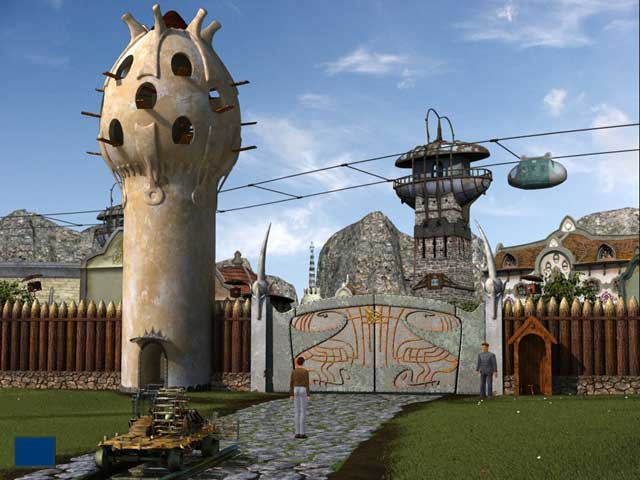
All things considered, JTCE isn’t a bad game. Had it performed better, it would have been quite good. It’s very reminiscent of Syberia, albeit not as polished. Still, Frogwares definitely has the right idea and JTCE does have quite a bit going for it.
At a suggested retail price of $19.95, this is a very affordable game. Despite its flaws, I consider it to be a worthy and challenging diversion. I do suggest playing it more than once, however — particularly if you’ve encountered problems. After I’d become familiar with JTCE’s quirks and eccentricities it became a much more enjoyable game. I’ve been able to appreciate what it has to offer more fully with each successive playing.
In the future, I’m hoping that Frogwares’ game-creation process will evince a bit more finesse. JTCE clearly indicates that this developer is capable of greatness within the adventure-gaming genre. I’m definitely looking forward to it.
Final Grade: B
System Requirements:
- Windows® 98/Me/2000/XP
- Pentium® III 500 MHz
- 64 MB RAM
- 16 MB DirectX® compatible video card
- CD-ROM Drive 8X
- 700 MB free disc space