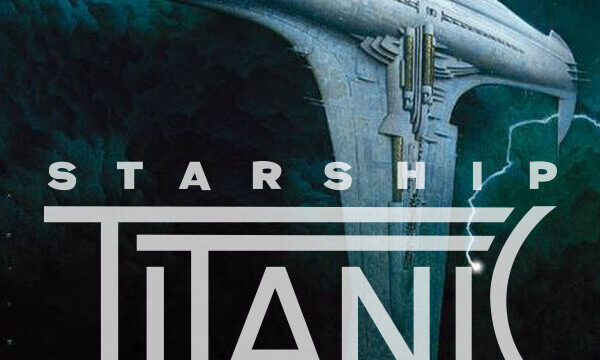
Starship Titanic Review
|
Review Starship Titanic The Digital Village
|
Walkthrough |
Learn more about this game at: |
I was extremely eager to get my hands on Starship Titanic. I’d read terrific reviews; I’m a Douglas Adams fan – I thought, how could I lose?
I practically skipped home from Virgin Megastore, ripping the plastic shrinkwrap off, reading the back of the box, and seeing that the look of the game had been designed by Eugenio Zanetti, the Oscar-winning designer of the 1995 film Restoration. Yum!
I was also impressed with the several installation options I was offered. This is a feature that should be available on more games. I don’t mean to brag, but I have a pretty large cd drive, and I appreciate the option to load all three cds onto it so that I can completely eliminate disk swapping!
So far, so good. I start the game. The game begins in the living room of Your Lovely Home, and after a minute or two the bottom of Starship Titanic literally crashes into your living room. A door opens, an a befuddled robot glides down the gangway, looking around, and muttering bleakly “Oh dear,” over and over.
I’m on the floor laughing with glee. I enter the ship, meet the other hilarious robots and proceed to tour the ship. The graphics are absolutely beautiful, and I’m almost giddy with pleasure at the idea of having (sort of) free reign to roam around the ship, check out my stateroom, and begin to try to figure out the game.
The game! Ah, there’s the rub. As long as Starship Titanic is dazzling you with its beautiful graphics and very funny robots, you’re tempted to consider it a good game. But as soon as you get down to cases and try to figure out what the #*$& you’re supposed to be DOING on the ship, well, that’s another matter entirely.
As for the story: well, I hate to report this, but Doug Adams forgot to write one. There’s no story. At all. Instead of a story, there’s one Big Fat Task: put the ships central brain back together by going on an inane and incredibly repetitive scavenger hunt around the ship.
The first few times through the various lovely rooms in the ship are fun, but by the 125th, I’d seen enough. I haven’t been this sick of the claustrophobic interiors of a game since slogging endlessly through the museum in Shivers!
Much ado was made about the “revolutionary” text parser which allows you to “converse” with the robots. I hate to break it to Mr. Adams, because he and his team worked so very hard on it (just read the documentation if you don’t believe me!) but it just isn’t very impressive. Most of the responses you get from the robots are nonsequiturs or simply “What are you talking about?” answers.
And the puzzles. I know, I know, I’m in a Douglas Adams world, and I should expect everything to be a bit twisted. But the things I had to do to hunt down the various articles of the treasure hunt were too often obtuse in the extreme. I mean, they were funny when I finally resorted to a walkthrough and tried them, but by then I’d given up any hope of solving the puzzles myself.
There is one puzzle dealing with navigational triangulation, at the very end, that I think is simply unfair.
By the time I was finished with Starship Titanic, I was worn out, fed up and decidedly unamused.
Final Grade: D
System Requirements:
CD-ROM version:
Windows 95
100 MHz Pentium (133 recommended)
16 MB RAM
160 MB available hard drive space
16-bit (high-color) capable video card and monitor
Video and sound cards 10% compatible with DirectX 5.0
4X CD-ROM driveDVD-ROM version:
Windows 95
100MHz Pentium
16MB RAM
10MB free hard drive space
16 Bit color at 640×480
Soundblaster of 100% compatible
DVD-ROM driveMacintosh version:
120 MHz Power PC or faster
Mac OS 7.5 or later
4X CD ROM
32 MB RAM
160 MB hard drive space
Thousands of colors
This review is copyright Ray Ivey and Just Adventure and may not be republished elsewhere without the express written consent of the author. Republication of said review must also contain a link back to Just Adventure.