The Uncertainty Machine Review
|
Review / Interview The Uncertainty Machine Developer/ Ratracer Review by Jerome |
|

First of all, everyone who has given their effort to create games for us adventure gamers in his/her spare time without profit deserves a big round of applause. Eduardo Campos – aka Ratracer – is such a person; an independent developer of adventure games using the AGS engine. His first game – The Uncertainty Machine – is free for download. If you are curious about the development of the game, also read my interview with the developer on JA+.
The story is about a newspaper reporter called Susan Gant. Following the introduction, as Susan is on here way to her job as a newspaper reporter, she witnesses a robbery in front of the newspaper building; the first sign that something big is going to happen. Her editor then assigns her a story that will soon involve a mysterious conspiracy. She will, of course, have to investigate the facts using all possible means.
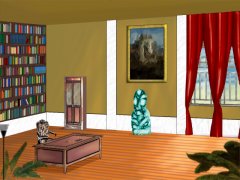
Like most independently developed games the plot is the most important component. Some people may feel the story is unoriginal, but I don’t agree. I think the game is recognizable because the developer was inspired by several popular games. This resulted in a collection of several familiar story aspects combining to form a unique mystery dealing with good and evil.
According to the developer’s website The Uncertainty Machine contains about 90 rooms, 40 dialogs, and 80 inventory items. Well, as I didn’t count them, those figures might be true. But I must say I would expect a much higher amount of dialogs because the story is mainly told using text. Unfortunately, this also resulted in apparently endless conversations between characters during at least two points in the game. Nevertheless, the story is far from boring.

The Uncertainty Machine is a third person point-and-click game. The developer must have played quite a number of adventure games as all of the typical elements you can imagine for an adventure game are included: a city-map, inventory items that can be combined, pixel hunting, a Lap-top screen, a mobile telephone, multiple endings and more. Eduardo did make clever use of such elements and, to be honest, even of some today’s prominent professional developers still use such elements to ensure their success.
The screen is divided into several parts. At the top you see the playing time and information that Susan has added in her notebook or laptop. Below this is the Inventory bar where you can either combine objects or use them on the playing screen. The playing screen is where the game actually takes place. During dialogs possible lines with questions are listed at the bottom. The interface of the game is simple; left click to interact, talk to other characters or use objects and right click to investigate. Some of the inventory items can be used in close-up views such as the mobile phone and the laptop computer.
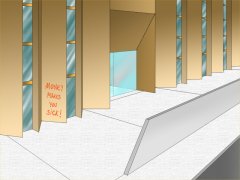
Playing the game is not very difficult. Some puzzles are challenging, but none of them is really unsolvable. There is a walkthrough available, but to be honest you should not need it. If you get stuck you probably have missed a clue or conversation somewhere.
The Uncertainty Machine was developed with the freeware AGS (Adventure Game Studio) engine. The AGS engine is based on technology used by Sierra and LucasArts in the early nineties (you surely remember the Kings Quest games). Screen resolution is 640×480 and may result in some coarse graphics on larger monitors. Concerning this, the characters are still well defined. While I thought the Susan’s pink outfit on day one was a bit boring, I was pleasantly surprised by her attire on day two.
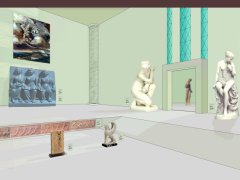
The strength of the graphics is the backgrounds, especially some of the furniture. The quality of the backgrounds even seems to improve as the game progresses as though the developer improved his graphic skills during development. Unfortunately the animations are very simple. Sometimes the movements of characters are so unnatural it tends to devaluate the complete picture.
Sounds… what can I tell about sounds? Okay the game has sound effects. They are fine, like the sound of traffic in the street, the elevator bell, breaking glass and birds in the park. The game has no speech and dialogs are written only. You quickly get used to this though, especially if you’ve played the older games. But, in my opinion, the weakest part of this game is the music. It would be a hit in the elevator scene but apart from that it is not too my taste.
I was pleased too see the developer mention on his website his intentions to release a second version with a new score. But if you have read the interview you know this is probably not going to happen. Too bad, cause it really could use some different tracks. In fact, even no music might be an improvement but the game does not feature this option. For this reason, I renamed the file MUSIC.VOX to something different and surprisingly it worked. Be careful though if you do this as I am not sure if the game will remain stable while playing. But, you might want to be fair and listen to the music first, it might be to your individual liking.
Overall, The Uncertainty Machine is a very pleasant game. If you enjoy adventure games and are into trying something different, then you certainly will enjoy this game. Besides, what do you have to loose, the game is free of charge and you just have to take the time to download the 20Mb installation file.
I think Eduardo did a great job and would like to thank him for expending his time and energy in creating The Uncertainty Machine. I hope he is encouraged to continue creating adventure games and hope we will hear from him again in the near future.
Final Grade: C+
System Requirements:
System requirements for AGS engine:
- Windows 95, 98, ME, 2000 or XP (NOTE: under Windows XP you may have to use the compatibility feature).
- Pentium 100 MHz or faster system
- At least 32 Mb RAM.
- Mouse and keyboard,
- DirectX compatible sound card
Copyright © 2003 Jerome for http://www.justadventure.com/, all rights reserved.
INTERVIEW WITH EDUARDO CAMPOS DEVELOPER OF THE UNCERTAINTY MACHINE
Conducted by: Jerome
Eduardo Campos – aka Ratracer – is an independent developer of adventure games using the AGS engine. His first game, The Uncertainty Machine, is free for download. Curious about the development of the game, I imposed on him for a short Q&A.:
JA – Hi Eduardo thanks for agreeing to this interview with JA+
Hi, First of all, thank you very much for your interest (and JA+’s) in my game (and me…). Lets jump straight to the questions, then!
JA – I found the Easter-egg in the game telling me your name is Eduardo Campos also known as Ratracer. Who or what is Ratracer. Is it just a name or did you choose your alias for a specific reason?
Ratracer was my first (and only) nickname at an internet forum. It’s just a nick, more than anything else, but if I want to find the reasons, here they are: The “racer” part of the name is related to a past dream of mine, of being a motorcycle racer. But “ratracer” because we all are in this ratrace, and also because I liked very much the comics book Ratrace of a french author which I don’t recall the name at the moment. (Red. Bodine Amerikah)
I’m 42 years and live in Porto, Portugal. I discovered the pleasure of adventure gaming with Indiana Jones and the Fate of Atlantis. I can’t say I “always” wanted to create an adventure game myself; since I had no idea there were free adventure game engines, until I found AGS a year ago. My profession has nothing to do with games or something. I work in the IT dept. of a bank. Before AGS, my previous hobbies (because they were hobbies) were being a motorcycle racing team manager and journalist for motor racing magazines.
JA – To make a game like The Uncertainty Machine you must have a creative mind, it has quite a lot adventure game elements. What were your motives to create the game and did you have any examples to follow?
I must start by thanking Chris Jones, the maker of the AGS (Adventure Game Studio) engine (which is freeware http://www.agsforums.com/), for providing us, amateur developers, a powerful and easy tool for creating adventure games and, as such, the possibility to full fill our dreams.
I don’t think I have a creative mind, really. As with most adventure games, I think the plot is the strongest attribute of the genre, so I tried to write a story. I also wanted my game would have some mystery into it, which is the element I enjoy most when playing an adventure.
But back to the creative point: there isn’t really creation in my game, I just took out the influences of my favorite games and my favorite literature genre, mixing them as well as I could. My art skills are limited, so I situated the game in a modern city. It’s a lot easier to draw a straight line than the wiggly curves of a cathedral.
JA According to the text on your website you might improve the music on The Uncertainty Machine; you mean the game is not finished yet? How long did you work on the game and will it ever be finished?
The game is finished and I dont think there will be changes in the future. A friend of mine was writing a new score, but time has passed in the meantime, and it isn’t ready yet.
Because I feared that I would never finish it I had the intention not to take more than a year to develop the game. Surprisingly for me, I managed to stick to that schedule: exactly 12 months! Now the beta test is finished and corrected all bugs (I would like to thank all the people at Gameboomers and AGSforums, that did a great work testing and suggesting stuff), I’m in decompressing mode and really don’t want to look back onto The Uncertainty Machine to make more improvements. So probably there will be no new music.
JA – Physics appears to be a major part in The Uncertainty Machine. What is your interest in this subject? Do you have such background?
No special academic background apart from traditional high school stuff. However, I am a “believer” in science (even if the “moral” of the game may say otherwise), and I try to read books from Sagan, Feynman, Michio Kako, etc. as much as possible. I love SF-literature as well, preferably the books that aren’t too fantastic and are based more on physical principles. Once again, it was mainly a source for inspiration but if the physics look somewhat reasonable it’s because I took some ideas from Arthur C. Clarke’s The Gods Themselves. I hope I changed those enough not to be a rip-off, but I can’t deny that I based the physics behind the “other dimensions” on that book. My next game, if there is one, may have a totally different background, based on something I like some idea I take from a book, a movie, or something else.
JA – With The Uncertainty Machine, do you want to send a word to the players of the game? What is the moral of the game?
One of the reasons I enjoyed so much developing my game is that I wrote the story as I was developing (drawing, scripting, writing puzzles) it. By the way, this is not the best way of creating a game; you should write the whole plot, before doing anything else, to avoid inconsistencies later on. But my unorganized way was more enjoyable since I didn’t know how the plot would be. It was almost as I was actually playing it myself.
Anyway, I am telling you this, to make clear that any moral in my game was coincidental. The Divide bit of the plot was thrown in the game very late in the development stages by changing backgrounds to include graffitis, changing dialogs to add lines about the Off Limiters, etc. At that moment, I tried to introduce some kind of message in the game. But I never wanted to be too explicit about it because I changed my mind about the plot too many times. So, if I say that the Citizens are supposed to represent the western world and the Off Limiters are the equivalents of the third world countries it may be a totally different interpretation of the players.
To conclude this reasoning, the Divide part of the plot was forced: as you play the game that subplot gets buried only to resurface at the end. There are also references to freedom and truth, but those are mostly a strike of luck. I was having a difficult time thinking of endings that somehow would wrap up most of loose bits lying around. Then I read an interview of a contemporary Portuguese poet (I just reread that interview in the newspaper and found out I got his name wrong in the game I might have to change that) that said the lines that got referenced in the game (Hmmm, this part of the answer is getting to be a bit of a spoiler) and gave me the idea for the museum bit and Mathus choice. If the game has a moral, if you want, hopefully it will be subjective, and it will be interpreted in different ways by different players.
More than anything else, I am getting carried away here, and the game should not be taken seriously. It’s just a game.
JA – Can we expect more work from you in future and are you exploring more techniques, if so what are you having in mind?
I hope so. I have been trying to improve my 3D skills, not because it’s trendy, but because I don’t like hand drawing. I think I can draw so-so, but I’m much too slow. The worst part of creating the game was the awful amount of time everything took to draw, especially animations. So, I hope I can learn to draw a lot faster with 3D tools. After that, I’ll start thinking of new stuff. One thing I will try to do is to limit the developing time to one year if I manage to draw faster. Hopefully, the game length of my next game will be longer. I don’t know how my next game will be; just it will be third person perspective and will be influenced by my favorite games. But, in the meantime I am also taking part in a team to work on a better developed game (than the Uncertainty Machine). I don’t know if the other members want it to keep it secret from the time being, so……
JA – Thanks Eduardo for your time answering these questions.
Thanks. I hope I wasn’t too wordy. I’m pretty quiet most of the time, but once I’m on it, I tend not to stop. 🙂
