Grim Fandango Review
|
Review Grim Fandango LucasArts Review by Michal Necasek |
Walkthrough |
Learn more about this game at: |
Place: City of El Marrow, in the Eighth Underworld. Time: possibly the 1940s. It is Día de los Muertos or the Day of the Dead. And since this is the Land of the Dead, everyone is on vacation, visiting relatives in the Land of the Living. Almost everyone that is.
Our hero Manuel Calavera (a.k.a. Manny) is working. He’s a travel agent at the Department of the Dead, affectionately known as the DOD. His job is to reap the souls of recently deceased people and sell them travel packages. After death, people need to cross the Land of the Dead to get to the Ninth Underworld, their final destination. Depending on how good lives they led, they qualify for one of the travel packages. Walking stick, ride in a padded coffin, steamer… and the souls of the saints and near-saints qualify for a ticket on the famed Number Nine express.
That is, most souls qualify for some sort of travel package. Those who have some serious spots on their records have to work off their debts to the society in the Land of the Dead – for instance by acting as travel agents. But people generally do not talk about what they did in the past so we never learn what sort of debt Manny has to work off exactly.
At any rate things are not going well for Manny Calavera. He can’t seem to be able to get any good clients, which means he won’t get any commissions. Strangely enough, other agents do not seem to have this problem. Thanks to a little subterfuge, Manny finally snatches a first class client: Mercedes “Meche” Colomar, practically a saint. She should qualify for a Number Nine ticket. But something’s wrong – there’s no double N ticket for her according to the DOD computer system (yes, computers made it even to the afterlife).
Something’s rotten in the Department of the Dead… and it’s not the corpses (they’re all very clean skeletons actually). Manny is now in serious trouble and what’s worse, Miss Colomar has taken off on foot without any guidance or protection, and the journey is perilous. Manny (who immediately took a liking to Meche – love is stronger than death you know) blames that on himself. But his more immediate problem is that his superiors are not happy with him at all.
In fact they probably want to sprout Manny. A little explanation is needed here. While everyone is obviously already dead, that doesn’t mean things can’t get worse. If one’s skeleton is destroyed, the afterlife is over. And because it is not easy to damage skeletons with bullets made of lead, the popular method of dispatching people is shooting them with bullets filled with Sproutella, special compound formulated to destroy bone through extremely fast growing vegetable life, or “sprout” them. Dead people here look a lot like flower patches.
So this is Manny’s situation – get away from the crooks running the DOD, if possible turn the tables back on them, and find Meche. LucasArts calls it Grim Fandango. The game was published in early 1999 (probably just missed the Christmas market of 1998) and is widely regarded as LucasArts’ last really good adventure game – and in fact one of the best (if not the best) LucasArts adventures ever. It’s not as funny as Day of the Tentacle, not as zany as Monkey Island and not as crazy as Sam and Max – but despite (or perhaps because of) that, it’s good. Very good.
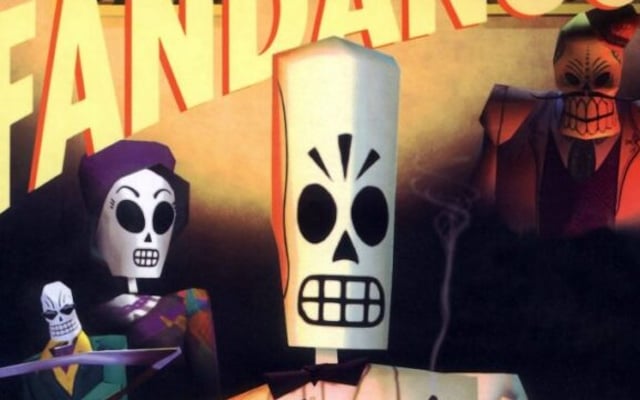
Grim Fandango is practically dripping with style. Retro style. The world of Grim Fandango looks like 1940s on an Aztec trip – especially the architecture exhibits strong Aztec influence. The Land of the Dead also seems to have distinctly Hispanic (Mexican?) flavour. Cities have names like El Marrow, Rubacava or Puerto Zapato. People have names like, well, Manuel Calavera. And Manny even speaks with slight but clearly distinguishable Hispanic accent and occasionally utters a Spanish word or phrase.
Manny will meet many allies on his quest. Most important of them all is Glottis, Manny’s sidekick. Glottis is a demon – an overgrown gremlin in fact (several times larger than Manny). His sole purpose in life is engines – and he can make them run really, really fast. Which will come in handy since Manny has quite a lot of travelling ahead of him. Glottis is, shall we say, a simple soul. Some players find him annoying, other view him as endearing or funny.
There is quite a lot of interaction with other people (and a few supernatural creatures) as well – Grim Fandango definitely isn’t a lonely game. Many people will help Manny, but others will hinder him or even try to destroy him. Fortunately Grim Fandango is a typical LucasArts game in that Manny can’t die – but perhaps he’ll manage to sprout one or two adversaries.
The game is divided into four parts which take place a year apart each, always on the Day of the Dead. With the exception of the second year (which is the most complex), the “chapters” are further split into several locations as Manny travels through the Land of the Dead. The gameplay is fairly linear overall, although the second year itself is as big as a short adventure game and there is a decent amount of nonlinearity. It is usually quite clear what Manny’s current goals and objectives are, which is always a good thing.
Let’s examine the technical side of Grim Fandango now. Graphics are a mix of 2D and 3D, so typical for many adventure games of the late 1990s and early third millennium period. The 3D models are relatively simple and perhaps even crude, but that is deliberate. All the skeletons have a very stylized look, which is a good thing – I imagine it might be quite difficult to tell realistically rendered skulls apart. The camera switches between predefined angles, which may be a little disorienting at first and take some getting used to. It may also not be always immediately obvious where the exits from a screen are, but it’s not a serious problem.
Controls are probably the biggest weakness of the game. Grim Fandango is purely keyboard controlled (Manny can actually be controlled with a joystick as well). And the controls aren’t perfect. Finding the way sometimes is not entirely easy and Manny has a tendency to “bounce” and turn around when he runs into obstacles. Getting into doors also isn’t always exactly smooth. Most annoying perhaps is the inventory system. There is no “overhead view” showing all items. You can either go to particular item by hitting a number – but you have to remember and/or predict which number corresponds to which item at any particular moment (not so easy). Or you have to “scroll” through the items one by one. The controls are not an insurmountable obstacle but the convenience of a mouse operated interface just isn’t there.
Sound on the other hand is near perfect. The technical quality is excellent (the sound is clean and crisp) and so is the voice acting. I especially liked the voices of Manny and Meche. Even better perhaps is the music. The Latin and retro tunes fit the atmosphere of Grim Fandango perfectly and contribute a lot to the overall quality and feel of the game.
The puzzles in Grim Fandango are quite varied. Some, but not nearly all, are inventory based – and notably missing is the possibility to combine inventory items. Other puzzles involve dialogue – I should mention that there are often dialogue subtrees that need not be visited but are worth listening to just for the fun of it. There are no slider puzzles, mazes or other unpopular playtime lengthening devices. The puzzles are well integrated into the storyline and I never had a feeling that they were thrown in just to slow me down. The difficulty is approximately “intermediate” – not totally easy but not mind blowing either.
Most adventure gamers agree that Grim Fandango is one of the best LucasArts adventures and adventure games in general. Quite possibly one of the top five adventures of all time, and certainly in the Top Ten. The style, atmosphere, wit, creativity and inventiveness are what makes Grim Fandango remarkable. No adventurer should miss this game. One would almost say that “they don’t make them like that anymore” – but fortunately that isn’t quite true. Grim Fandango is clearly an A class game – and it could have been an A+ if it weren’t for the clumsy controls. If you haven’t yet, go play Grim Fandango now!
Final Grade: A
System Requirements:
- Windows 95/98
- Pentium 133
- 32 MB RAM
- 4X CD Rom
- 2 MB Video RAM
- Optional: 3D Card