Ring: The Legend of the Nibelungen Review
|
Review Ring: The Legend of the Nibelungen Arxel Tribe Review by Maggie Holt |
Walkthrough |
Learn more about this game at: |
I had heard many conflicting reports of Ring before trying it — having now played it through – I can totally understand why.
Let me say right up front that I can forgive this game more or less all its faults simply because it took me right back to my beginnings as an adventurer. The first game I ever played was Riven and the second was Atlantis by Cryo – (not surprisingly I became an immediate adventure-game junkie!) Anyway, Ring is also by Cryo and has many similarities to that first Atlantis production. In that sense, this review may not be as objective as it should be…but tough!
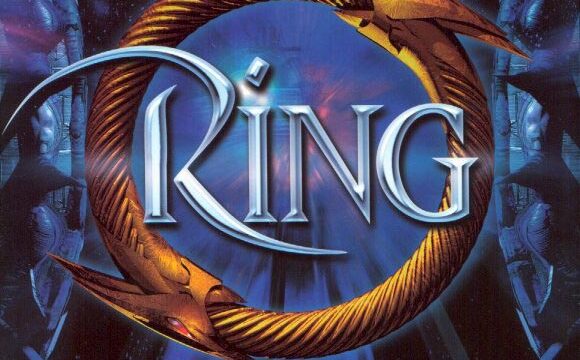
The first thing that hits you about this game is the graphics. These days we are pretty blasé about gaming artwork and expect a photo-realistic standard. It would be difficult to use this description for Ring, in fact I would suggest that it has a quality all of its own. Awesome, confusing, surreal are all adjectives I would use to describe the look of this game. If anyone remembers those weird and wonderful toys of the 1980s called ‘transformers’ – well, that might give you some idea of what I’m trying to describe. If not, then I would recommend taking a look at some of the screenshots – this is art, with or without the game.
The music is of course from Wagner’s opera of the same name, and plays along very appropriately in the background (that is, naturally, if you enjoy classical music). There are subtitles and I thought at first that it would be a good idea to turn these off, however I wouldn’t recommend it – there are a couple of places where it’s quite difficult to hear what the characters are saying and at those times it’s useful to have this back-up. The voice-overs deserve a special mention – if only for the fact that they range from the sublime to the ridiculous, literally. There’s a goddess-narrator with a lovely soothing, female voice and a couple of pleasant male characters: Siegmund and the story presenter, Ish. However these are interwoven with several extremely irritating and over-the-top attempts to characterize some of the individual Nibelungen.
The game is split into 4 or 5 separate adventure-quests, which all radiate out from a central point (much like Atlantis 2 where the magic boat was the hub) in this case it’s a kind of asteroid with a plateau in the middle of it. This is where characters are introduced, and conversations or arguments take place with some of the peripheral characters, such as the great god Wotan and a couple of giant monster-gods called Fafner and Fasolt. There is a moralistic element to the game and at the end of each quest, Ish the presenter of the story, is asked what he has learnt…… why this happens, I never quite found out. Perhaps it’s implicit if you already know the story of the Ring, but for the purposes of game-play I couldn’t find any real point to it.
During the game you will inhabit four distinct characters ranging from an evil dwarf-king to a female Valkyrie warrior. As Alberich, the cruel and heartless dwarf-king, you will travel to Nibelheim, his underground world of mines and the kingdom of the dwarves (the Nibelungen of the title). Here your goal is to get the dwarves working again, because, during Alberich’s absence, they have apparently gone on strike. In order to complete this quest – still in the character of Alberich – you will also have to travel to the Rhine, the home of the Rhine-maidens, in order to steal their gold. It was a new and disturbing experience for me to play this decidedly unpleasant personality – being a born ‘goodie-two-shoes’ – I kept trying to do the ‘right’ thing and make myself ‘agreeable’……. not a good idea when you’re a baddie – I ended up dead a couple of times on account of being ‘too nice’! That’s something worth bearing in mind with this game: you can die! It’s a good idea to save frequently.
Loge the fire spirit is a much more mysterious character, who is only ‘allowing’ himself to be used by the gods for their current purpose. It’s his mission to steal the ‘Ring’ and magic crown from Alberich and bring them back to Wotan. Despite his intention to steal, he definitely has the higher moral ground in comparison with Alberich.
Siegmund, Wotan’s son, is half man and half wolf. This quest-segment aims to explore the tragedy of Siegmund’s past, when his mother was killed and his twin sister disappeared. At the end of this sequence one of his other sisters, Brunnhilde, comes to his defense in battle and saves him from his enemy. For some strange reason, this enrages Wotan and means that Brunnhilde now has to run away to find help.
Finally as Brunnhilde, the Valkyrie warrior and also a child of Wotan you have to flee to Walhall, the Necropolis, to find the final artifact: A ball, which you must take back to the asteroid in order to complete the game.
The game-play is predominantly 3rd person point and click, with full 360-degree movement and a very simple, intuitive interface. There are numerous cut-scenes (one hour’s worth according to the box information) and twenty-two different characters to inhabit or interact with.
The producers have very kindly included a full walkthrough in the game manual, and I did use this on a couple of occasions – I have a tendency to be a lazy adventurer and will take the easy option if it’s offered to me. However the puzzles in general are not difficult and the main advantage of the walkthrough is that it prevented all that interminable wandering about, wondering what to do next, which is my pet hate.
On the subject of the puzzles, this game has pretty much the standard arsenal: There’s a tile puzzle, a numbers puzzle, several ‘what-goes-where’ puzzles (my favorites), some manipulation, and a music puzzle (why producers always assume that adventure gamers are naturally musical has always baffled me!) Plus of course it’s all inventory-based.
Specific good points: It’s possible to save virtually anywhere in the game, which means you can half-finish a puzzle and come back to complete it after you’ve taken a phone call, or eaten your tea.
Specific bad points: There was a very peculiar and out of place sequence during one of the quests that involved a conversation with Woden, father of Siegmund and Brunnhilde. Up to this point the graphics had been extremely interesting and rewarding, why they then decided to use poorly executed 2-dimensional box-drawings inserted onto the screen is quite baffling. This bit would have lent itself nicely to an animated cut-scene, which would have been far less boring and in context with the rest of the game.
I think it would have been a good idea with this game if the makers had used a pre-game introduction built into the story, like in Riddle of the Sphinx. This epic is far to complicated to be dropped off somewhere in the middle and to be expected to make sense of it at all – especially if like me, you have no previous knowledge of Wagner’s opera. I did look at the story of the operas after I had completed the game – (typical of me – I always jump in and learn to swim afterwards!) Some of the main elements of the Ring Cycle appear to have been included, but it’s by no means a full representation and whilst this might have been a mammoth task it could possibly have produced a real masterpiece. Whatever the outcome, it would certainly have increased the length of the game. I used the walkthrough as reference a couple of times and it took me about 8 hours to play – an easy weekend completion. Even without using the walkthrough at all, I can’t imagine anyone getting much more than a dozen hours play from it.
Despite all that, I had no problem enjoying the game without a coherent grasp of the story – possibly since I approached it with no real expectations. I imagine that most adventurers can accept a certain level of puzzlement regarding what they’re doing and why – it tends to be a feature of many adventure games.
Final Grade: B
System Requirements:
- Pentium 133
- 32 MB RAM
- 290 MB Free Hard Drive Space
- 8X CD ROM Drive
- Windows 95
- Direct X 6.0 compatible SVGA video card (65K colors)
- Sound Card and Speakers (highly recommended)
- Optimized for MMX