Intro – in which the author makes his confession
|
Review Uru: Ages Beyond Myst
Review by Robert Washburne |
 |
Intro – in which the author makes his confession
Let me start off by saying that I did not like this game. I mean, I REALLY did not like this game. I was actually one of the thousands of beta testers for this product so I could have written this review back in November when my NDA ran out. But I just couldn’t bring myself to go back and play the game again to get the screen shots. So you will not see any screen shots in this review (that’s the only way I could bring myself to start writing). If you want to see screen shots, go to the Uru home page.
But I realize that there are people who would enjoy this game. So rather than giving it the “F” which I felt it deserved, I have given it a “B-” which I hope accurately rates the overall game.
Please let me explain.
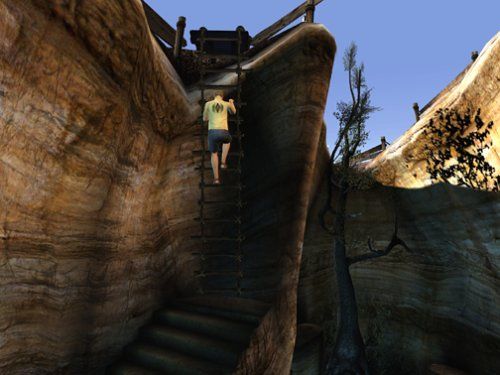
Adventure games can be divided into two categories: Physical and Non-Physical. Physical games include titles such as Tomb Raider where you have to run, jump, solve timed puzzles and require the gamer to have a measure of manual dexterity. Some purists (not me) would argue that this makes them “Action” games rather than a true adventure. Non-Physical games, such as Myst, require no manual dexterity and can be played as leisurely as you like.
Some people like both types of games. Others only like one type or the other. I only like Non-Physical style games. I don’t like having to jump onto pixel-perfect locations or to have ticking clocks breathing down my neck. That’s just me. That’s why I love Myst.
But Uru is a Physical game.
Uru requires you to leap clefts and jump onto moving platforms. There are timed puzzles and many opportunities to “die” if you miss. All the things Myst never made you do. All the things I hate in a game.
Yet I realize that there are many people out there who do like the physical aspect. After all, how popular is Tomb Raider?
So, now that you understand (and maybe even share) my prejudice, let’s get into the review.
Background
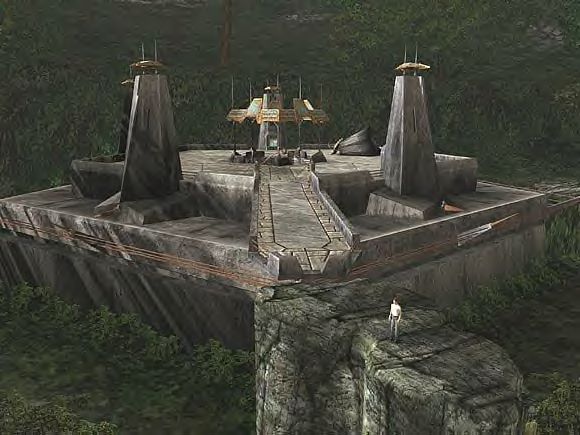
The story goes that D’ni, the ancient city of Atrus’ ancestors, has been discovered by human archaeologists. They immediately do what anyone would do in that situation; take control of it and only let their friends in. But there is a rogue in their midst by the name of Zandi who, working in consort with Atrus’ daughter, Yeesha, wants to open D’ni and the Age books it contains to the general public. So you and the general populace get to wander around the ancient glories with the reluctant permission of the site authorities.
There are a few ages that you can explore on your own. Yeesha hopes that these will teach you about the sins of the D’ni people so that you won’t make the same mistakes. As the research continues, more Ages will be “discovered” and opened to the public at a rate of about one per month. There are also several Easter Eggs in the beginning that will be recognized by those who have played the other Myst games and read the Myst novels.
Review
STORY: “B-” Every adventure game has a story and Uru is no exception. But this is about the lamest story of any of the Myst titles. In the previous three Myst games you had mysteries to uncover and bad guys to thwart. Uru has neither. What there is to learn about the ages you discover by reading the journals of the archeologists. You learn nothing new, which isn’t about to be published.
Instead of a villain to thwart, Yeesha simply wants you to learn a lesson from the history of D’ni. But she has no monopoly on wisdom and her conclusions are highly colored by her beliefs. A person could easily come to different conclusions than the ones she wishes you to reach. And anyway, since when did anyone ever learn anything from history? Wasn’t the Great War the war to end all wars?
But you do end up learning more about the fascinating story story/history of the Myst universe and I count that for much.
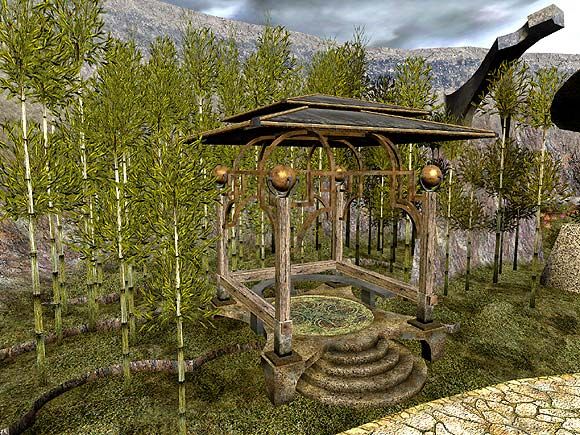
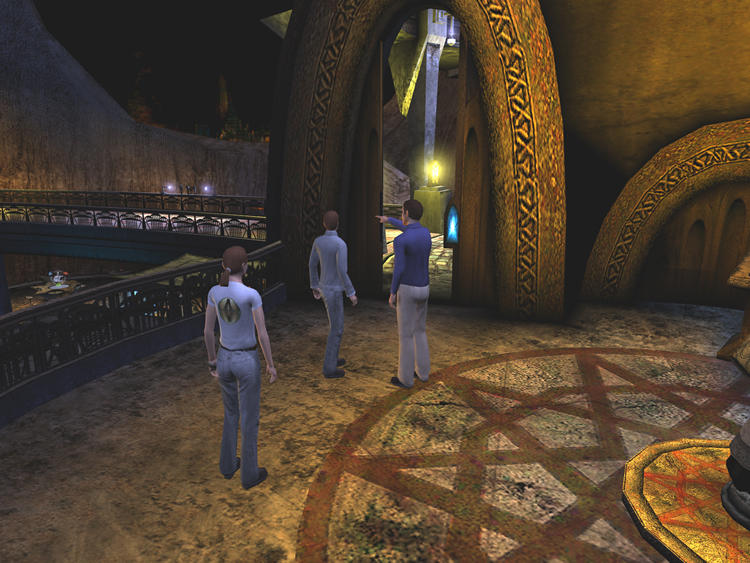
GRAPHICS: “A” There is no question that the graphics are gorgeous. To say that the worlds are beautifully rendered would be to say the Mona Lisa was nicely painted. This is the one area where the Myst tradition is faithfully carried on. If you like eye-candy, then you will be in second heaven with Uru. My only complaint is that the graphics end up being the center of focus for Uru. Instead of using the graphics to highlight the puzzles as Myst did, the puzzles are used as an excuse to lead you to more graphics. So why not an A+? As beautiful as the world is, your avatar (the character which represents you in the game) is a bit cartoony. They really don’t match. Not a big issue, but enough to ruin a perfect score.
SOUND: “B+” This is a little hard to review as I did not go out and spend money on the game (I was a beta tester, remember?). In the version I played, there was only music in two areas; the opening Cleft Age and later in a Museum. In both cases the music was perfect. The Cleft made me feel like I was on a mystical journey to Ixland. The Museum invoked feelings of greatness from ages past. But they were the only places. There was no music anywhere else. I have spoken to people who did spend money of the final game and they tell me that there is more music in the game. If it is as good as the pieces that I heard, then it is top rate. If it has been included in the rest of the game, then it deserves an “A”.
NAVIGATION SYSTEM: “C-” Yes, I’m prejudiced, but I can’t imagine anyone liking this system. First, there are four different ways to navigate though the game; from first person or third person perspective and with the mouse or the keyboard. And you must use all four if you hope to finish the game.
Third person is the only way to see your feet and must be used when you are in danger of slipping off the edge. But you have no control over camera angle from third person. So you must switch to first person to look around (but you can’t look down.) The mouse is a convenient way to move and easy to control, but it only allows you turn a few degrees left or right. If you need to really turn sharply, and you will, then you need to use the arrow keys.
The result is that you find yourself moving from keyboard to mouse to keyboard and back. This usually happen just as you are “getting into” the game and just ruined the experience for me. I wanted to focus on the game, not constantly fight with the controls.
And there was no excuse for this. All of the capabilities could have been built into the mouse in first person just like they were for RealMyst. In fact, at one point in the beta test you could turn completely around with the mouse, removing the need for the arrow keys. But that ability vanished before the final build.
I played the game the whole way through three or four times, but never became comfortable with any of the navigation systems. Your millage may vary, which is the only reason I don’t give it an F.
PLAYABILITY: “C-” Navigation system aside, there are serious playability issues.
First, the “Suspension of Belief” is inconsistent. Every game requires some suspension of belief – there are things you could do in real life but can’t in the game and vice versa. But the rules should be consistent. Uru will herd you through an age and carefully keep you in the box. Then it will bring you to a place where you have to jump out of the box. But why should I have thought to do that when the whole game up to this point has told me I can’t? If I can’t hop over a six-inch curb, why am I suddenly expected to know that I can jump three feet up onto a stone?
And none of it is consistent with the original Myst series. There were many solutions I never thought of because you couldn’t do them in Myst. OK, so we are told that Uru is a different game from Myst. Fine. So why didn’t Ubisoft place all the differences into the intro/training age and then stay consistent with them? You place a game into the Myst universe and people are going to expect it to resemble Myst.
Second, here is no way to save a game. You’ve painstakingly worked your way across the Age leaping and jumping from critical spot to critical spot. You make a critical jump, but miss and fall into the abyss. But you don’t die, you automatically link back to home base. This means that you must wait a minute or two (not seconds, minutes) while your personal world, Relto, is loaded into memory. Then you can walk over to your bookshelf, select it, select the Age book and link back to the Age you came from. Minutes pass again while it loads back in. Now you can work your way back across the Age to try your critical jump again.
Miss that jump a couple of times and you’ll be quitting the game to go play Solitaire. Now, it may not be quite that slow on your system. It may only take 20 seconds to load Relto and another 40 seconds to load your Age. But even on the fastest system it will take over a minute of waiting/repeating before you can try again. There is no excuse for this.
There is yet another playability issue with Uru; you must move objects around in the game, but you can’t use your hands. If you walk into something small, you will kick it in front of you like a soccer football. Remember that navigation system? Try herding a rock onto a pressure plate. In real life you would just pick it up and place it there. In any other game you would click on it, the object would become your cursor and you would place it where you wanted it. In Uru it becomes a major project.
And finally, many of the clues to the puzzles are ambiguous or nonexistent. You look at the clue and it seems to be telling you one thing, but it turns out to mean something completely different. This ruins any satisfaction you might have gotten from solving it for yourself.
ADDICTABILITY: “D-A” That’s not “From D to A.” That’s “Sometimes D, Sometimes A.” When you are just moving around, the addictability is high as you just HAVE to see what’s around the next corner or through that next door. But when you hit one of those Playability issues, well, Solitaire can start to look pretty good.
PUZZLES: “B” Puzzles are a mixed bag. About a third of them are wonderful and truly follow the tradition of Myst and Exile. Another third are more of the type you would expect to find in Riven. The remaining third are physical puzzles of the type you would never find in Myst. And again, they seem to take a back seat to the graphics.
So What Gives?
About the second time you hit one of those playability issues, you will be asking yourself “Why did the developers use an engine which is so inappropriate for adventure gaming?” The answer is that Uru is nothing more than a teaser to get you interested in the on-line game.
Everything starts to make sense when you realize that everything is geared to the multiplayer on-line game. For that, you need an avatar and a physical game engine. So what is multiplayer like? Well, we got to play a little and it is fairly promising.
Come visit scenic D’ni
When you first sign up you are assigned to a Neighborhood. Anywhere from 50 to 150 players are assigned to each neighborhood. They all look the same and they are gorgeous. You feel like you are in an actual underground neighborhood of D’ni. You can meet others and speak with them. Really speak into your microphone and really hear their response in your speakers. The neighborhoods contain everything you need for a nice get-together from auditoriums to meditation rooms. There is even an outdoor “cafe” where you can play rock-paper-scissors with a few friends. Trust me when I say that you will spend the first ten minutes or more just wandering around in slack-jawed wonder.
From your neighborhood you can link to the City itself. And it is GORGEOUS. There are multiple copies of the City to go to, called Caverns, just in case one gets too crowded. The City contains all the important places you would expect; Palace, Museum, Port, Opera House, and Public Library. You will probably spend two days just exploring the City. Try to remember to eat. Try to remember to breath.
By this time you have met many other players and may have made some friends. You can create your own private neighborhoods and only give your friends access to them (but only one private neighborhood per player). You can even invite people back to your personal Relto. Once there, you can unlock one of your linking books and invite them into your personal games. Having trouble solving a puzzle? Invite a friend to come in to play it with you. During that brief time your computer actually becomes the server for this private multiplayer game.
Each month you and your friends can privately explore new Ages. The interaction is very friendly. You can’t get physical with each other. Try walking into someone and you will pass right through them like a ghost. So no bullies or “PKers” to worry about.
All in all it is an uber-cool concept and the graphics are some of the best to reach your computer screen (they even rival the graphics of Amerzone). If only they had a decent navigation system to go with it….
Bottom Line: I have a friend who purchased the game. Their opinion? “It’s all right, but all of the good stuff only works in the on-line version. I feel like I paid $50 for an ad.” I think that sums it up fairly well.
Final Grade: B-
Like Myst?
Play: Dark Fall
Read: The Myst novels
See: The Lord of the Rings
System Requirements:
- Operating System: Windows® XP/ME/2000/98SE (only)
- Processor: Intel® Pentium® III 800 MHz or AMD Athlon™ (Pentium IV or Athlon 2 GHz or greater recommended)
- RAM: 256 MB RAM
- Video Card: 32 MB NVIDIA® GeForce™ 1, 2, 3, 4, or FX; ATI® Radeon™ 7000-9800 or better
- Sound Card: DirectX® 8.1-compatible sound card (DirectX 8.1-compatible EAX 3.0 recommended)
- DirectX Version: DirectX 8.1 (included on disc)
- CD-ROM: 4X CD-ROM drive or faster (not recommended for use with CD-RWs)
- Monitor: 800×600 resolution, 16-bit color monitor (1280×1024 resolution recommended)
- Hard Drive Space: 2 GB (4 GB recommended)
- Peripherals Supported: 101-key standard keyboard; two-button mouse
- Internet Connection: Not required (ADSL/Cable modem recommended)
Screenshots