JA INTERVIEW WITH LEE SHELDON
Interviews
JA INTERVIEW WITH LEE SHELDON
Conducted with Bob Freese
November 5, 2002
Lee, a number of years ago, I bought Ripley’s Believe it or Not!: The Riddle of Master Lu. I was a Compuserve subscriber at the time and it was there that I asked for hints. To my amazement there was this person at “the other end” who was “always there” helping players day after day. Not only did I love the game 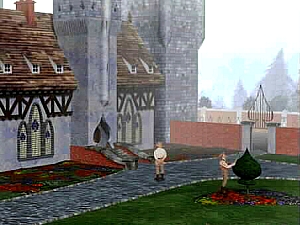 (and still do), but whenever I got hung up, that person was there. It took a while before I realized that the person helping players with the game was a gentleman by the name of Lee Sheldon! Lee, I was blown away – to think that the writer and co-designer was actually out there helping us fledgling adventurers was almost beyond belief. I will never forget the experience as long as I live! I’ve read that you’re one of the nicest, most approachable people in the business, and this proves it. Awesome, Lee! Where did you get the inspiration to hang with us rookies and be the help that you were?
Thanks for those kind words! I was a player before I was a designer, and the exchanging of hints was something we all did on the Gamers Forum. I saw no reason to stop simply because I started making the games.
Cool! Okay, the early days – I’ve read a little bit about your education, background and Hollywood experience. Could you please expand on those years including the shows you wrote for – I’m sure our readers will find your story fascinating.
Heh, they won’t find it very fascinating if I make it as long as it could be! The short version is that I began making my living in Hollywood in 1974. I sold a couple spec film scripts that were never produced, wrote a couple episodes of a Hanna-Barbera cartoon called Clue Club that was meant to follow in the dog tracks of Scooby Doo, but only lasted one season, then broke into primetime writing for Charlie’s Angels. Out of the 200+ scripts I wrote, those which still have resonance for me include scripts for Charlie’s Angels, Nero Wolfe, Cagney & Lacey, Quincy, Simon & Simon, Blacke’s Magic, Tucker’s Witch, Snoops, Star Trek:Next Generation, Father Murphy, and Eight Is Enough.
I mainly wrote mysteries. Even the Eight Is Enough episode was a mystery called The Maltese Airline Bag. One non-mystery was a PBS series I did for, about and featuring children called The Perkins Family. It was 13 episode soap opera for kids. I wrote the storyline based on kids’ input on what storylines they wanted to see, then the young actors (kids played adult characters too) improvised all their dialogue. John Binkley was the man responsible for the unique concept.
I probably learned the most about writing (particularly characters) when I was the Head Writer on the daytime soap Edge of Night for its last two years.
Gotta ask – did you get to meet any of the stars?
I met most of the stars that I worked with. Some of the nicest included Harry Morgan, Tim Matheson, Rock Hudson, Tim Reid, Patrick Stewart, Cheryl Ladd, Jackie Smith and Jonathan Frakes. Jonathan and I worked on two shows together.
How did you go about getting these writing opportunities?
Hmmm… Well, when I was working as a clerk at Samuel French (play publishers) in Hollywood, I used to pester actors when they came in to buy copies of plays. I think I scared Terri Garr, trying to get her to read a screenplay. As the way these things sometime happen, one person finally read a script, passed it on to someone else, and it continued to survive until somebody with money read it and hired me.
Was an agent necessary?
Not in the very beginning (impossible to get one), but after interest was generated in my first script, an agent was essential and much easier to find.
Also, I’ve always wondered just how much “production interface” the writer has with the director or producer. Were you usually on the set, helping to contribute to the story “on the fly”?
It depends on the situation. I was very lucky on Charlie’s Angels. The show’s producers, Ron Austin & Jim Buchanan, took me under their wings and mentored me. Not only was I allowed on the set (almost unheard of as a freelance writer), but I appeared in one episode I wrote called Haunted Angels. I’m the picture the angels hold of a dead young man who may have come back from the grave.
Heh heh! Do you have any “favorite moments”, “uppers or downers” during your “Hollywood years” you’d like to relate to us?
Favorite moments? Singing oldies with Cheryl Ladd in a garage on location at Marion Davies’ house when we were shooting Rosemary for Remembrance. Writing a speech for Harry Morgan soon after his wife had died about his character’s dead wife near the end of a Blacke’s Magic episode. It was a very lyrical passage, almost poetry. Some actors might have shied away from the sentimentality, but Harry gave it all he had, and thanked me for it afterwards. Experimenting with storytelling techniques on Edge of Night, especially in our 1984 story about brainwashing via cable TV. The producers Nick Nicholson and John Valente really let me try some very unusual things! Just one example: Willie Aames played the owner of a disco with a huge video screen. He hired some men to beat up one of our heroes. I showed him in the disco in front of the screen and the actual fight on the screen as it happened instead of intercutting the two scenes. The effect was startling. I also began a new storyline on the last show of Edge of Night where a street disappears. People complained that I never would have been able to explain how it happened. A year later I repeated the mystery in a different story for Blacke’s Magic to provide the answer.
Okay, how did a nice guy like you get…………nah, strike that. How the heck did you get into this zany gaming business? Were you a gamer before you made the transition?
I had played computer games since 1981. I found myself watching TV only if I was up for a particular show. I’d watch it and study it. But I rarely watched for entertainment any longer. I played games for entertainment. It was a natural transition for me.
What was your first gaming project?
The first one to actually get published was It’s a Dog’s Life aka Digby the Dog. I wasn’t the first writer/designer on this kid’s storybook/game, but Shelley Duvall was contractually guaranteed to have sole writing credit. I never met her nor talked with her. But she was a character, and Digby was her dog.
How did you come to join the Sanctuary Woods team in the writing and designing of Master Lu? Who approached whom?
Christmas 1993 saw the release of some “major” CD-ROM games. We discussed them in the Gamers Forum. I was almost alone in criticizing the trivial storylines and cardboard characters. Publicly I got yelled at, but I received several private emails asking me if I wanted to make games: Bob Bates at Legend, Ron Gilbert at Humongous… but Sanctuary Woods’ Matt Gruson was the only person who offered me an inhouse position. So I took it and moved to Victoria, BC in spring of 1994.
For what its worth, Master Lu is one of my favorites. I think the game was on the cutting edge at the time and I think the “storytelling” aspect of the game was the lure for me. How did you get interested in the “Robert Ripley” genre?
Well, thank you! Most of my projects have been inherited from someone else, and Master Lu was no exception. I’d been working on another children’s title, Once Upon a Forest (based on the 20th-Century Fox animated motion picture and my first adventure game), when the lead designer told our producer, François Robillard, that he wasn’t up to the project, and wanted to quit. I took his massive stack of research notes, and wrote a new design with François, using the original story outline as our springboard. François was responsible for many of the best puzzles (including the now infamous Baron’s Lab). I handled story, additional gameplay, dialogue, overall game structure etc. I also directed voice actors, the actors we used to model our walkers, and the short video clips.
How did you get together with Southpeak Interactive? Were you simply welcomed aboard, or were you hired for a specific project? I think I read that you joined Southpeak when Temujin was still in progress. True?
Southpeak was recruiting at GDC in 1996. I joined them in North Carolina after all the 360 degree video for Temujin had been shot. I threw out an unworkable design, rewrote the backstory, then set about the enormous challenge of incorporating gameplay into existing video. Well, at least the game got to a finished enough state where it could be released! All in all a very difficult experience.
I’ve played Temujin five times, I think. Personally, I think it was very underrated by most reviewers. I truly enjoyed it, especially the puzzle solving – triggering FMVs. Most of your games have been FMV, haven’t they? Coincidence, or do you favor FMVs?
I did at the time. And as awkward as it was in some ways, Southpeak’s engine was as close as the technology got to doing it right. I still believe that human beings, not animated figures, are far more adept at capturing a player’s emotions. But the cost and effort to do it right are both very high, and there is such a prejudice against FMV (and rightfully given what we’ve seen!), that I don’t see anybody rushing to invest in it in a big way anytime soon.
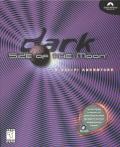 Dark Side of the Moon – a corrupt mining company in outer space, an heir seeking his mineral claims, and a strikingly beautiful black jack dealer (Wow!), who just might not be what she seems. Adventure gaming needs good storytelling and this game had it. Did you present the concept to Southpeak, or did they ask you to develop a story woven with these elements?
Southpeak had a brief “game description” they wanted to try. I think all that remained when Mark Barrett and I were done with it was the setting. I did the first story outline and we hired Mark to write a first draft design document that was mainly a screenplay. The really nice last speech of Jake’s uncle is almost entirely Mark’s work. He’s a very good writer, and one of the few who understands games. I wrote the subsequent drafts, added puzzles and gameplay, and produced the video shoot. I was very pleased with the game overall, and thought the video was professionally acted and directed. The lead actor took some heat from critics and fans for being such a dweeb. I take my share of responsibility for that. I cast him, and thought his voice had a nice “Christian Slater” quality. I wanted him to be an ordinary guy, but he came across way too weak, despite what was a good performance. The actor gave us what we wanted.
I had the opportunity to review this game and was very impressed by the “movie-like”, crystal clear cinematics. It set the standard for its day. How did you guys do this?
Yikes! A technical question! It was very complicated, expensive and time-consuming, since we had to shoot all angles of the 360% image then stitch them all together. Much green screen work, and few physical sets (the shuttle craft was constructed). I think the technique was sound, but computers were still not powerful to handle all that video as smoothly as we might have liked.
Dark Side of the Moon, as originally released, offered multiple CDs. Many reviewers (including myself) reported on the disc swapping requirements (lots, depending on the player’s path through the non-linear story). Soon thereafter, Southpeak released a DVD version of DSOM. Was this decision made solely upon reviewers’ and players’ comments?
Yes, and if you know where I can get my hands on a DVD copy, let me know! I don’t have one! Here is an example where my desire to do a non-linear story (which I think is essential to fit the story to an open game environment where players can choose where they want to go next) fought against the medium. If I’d done a straightforward linear story like most adventure games, the disk swapping would not have been an issue. It was a game that needed to be released on DVD.
Lee, most of our readers are adventure junkies. I give up. Actually I’m mad as hell. What the heck is going on in the American PC game market? Are we “dumbing down”? I woefully wade through the pages of gamer mags and see blood, guts, swords, guns, ad nauseum. I guess these games sell. Publishers are apparently convinced that adventure games won’t sell here. We at JA have thousands of adventure-starved readers. Canada and Europe has seen the lack of foresight of the publishers here and are lining the shelves (albeit lightly) with adventure game titles. However, two or three games produced out of the USA in the past two years have been among the best I’ve ever played. What’s the problem? I assume that adventure games are expensive to produce, and maybe the payoff just isn’t there now. RPGs went through the same drought a few years ago. Do you think there will be a resurgence of interest in intelligent adventure game production soon or not? Is story telling a lost art?
I’m a very bad prophet. I have no idea whether there will be a resurgence of interest, especially since RPGs seem to have become the storytelling genre of choice these days. But story is certainly not lost. It’s just neglected. We still put up with woefully bad stories in games because “they are only games.” When the developers hear the voices of players wanting better storytelling, rather than just storytelling, then we may see brilliant stories in many genres. As for adventure games, I think a MMP adventure game set in an interesting world would be a big hit, if people thought about the needs of multiplayer puzzles, and got away from rehashing solo puzzles. There are no secrets in MMPs. A new paradigm is needed.
Thanks for your insight, Lee. Changing the subject a bit, what have you been doing since leaving Southpeak?
After Southpeak I worked on an MMP called The Gryphon Tapestry that was a true MMP adventure game as well as an RPG (and a storybook!). Unfortunately the company ran out of money as we entered beta. Since then I’ve worked on several MMPs including an MMP version of Myst at Cyan, and a Disney MMP. I give a tutorial at GDC every year on storytelling and game design, and am lecturing at Full Sail. I’m currently writing a mystery novel set in the Florida Keys, and waiting to hear what game project I’ll be working on next. There are a couple of interesting possibilities, but no one has made me an offer yet.
I understand you host a website entitled www.anti-linearlogic.com. I give up – I’m not a rocket scientist. What the heck is “anti-linearlogic”?
I strongly believe that storytelling in games should be non-linear to match how people play. There is a perfectly valid logic and techniques that can be applied to achieve this. If you want to learn more, come to one of my talks!
Will do! Hey, I understand you’ve recently published a book. Could you please tell us about your inspiration for the book and what its about?
It’s a comic mystery novel called Impossible Bliss (You can order it from Barnes & Noble, Amazon, etc.!). I’m pleased to report that it received some excellent reviews, and we have a couple European publishers inquiring about international rights. It’s an impossible crime set in Carmel, California, and involves the disappearance of a golfer from a sand trap. My favorite mystery writer is John Dickson Carr, and one of the reviewers did me the honor of comparing it favorably to Carr’s work.
Excellent! So what’s on your menu of anticipated projects, and what will it take to get you back into the adventure gaming business? Want to come full circle? One of our staff writers asked me to ask you if there’d be any chance of you’re authoring a Cagney and Lacey or Master Lu II PC adventure game. Sure sounds like a great idea to me!
Hehe. Well, I did quite a bit of work on a sequel to Master Lu called Ripley’s Believe it or Not!: The Siberian Cipher. The Ripley people own the rights, but if there were enough interest… who knows? What I’d really like to do is a MMP mystery adventure/RPG hybrid. Maybe some day!
Lee, thank you so very much for your time. Congratulations on your distinguished career and very best wishes for the future!
Well thanks, Robert! Happy adventuring!