Syberia Review — Part 1
|
Review Developer: Microids |
 Walkthrough |
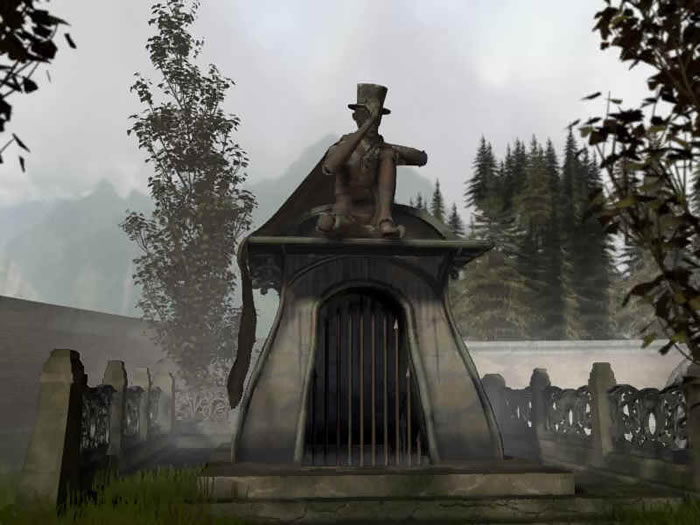
You’re standing on a small hill outside a quaint French village. You hear a funeral dirge. You glance toward the music and you see coming over the hill . . .a robot? A puppet? An automaton? Whatever it is, it’s not human, though it’s tapping out a doleful beat on a drum. Following it is an entire funeral procession made up of mechanical mourners. The opening cinematic of Syberia is one of the most haunting I’ve ever seen in an adventure game, and it immediately sparks your interest in the game world.
Syberia is visionary author and artistic director Benoït Sokal’s wildly ambitious follow-up to Amerzone. However, the biggest mistake a player could make going into this game is to expect an experience similar to the one enjoyed in Amerzone. Whereas the earlier game was an intriguing, whimsical romp with a bunch of outlandish and beautiful creatures (I’ll never forget my ride on the water giraffes!), Syberia is an intense, dark character study. To make a musical analogy, if Amerzone is Grofe’s Grand Canyon Suite, Syberia is Beethoven’s Fifth Symphony.
In fact, the entire story of the game is drenched in a sense of sorrow and regret. The melancholy feeling of the game is expressed in everything from the lighting of the scenes down to the very geography of the locations. For example, there’s a sequence late in the game that is set in a faded resort on what used to be the shore of the Aral Sea. The buildings now sit, crumbling and dusty, as the doomed lake recedes farther and farther into nothingness. Syberia is actually the saddest adventure game I can remember playing since the brilliant Azrael’s Tear. This is not a complaint.
Not only is the tone of the game a departure from what has come before, so is the format. This is a third person adventure, a la The Longest Journey, rather than the first person Amerzone. It’s also a significantly longer and altogether more ambitious game than Amerzone.
After the haunting beginning, the first thing the player notices about the game is that it is flat-out, fall-down-on-the-floor beautiful. [art department names] I’ll say right now that Syberia ranks with The Longest Journey, Nightlong, The Feeble Files and Discworld Noir as one of the most beautiful 3rd-person adventures I’ve ever seen. More on the game’s visual elements later.
In the story you play a young American attorney who’s come to the village to complete the sale of the local toy factory to a huge American conglomerate. It seems her timing is bad, however, because the person whose signatures she needs was the person being buried in the opening scene.
The rest of the story involves our heroine searching for a missing heir to the business – the dead woman’s brain-damaged brother Hans, previously presumed dead. He’s a very curious character indeed: possibly a genius, certainly an eccentric and talented tinkerer in all things mechanical. The specialty of the family factory were fantastic mechanical automatons, but this missing heir’s interest in all things mechanical goes far beyond mere wind-up toys.
The bulk of the game is spent getting to know this mysterious missing person, mostly from other people (and creations) who have known him, as well as the contraptions he’s left behind. But he’s just one of a host of people you’ll meet on this strange journey. Syberia consists of a parade of sad, colorful misfits who are fascinating to get to know.
Though the story begins in France and continues on into Germany, Russia and beyond, the game really takes place in its own distinct world. There’s a sense of disorientation to the proceedings that makes the ambience of the game even richer.
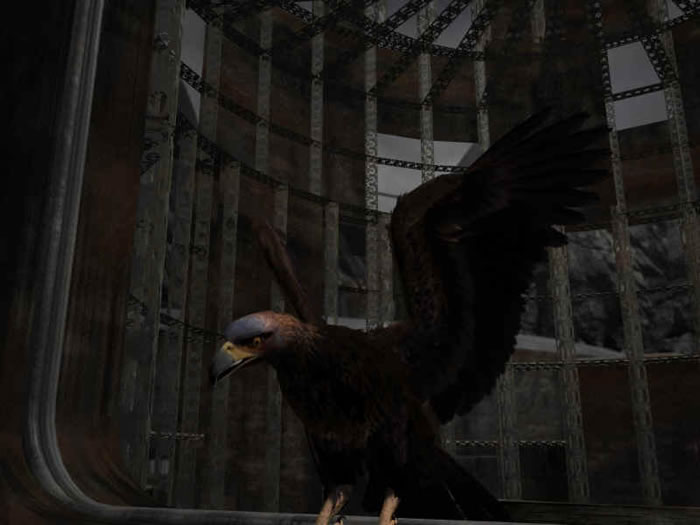
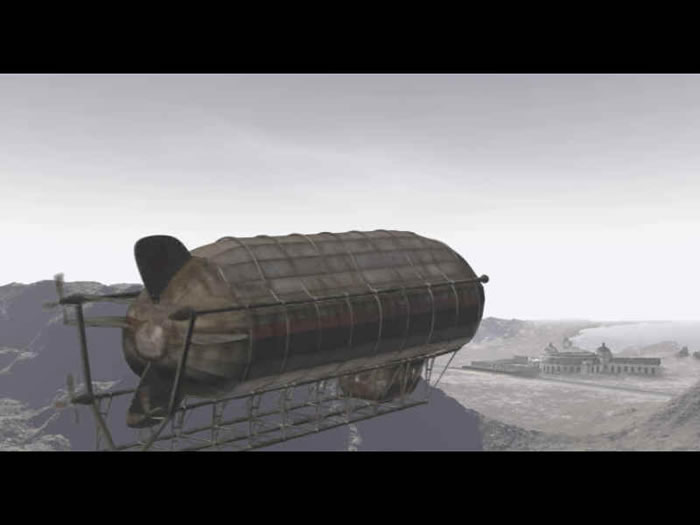
Let’s get back to the game’s visuals. As said before, this game is seriously good-looking, and the charms of the visual design are one of the chief pleasures of the game. The game uses a lovely palette which is quite easy on the eyes. The cut scenes have such cinematic flair that, should I hear that this team had made an animated feature film, I would rush out to see it. There are very nice uses of motion-capture throughout (mostly with the main character, but with others as well). The single weak point in the graphics is the fact that the ambient character shadows are pretty oversimplified (just gray ovals, no matter what the lighting angle). The game just has loads of visual style to spare – even the Options screen is a feast of eye candy. I could list specific examples of the game’s visual treats, but I don’t want to ruin their discovery for you.
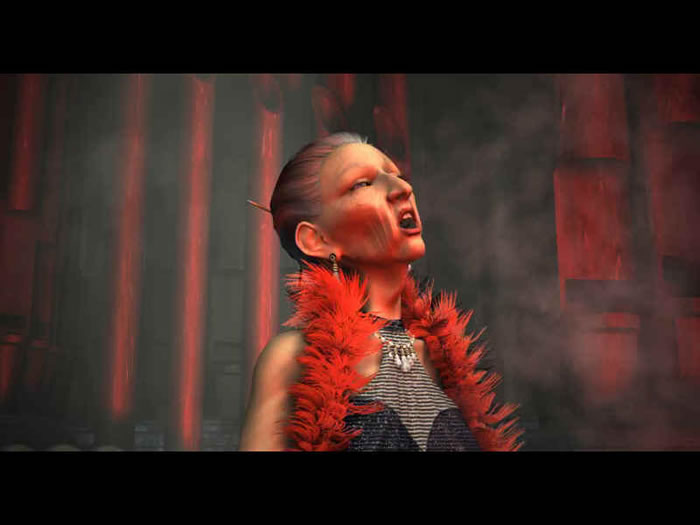
The camera angles are fluid and appropriate, and there’s even some nice left-right scrolling on some of the “sets” – this is a feature I wish was much more common in third-person adventure games. It’s a very effective technique of reinforcing the “reality” of the location.
The beautiful score by Dimitri Bodiansky and Nick Varley adds greatly to the game’s dark, silky atmosphere.
All is not perfect in the land of Syberia, however. The localization of the game is pretty weak, with shaky grammar and some very sub-professional voice work. This problem mostly rears its head on the telephone. It’s one of the features of the game that your character has some of her most important character interactions while talking on her cel phone. A couple of these characters are not only badly performed, but very badly written. There’s a plot arc involving the character’s boyfriend that’s so telegraphed and ham-fisted it loses any dramatic impact. A little bit of subtlety would have gone a long way here.
On the other hand, most of the other voice work in the game is perfectly acceptable.
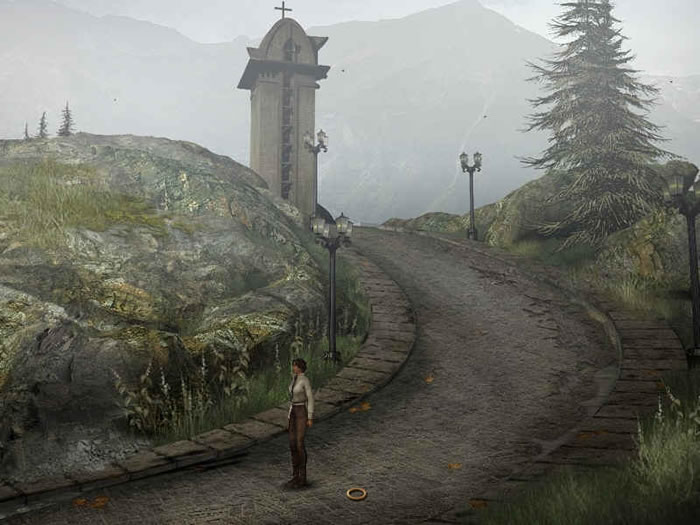
The puzzles are pretty good, but as in most third-person games, require very careful scrutinizing of the screen. Many puzzles also depend on careful attention being paid to the many conversations you’ll have with the game’s colorful characters. In other words, that wacky story someone may have told you on the phone twelve hours ago may suddenly become relevant twelve game hours from now. Since many of the puzzles won’t yield to anything but the most persistent probing, there’s lots of “to-ing and fro-ing” around the game’s lovely environments. It’s a good thing they’re beautiful, because you’re going to see a LOT of them.
The worst thing I can say about the puzzles is that there are FAR too many that depend on finding keys. Plus, you may get very sick of hearing your alter-ego chirp merrily, “No need to go down there!” when you’re trying to explore some new area sooner than she wants you to. It became almost as annoying as the refrain of “You must gather your party before venturing forth,” in the Baldur’s Gate games.
However, these are small concerns. Syberia provides a huge dose of what adventure gamers are hungry for: a rich story, complicated characters, tons of puzzles and exploration of a series of beautiful and intriguing environments. From its eerie, haunting beginning to its bittersweet, challenging conclusion, the game serves up a heady experience I don’t think you’ll soon forget.
Final Grade: A
System Requirements:
Windows 95/98/ME/2000/XP
Pentium II 550 MHz
64 Mb RAM
3D graphic Card – 16Mb