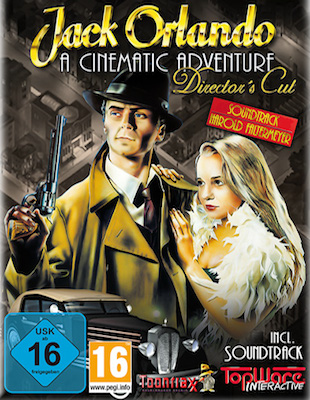
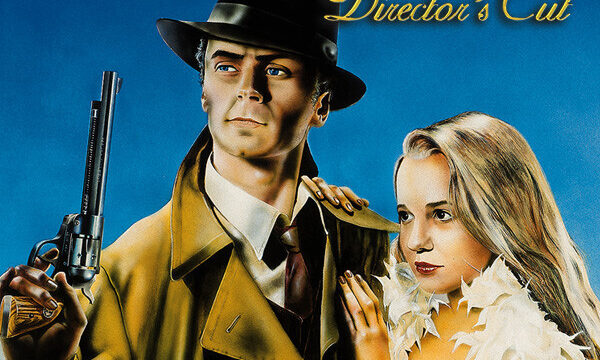
Jack Orlando Directors Cut
|
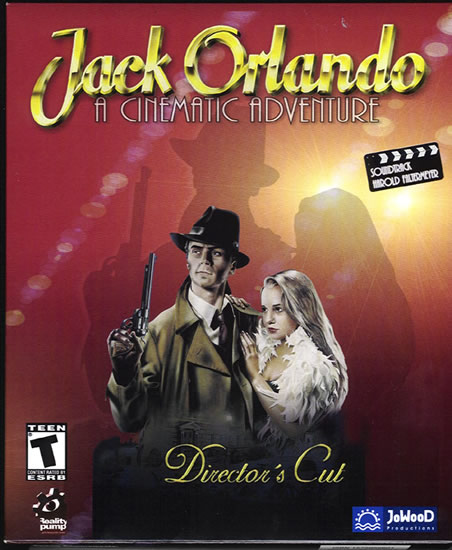
Jack Orlando Director’s Cut Developer: Reality Pump |
 |
Back in the ‘good old days’ when Just Adventure was in its infancy, we would review adventure games by categories: plot, puzzles, graphics and so on. This was done for a reason for back in the early days of multimedia games one never knew what to expect. For example, while a game’s plot might be excellent, the music was often tinny or, as was usually the case, the actor’s lines might sound as though they were voiced by relatives of the game’s developers (and they often were!). Nowadays, games are so technically advanced that it is the exception rather than the rule to find a game with subpar music or voice-acting.
As Jack Orlando was initially released in 1996, we have decided to subject it to our old rigorous system of grading. The original product was not available in the United States (a harbinger of the future of adventure games perhaps?) and could only be obtained by trading or purchasing it from a European friend on the Internet. Yet, even if you were lucky enough to obtain a copy, another problem then surfaced as it was damn near impossible to get the game to run even after tweaking dos for hours on end. Bottom line: very few American adventure gamers ever played Jack Orlando.
Now, five years later, Jack Orlando: The Director’s Cut (JOTDC) has been re-released. As any movie buff is aware of, a director’s cut is when a movie is reissued with scenes that were originally omitted from film’s initial release. Which begs the following question: what has been added to JOTDC? The simple answer is –
who knows? The back of the box makes no mention other than to mention the game’s features. The manual (included on the cd) goes only a little further as it describes how “experienced art cartoonists designed every scene, using the air-brush technique to scan, touch-up, and blend in the hand-drawn foreground animation.” But what exactly was added to the game? New puzzles? New music? New artwork? What? Was anything added that was supposed to be in the original and if so why was it originally omitted? Give us a clue here. It would have been interesting to know how the game was altered and why the developers thought it improved upon the original product. Instead, we have been left in the dark.
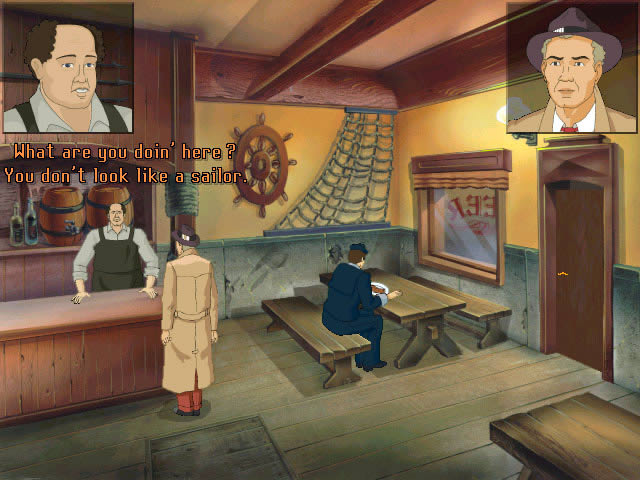
The year is 1933 and Prohibition has come to an end. Unfortunately for Jack Orlando, his drinking problem continues. This once famous private eye who was once the toast of the town is now dependent on the bottle to get through the day and just when it seems life can not get any worse, it does. Jack inadvertently stumbles upon a murder only to find himself bushwhacked. When he awakens hours later, it is next to a dead body and
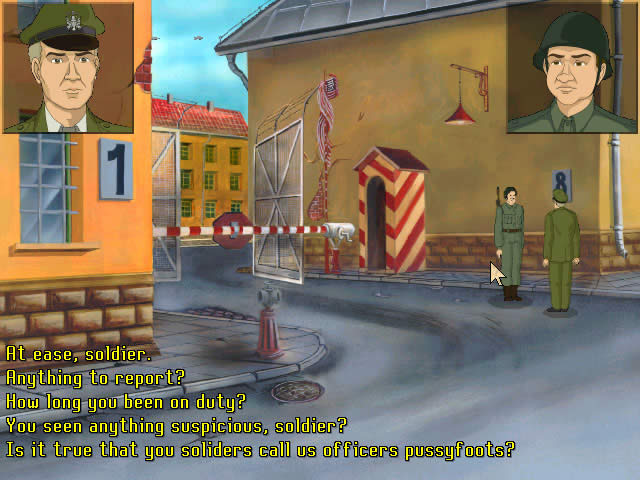
Jack now has only 48 hours to prove his innocence. Speakeasies, casinos and a distillery dot a post-depression landscape as do prostitutes, crap dealers and dockworkers. So far so good as the first 75% of the game resembles a suspenseful detective novel as clues lead to suspects and suspects lead to the guilty party. Then unexpectedly an abandoned building shields a sinister gothic hideout replete with skulls and gargoyles that seems to server no purpose other than to provide a puzzle solution for an ancient manuscript. Worse yet is that somewhere along the last quarter the game falls apart as it veers into an unexpected direction and we find ourselves at a military base tracking a truck that has delivered weapons to some unnamed foreign entity. How and why this happens was never made sufficiently clear, but it did serve to destroy what had been a well-constructed detective scenario. Jack Orlando plot – C-.
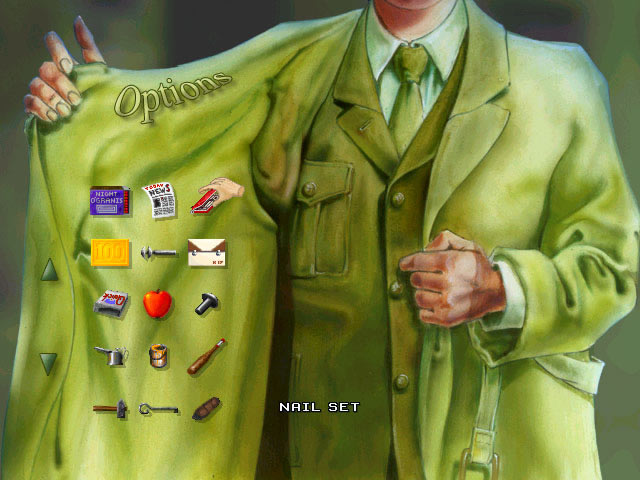
As is common in a 2D point-and-click adventure, there is frequent pixel hunting and the obligatory agenda of
if-it-ain’t-nailed-down add it to your inventory. In a nice touch, Jack’s inventory items are accessed from inside his trenchcoat. The majority of the puzzles can be categorized as the try-everything-in-your-inventory-till-something-works variety but inventory items do remain true to the game’s time period – cigar butts, casino chips, bottles of cheap gin and so on. Yet, in an oversight that should have been corrected in the Director’s Cut, there is one puzzle which, if solved out-of-order, could possibly prohibit the player from finishing the game! While I personally did not undergo this misfortune, our good friend Mr. Bill of Mr. Bill’s Adventureland did:
“… there is a potential dead end in the new version of the game which can cause a person to have to repeat things (maybe even the entire game to that point if they only have one saved game), especially if they are the kind of player who doesn’t save often under different names. But despite this potential problem, we still love the game.
The potential dead end occurs if the player allows Bellinger to be killed before giving the vase to the flower lady and receiving the manuscript in return. Because after Bellinger is killed, the flower lady disappears, never to return. As a result, the guard never appears at the Casino entrance and so you can’t ever enter the Casino.”
Yikes! While I would find such an oversight to be inexcusable in any adventure game, it is inexplicable that it should exist in a game that has been remade. Jack Orlando puzzles – C-.
As with the puzzles and plot, JOTDC‘s music and voice-acting are also a very strange mixed bag. The music for the gritty prohibition street scenes recreates the jazzy air of this period. A barroom torch song is particularly wonderful and bluesy. But again, when we switch to the military base, what should be suspenseful end-of-game refrains are instead light and frothy and totally incongruous. The voice-acting follows the same uneven pattern. While most of the male voices are passable, with Jack being the best, the female voices are simply atrocious. It at times sounds as though men are imitating women’s voices. Shakespeare this ain’t! Music and voice-acting – C-.
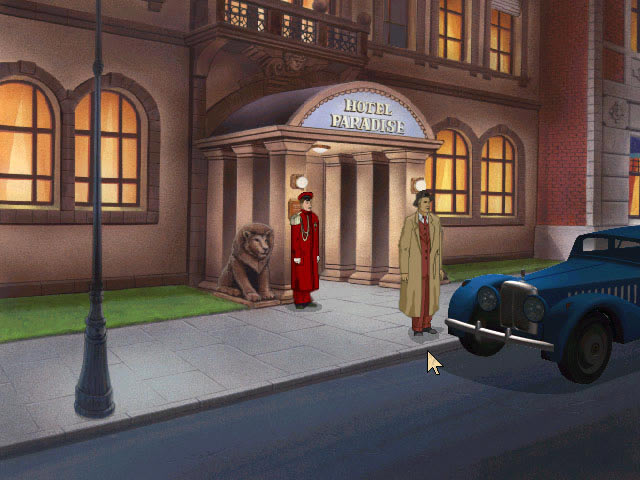
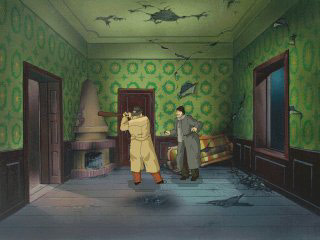
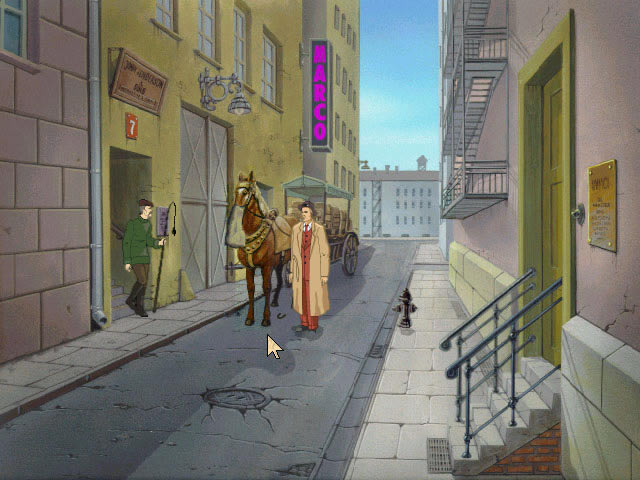
For a game that has hand-drawn animated 2D graphics featuring 65,000 colors, light sourcing and over 100 characters in more than 200 different scenes Jack Orlando suffers from The Road to India syndrome. Streets are eerily empty. Traffic is non-existent. When an automobile or pedestrian does appear, we notice more because the emptiness of the atmosphere has been shattered. Characters though are large and detailed and there is a crispness and vibrancy to the animation. While the graphics are easily the highlight of the game, they are still not enough to salvage an overall below average product. Graphics – C.
As to my original question regarding the differences between the two versions of Jack Orlando, we leave it up to our good friend Mr. Bill to finally shed some light on this mystery:
There is only one Jack Orlando game, but two versions:
1. The Original 96-97 release:
This version may be difficult to get to play on the newer computers because of its need for an older VESA driver (for video card). We also had difficulty getting the sound to work well for us.
2. The Director’s Cut 2001 release:
This version ran beautifully for us under Win 98 and the music was the way it was meant to be heard. Absolutely great music. Runs under both Win 95 and Win 98 requiring DirectX 8.0. A new section was added to this version with several new rooms, new inventory items were added and some old red-herring type inventory items (of which there are many) now became significant.
Why did not the developers provide this information somewhere in the documentation? Another mystery for the next remake.
A walkthrough for Jack Orlando: The Director’s Cut can be found at http://www.mrbillsadventureland.com/walkthrus/jackorlandoW/jackorlandodcnW.htm. Our thanks to Mr. Bill for his kind assistance with this review.
Final Grade for Jack Orlando: The Director’s Cut: C-
If you liked Jack Orlando: The Director’s Cut then
Read: Any Mickey Spillane or Dashiel Hammet novel
Watch: Any Bogart movie
Play: Any of the Tex Murphy games
System Requirements:
Windows 95/95/ME/2000
Pentium 200 MHz or higher
32MB RAM
4MB Graphics Card
16-bit Sound Card
10x CD-ROM
DirectX 8.0